
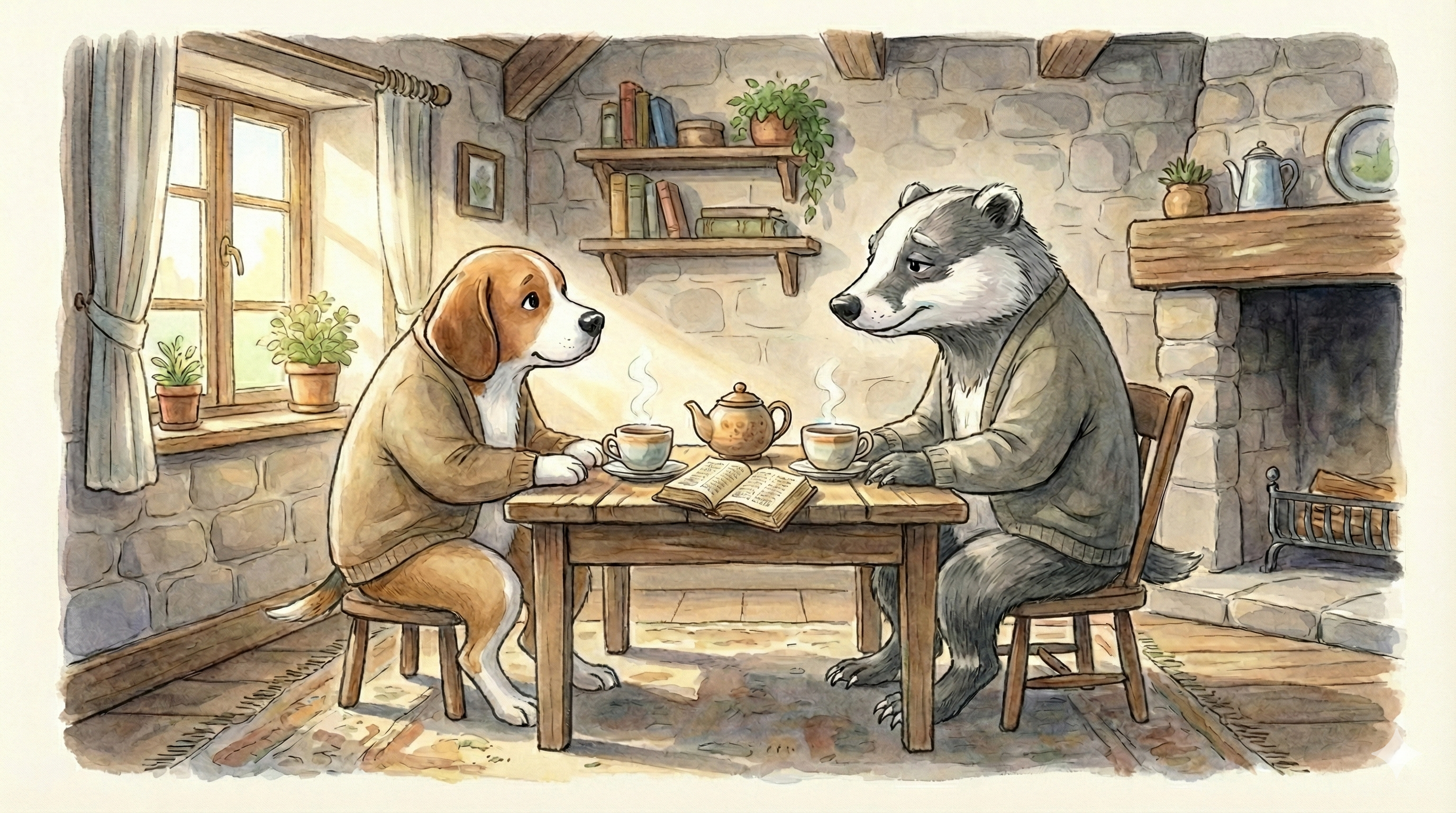
A Beagle’s Morning
The first light of morning crept through the round entrance of Stanley’s burrow, painting soft shapes on the plastered walls. The beagle stirred on his sleeping mat, blinking awake as the cool air touched his nose. He stretched slowly, his sturdy body extending along the mat before he relaxed again with a contented sigh.
Stanley lay still for a moment, listening. The world was waking up around him: birds beginning their morning songs, the rustle of leaves in the early breeze, the distant sound of water running somewhere in the valley below. He loved these quiet moments before the day fully began, when everything was still settling into itself.
He rose from his mat and shook himself, his floppy ears swaying with the motion. His burrow was simple but comfortable: a main room with his sleeping area, a small nook for storing food and supplies, and an alcove near the entrance where he kept a water basin and clean cloths. The walls were smooth plaster over stone and timber framing, keeping the space dry and secure against the elements. Abe had helped him with the construction last spring, ensuring proper drainage and ventilation. A few shelves held jars of preserves, dried herbs, and a small collection of smooth stones he’d found on walks over the years.
Stanley padded to the alcove and poured fresh water from the clay pitcher into a glass. He drank deeply, then wet a clean cloth and used it to wash his face and hands. Simple morning routines had their own quiet dignity. Small acts of care that prepared you for the day ahead.
He knelt on his mat, his front paws together, head bowed.
“Father,” he prayed quietly, “thank You for rest. Thank You for this new day and for the breath in my lungs. I don’t know who will need a listening ear today, but You do. Help me be present. Help me listen well. Give me patience and compassion. Let me point others to You, not to myself. Guide my steps and my words. Amen.”
Stanley stood and stretched again, working out the last bits of sleep from his muscles. He was built for endurance, not speed. His sturdy frame and strong legs meant he could walk for hours without tiring, which was useful for his daily rounds through the valley. Beagles were meant to move, to explore, to follow their noses and their curiosity. But God had given Stanley a different calling alongside that natural energy: the ability to slow down, to sit still, to be fully present with someone who was hurting.
For breakfast, Stanley ate simply: dried meat from Anvil’s smokehouse, a piece of cheese from Rosemary’s shop, and a few wild strawberries he’d gathered yesterday from the patch near the meadow. He poured himself water from the clay pitcher and drank deeply. As he ate, he thought through his day.
Tuesdays were good for visiting. Most folks were past the Monday push of getting the week started but not yet caught up in the end-of-week rush. He’d check on Mr. Davis first. The badger had seemed particularly quiet lately, and Stanley knew that grief had its own rhythms. Sometimes the hardest days came weeks or months after the initial loss, when everyone else had moved on but the grieving person was still walking through the valley. Then perhaps swing by the meadow to see if any of the younger animals were playing there. And he should definitely stop by Maple’s burrow: festival planning had her wound tight as a spring.
Stanley tidied his sleeping area, folding his blanket and straightening the mat. He swept the floor with a small broom made of bundled twigs, pushing dust and debris out the entrance. A clean space was a peaceful space, and peace was something Stanley valued deeply. How could you be present for others if your own home was chaos?
With his burrow in order, Stanley stepped outside into the morning sun. The hillside spread below him, green and alive. The valley stretched out in all its beauty: the meadow, the woods, the creek winding silver through the landscape, the scattered homes of his neighbors. Stanley breathed deeply, filling his lungs with the good clean air.
“What a gift,” he said aloud to no one in particular. “What a gift You’ve given us, Lord.”
He set off down the hillside path, his nose working automatically. Beagles couldn’t help but notice smells; it was how God had made them. Rosemary’s bread baking. The sweetness of wild roses near the forest edge. The earthy smell of the creek. The faint metallic tang from Anvil’s forge, already working this early in the day. Each scent told a story about the valley waking up and getting to work.
Mr. Davis
Stanley’s first stop was Mr. Davis’s small cottage near the creek. The badger had lost his wife nearly a year ago, and though he’d shown remarkable strength through the initial months of grief, Stanley had learned that sorrow didn’t follow neat timelines. Sometimes the weight came in waves, hitting hardest when you least expected it.
He scratched gently at the door.
There was a long pause, then shuffling footsteps. The door opened to reveal Mr. Davis, his gray and white fur slightly unkempt, his eyes tired.
“Stanley,” the badger said, managing a small smile. “Good morning.”
“Good morning, Mr. Davis,” Stanley said warmly. “I was taking a walk and thought I’d check in. May I come in for a moment?”
“Of course, of course.” Mr. Davis stepped back, ushering Stanley inside.
The cottage was tidy but had the feel of a place maintained by duty rather than joy. Everything was clean and in its place, but there was a heaviness in the air: an absence that couldn’t be organized away.
“Have you had breakfast?” Stanley asked gently.
“Some porridge,” Mr. Davis said, gesturing vaguely toward the small pot on his stove. “I’m managing.”
Stanley settled himself in the chair across from the badger. “How are you really doing?”
Mr. Davis was quiet for a long moment. Then his shoulders sagged slightly. “Some days are harder than others. Yesterday was… particularly difficult. It would have been our anniversary. Thirty-two years.”
“I’m sorry,” Stanley said simply. “That’s a hard day to bear alone.”
“I thought I was past the worst of it,” Mr. Davis continued, his voice thick. “But then these dates come up, or I’ll see something she would have loved, or I’ll turn to tell her something and remember…” He trailed off, looking away. “I feel foolish. It’s been almost a year. Shouldn’t I be better by now?”
Stanley leaned forward in his chair. “Grief doesn’t work on a schedule, Mr. Davis. There’s no ‘should’ about it. You loved your wife deeply for over three decades. That kind of love doesn’t just disappear because time passes. The sorrow is the other side of the gift—it shows how real and good what you had was.”
Mr. Davis’s eyes grew damp. “Sometimes I wonder if I’m honoring her memory properly. If I should be doing more, or doing less. If I’m grieving too much or not enough. If God is disappointed that I’m still struggling.”
“Can I tell you what I think?” Stanley asked.
The badger nodded.
“I think the Lord sees your tears and counts them precious. I think He knows every anniversary, every memory, every moment when the loss feels fresh again. And I don’t think He’s disappointed. I think He’s compassionate. Jesus wept at Lazarus’s tomb, even though He knew He was about to raise him. Grief isn’t a failure of faith. It’s the price we pay for love.”
Mr. Davis wiped his eyes with the back of his paw. “Thank you for saying that. I needed to hear it.”
They sat together for a while in companionable silence. Stanley didn’t try to fill the quiet with platitudes or rush the badger toward feeling better. Sometimes the most loving thing you could do was simply be present in the sorrow, not trying to fix it or hurry past it.
After a time, Stanley said quietly, “Would it help to talk about her? Sometimes remembering the good is its own kind of comfort.”
Mr. Davis’s expression softened. “She loved this time of year. Late spring, when everything was blooming. She used to say that the valley in springtime was proof of God’s lavish generosity: that He could have made everything gray and green, but instead He gave us a hundred different flowers.”
“That sounds like wisdom,” Stanley said.
“She was full of it,” Mr. Davis said, a genuine smile breaking through his sorrow. “Practical wisdom, the kind that came from walking with the Lord for decades. She could see His hand in the smallest things.”
They talked for a while longer, Mr. Davis sharing memories, Stanley listening attentively. When Stanley finally rose to leave, the badger’s eyes were clearer, his shoulders a bit lighter.
“Thank you for stopping by,” Mr. Davis said. “It helps, having someone who doesn’t expect me to be ‘over it’ yet.”
“You’re allowed to grieve as long as you need,” Stanley assured him. “And I’ll keep checking on you. You don’t have to walk through this alone.”
“Would you… before you go, would you pray with me?”
Stanley bowed his head. “Heavenly Father, thank You for Mr. Davis and for the years You gave him with his wife. Thank You that love is real and deep, even when it costs us grief. Be near to him in his sorrow. Remind him that You collect his tears, that You know every ache of his heart. Give him Your comfort, Your presence, Your peace. Help him trust that this season won’t last forever, but that for now, You’re walking through it with him. We ask this in Jesus’ name, amen.”
“Amen,” Mr. Davis whispered.
Stanley left the cottage and continued his rounds. The morning sun was warming the valley now, burning off the last wisps of dew. He made his way toward the meadow, where the sound of young voices carried on the breeze.
The Meadow and Maple
He found a group of younger animals playing near the edge of the field: several field mice, a pair of young rabbits, and a fox kit who was learning to keep up with the others. They were playing a game that seemed to involve a lot of running and laughing, the rules of which Stanley couldn’t quite follow but which appeared to bring immense joy.
Stanley sat at the edge of the meadow, watching with a smile. One of the rabbits noticed him and hopped over.
“Hi, Stanley! Want to play chase with us?”
Stanley chuckled. “Not today, friend. But I’m happy to watch. You’re all getting so fast.”
The young rabbit beamed with pride and bounded back to his playmates. Stanley stayed for a while, a calm presence at the edge of their energy. Sometimes young ones just needed to know an adult was there, paying attention, caring that they existed. Not directing or correcting, just… present.
When the players eventually scattered toward their homes for midday meals, Stanley headed toward the village center. He could see Maple’s burrow from here, and sure enough, there was the badger herself, pacing outside her entrance with papers clutched in her paws.
“—and if the decorations arrive late, do we postpone the opening ceremony? But then the whole schedule shifts, and people have made plans, and Elder Thomas is traveling from the neighboring valley specifically for Sunday morning, and what if he gets here and we’re all confused because—”
“Maple,” Stanley called gently.
The badger whirled around, papers scattering. “Oh! Stanley! I didn’t see you there. I was just—there’s so much to—the festival is Saturday and—”
Stanley walked closer and sat down, his calm presence a counterweight to her frantic energy. “Breathe,” he said quietly. “Just breathe for a moment.”
Maple stopped, blinking at him. Then she took a deep breath, held it, and let it out slowly.
“Good,” Stanley said. “Now, let’s talk. What’s really bothering you?”
Maple sank down beside her scattered papers. “I want everything to be perfect. The Grace Light Festival is so important: it’s about celebrating God’s goodness, and I want it to honor Him properly. But there are so many details, and what if I miss something? What if I mess it up and people don’t experience the joy they should? What if—”
“Maple,” Stanley interrupted gently, “can I ask you something?”
“Of course.”
“Do you think God’s goodness depends on whether the decorations arrive on time?”
Maple blinked. “Well… no. Obviously not.”
“Do you think people’s gratitude for God’s grace is going to be ruined by an imperfect schedule?”
“When you say it like that, it sounds silly,” Maple admitted, her ears drooping slightly.
“It’s not silly,” Stanley said kindly. “You care deeply. That’s beautiful. But you’re carrying a burden that’s too heavy. You’re acting like you have to create the festival’s joy, when really, the joy is already there. God is already good. People are already grateful. Your job isn’t to manufacture perfection—it’s just to create space for celebration to happen.”
Maple’s eyes filled with tears. “But what if I fail?”
“Then you fail,” Stanley said simply. “And the Lord is still good. And people will still celebrate. And your friends will still love you. Maple, you’re trying to earn something you already have. God doesn’t love you more when things go perfectly. He just loves you.”
The badger wiped her eyes with the back of her paw. “I know that. In my head, I know that. But my heart keeps forgetting.”
“Hearts are forgetful,” Stanley agreed. “That’s why we remind each other.” He moved closer, sitting beside her. “Can I pray with you?”
“Please,” Maple whispered.
Stanley bowed his head. “Father, thank You for Maple. Thank You for her faithful service, for the way she cares so deeply about honoring You. Help her remember that You’re not a demanding taskmaster looking for perfection, but a loving Father who delights in her efforts. Lift this burden of fear from her shoulders. Remind her that You’re sovereign over the festival: over the weather, over the schedule, over people’s hearts. Help her trust You with the details and find joy in the planning instead of anxiety. Let her rest in Your grace. In Jesus’ name, amen.”
“Amen,” Maple said softly. She sat for a moment, then looked at Stanley with red-rimmed but clearer eyes. “Thank you. I needed that.”
“You’re welcome,” Stanley said. “And Maple? You’re doing a good job. Really. The festival will be wonderful because people love gathering together to praise God. That’s what makes it wonderful: not perfect execution.”
Maple managed a small smile. “You’re right. I’ll try to remember that.” She looked at the papers scattered around her. “I should probably get back to work. But… less frantically this time.”
“That sounds wise,” Stanley said, standing. “I’ll see you at the festival, if not before.”
As he walked away, he heard Maple humming. A good sign. Sometimes the best help you could give someone wasn’t solving their problems, but helping them remember what was true.
Lunch at Mrs. Winters’
Stanley’s stomach rumbled, reminding him that breakfast had been hours ago. The sun was high now, well past midday, and he realized he’d worked right through lunch time. He turned toward the village center, thinking he might stop by Rosemary’s bakery for a quick bite.
As he passed Mrs. Winters’ cottage, he saw the sheep outside, hanging washing on a line strung between two posts. Her snow-white wool gleamed in the sunlight, and she moved with the steady, unhurried efficiency of someone who’d been managing a household for decades.
“Stanley!” she called out, looking up from her work. “What perfect timing. Have you eaten lunch yet?”
“Not yet, Mrs. Winters,” Stanley admitted. “I got caught up in conversations and—”
“Say no more,” she said, waving him toward her gate. “Come in, come in. I was just about to sit down myself, and there’s plenty. You can’t go around caring for everyone else if you don’t care for yourself.”
Stanley followed her inside to a cozy kitchen that smelled of fresh bread and herbs. Mrs. Winters moved with practiced ease, setting out cold roast chicken, cheese, fresh bread, and a jar of pickled vegetables.
“Sit, sit,” she said, gesturing to a chair at her table. “I was just about to have some myself.”
They settled together, and Mrs. Winters said a brief grace before they began eating. Stanley discovered he was hungrier than he’d realized, and the simple food tasted wonderful.
“I saw you talking with Maple earlier,” Mrs. Winters said, cutting another slice of bread. “Festival planning getting to her?”
“A bit,” Stanley admitted. “She’s carrying the weight of making everything perfect.”
Mrs. Winters nodded knowingly. “That girl has always been like that. Heart in the right place, but ties herself in knots trying to control things only the Lord can control.” She paused, buttering her bread. “I’ve been praying for her. She needs to learn to trust more and worry less.”
“You’re good at that,” Stanley observed. “Trusting, I mean.”
“Not always,” Mrs. Winters said with a slight smile. “I’ve had my share of anxious seasons. But I’ve also lived long enough to see the Lord’s faithfulness over and over. That builds trust, eventually. When you’ve watched Him provide through lean years and hard times, you start to believe He’ll keep doing it.”
Stanley took a drink of water. “Mrs. Thompson was telling me you’ve been patient with her questions.”
“Ah, yes.” Mrs. Winters’ expression softened. “Poor dear. Seventy-three years she sat in meetings, and never once heard the gospel clearly. Makes you wonder what we’re doing wrong in our teaching that someone can attend that long and miss the whole point.”
“But she heard it eventually,” Stanley said. “That’s what matters.”
“It is,” Mrs. Winters agreed. “And she’s hungry now: asking good questions, reading Scripture, trying to understand. That’s a beautiful thing to see. Reminds me that it’s never too late, that the Lord can reach anyone at any time.” She paused. “I’ve been introducing her to some of the other women in the village. She needs friends, people who can walk alongside her in this new life.”
Stanley smiled. “That’s good of you.”
“It’s just what we do, isn’t it?” Mrs. Winters said matter-of-factly. “The Lord gives us community for a reason. We’re meant to help each other along.”
They ate in comfortable silence for a moment, then Mrs. Winters said, “How’s Mr. Davis doing? I’ve been meaning to visit, but I wasn’t sure if he was ready for company yet.”
Stanley considered how much to share. “He’s struggling. Yesterday was his anniversary: thirty-two years. Those milestone days are hard.”
Mrs. Winters nodded slowly. “They are. I remember when I lost my Harold. It was the little dates that got me. Our anniversary. His birthday. The day we first met.” She was quiet for a moment. “But the Lord was faithful then, and He’ll be faithful to Mr. Davis now. Grief is a long valley to walk through, but you don’t walk it alone.”
“That’s what I try to remind people,” Stanley said.
“And you’re good at it,” Mrs. Winters said warmly. “You have a gift for being present with people in their pain. That’s rare, Stanley. Most folks want to fix things or hurry past the hard parts. But you sit with people. That’s a real kindness.”
Stanley felt his ears warm slightly at the praise. “I just… it’s what I can offer.”
“It’s what you’re called to offer,” Mrs. Winters corrected gently. “And you do it faithfully. The Lord will honor that.”
They finished their meal, and Stanley helped clear the dishes despite Mrs. Winters’ protests that he was a guest. “You fed me,” he said simply. “I can at least help clean up.”
As Stanley prepared to leave, Mrs. Winters walked him to the door. “Thank you for stopping by, Stanley. It’s good to have a meal with a friend.”
“Thank you for feeding me,” Stanley said. “And for the wisdom.”
Mrs. Winters chuckled. “Just the ramblings of an old sheep who’s been around long enough to see a few things.”
“Wise ramblings,” Stanley said with a smile.
Stickles at the Creek
The afternoon sun was warm as Stanley made his way toward the creek. He wasn’t in a hurry. There was something deeply right about moving through the day at a measured pace, being available for whatever (or whoever) the Lord might put in his path.
He found Stickles near the water, sitting very still on a sun-warmed rock. The porcupine’s quills gleamed like pins in the light, and his eyes were fixed on something in the shallow water near the bank.
“Hello, Stickles,” Stanley said quietly, not wanting to startle him.
“Shh,” Stickles said, not looking away from the water. “Come see. Very slowly.”
Stanley eased forward until he was beside the rock, then looked where Stickles was looking. There, in the clear shallow water, was a tiny fish—barely longer than Stanley’s paw. It was perfectly still except for the gentle movement of its fins.
“Beautiful,” Stanley whispered.
“See how the light catches its scales?” Stickles said softly. “Like little mirrors. I’ve been watching it for almost half an hour. It keeps doing the same circuit: around that stone, through those reeds, back to this spot. Very precise. Very purposeful.”
Stanley watched with him for a few minutes, appreciating the small wonder of a fish being exactly what God had made it to be.
“Thank you for sharing this,” Stanley said eventually.
Stickles nodded. “It helps, sometimes. Watching something small and perfect. Reminds me that God cares about details. That nothing is too small for His attention.”
“That’s a good truth to remember,” Stanley agreed.
They sat together by the water, not needing to fill the silence with words. Stickles had always been one for quiet observation, and Stanley understood the value of simply being present in a moment.
After a while, Stickles spoke again. “Stanley? Can I ask you something?”
“Of course.”
“How do you know when to speak and when to just listen?”
Stanley thought about this carefully. “I’m not sure I always know. But I try to pay attention to what someone needs. Sometimes people need answers or wisdom. But most of the time, they just need someone to hear them. To bear witness to their struggle. So I listen first, and I wait to see if they’re asking a question that needs answering or just expressing something that needs to be heard.”
“And if you’re not sure?”
“Then I ask,” Stanley said. “I say, ‘Do you want me to just listen, or do you want to talk through this together?’ Most people appreciate being asked.”
Stickles nodded slowly, his quills catching the light. “That makes sense. Thank you.”
“You’re a good listener too, you know,” Stanley added. “All that observation you do—that’s a kind of listening. You pay attention to what the world is telling you. Not everyone has that gift.”
Stickles looked pleased. “I never thought of it that way.”
They parted ways at the creek, Stickles continuing his slow circuit of observation, Stanley heading back toward the village. The afternoon was stretching toward evening now, the light turning golden and warm.
Cedar in the Oak
As Stanley walked past the Great Oak Tree, he heard singing: Cedar’s voice, unmistakable and beautiful, rising from somewhere in the branches above. Stanley stopped and listened. The fox was practicing, his voice soaring through what sounded like a hymn. The notes were clear and pure, and Stanley felt his heart lift at the sound.
When Cedar finished, Stanley called up, “That was beautiful, Cedar!”
There was rustling, and Cedar’s russet face appeared among the leaves. “Oh. Stanley. Thank you. I didn’t know anyone was listening.”
“I’m grateful I was,” Stanley said. “Your voice is a gift.”
Cedar climbed down and sat on a low branch, his tail wrapped around for balance. “It’s easier to sing than to talk,” he said quietly. “When I’m singing, I don’t have to think about what words to use. The song already has them.”
“That’s wisdom,” Stanley said. “Sometimes the best words are the ones already given to us: in hymns, in Scripture, in prayers others have prayed before us. We don’t have to invent everything from scratch.”
Cedar nodded. “That’s what I love about worship. I’m not creating something new. I’m joining something old and true. Adding my voice to all the voices who’ve sung these songs before me.”
“And it’s a beautiful addition,” Stanley assured him.
Cedar smiled—a rare expression for the quiet fox. “Thank you for saying so.”
Mrs. Thompson’s Garden
Stanley continued his walk, his path taking him past Mrs. Thompson’s cottage. The elderly human was in her garden, tending to flowers with careful, deliberate movements. She looked up as Stanley approached, her monocle glinting in the afternoon sun.
“Good afternoon, Stanley,” she said in her refined, elderly voice.
“Good afternoon, Mrs. Thompson,” Stanley replied warmly. “Your garden is looking lovely.”
“The Lord provides the growth,” she said, straightening slowly and pressing a hand to her lower back. “I merely tend what He gives. Though I confess, my back doesn’t appreciate the bending as much as it used to.”
Stanley moved closer to the garden fence. “How have you been? It’s been a few weeks since we’ve talked.”
Mrs. Thompson set down her trowel and moved to sit on the small bench near her cottage door. “Truthfully? I’m still… adjusting. To this new life in Christ. It’s wonderful, don’t misunderstand me. But sometimes I feel rather foolish: seventy-three years of church attendance, and I only just now understood what it was all about.”
“Better late than never,” Stanley said gently. “And the Lord doesn’t see those years as wasted. He was preparing you, even when you didn’t know it.”
“That’s gracious of you to say,” Mrs. Thompson said. “Mrs. Winters said something similar last week. She’s been wonderfully patient with all my questions.”
Stanley smiled. “Mrs. Winters is good at that. She’s walked with the Lord a long time.”
“She has substance,” Mrs. Thompson agreed. “Real, tested faith. I hope to be like that someday—though I suppose I’m starting rather late.”
“You’re starting exactly when God intended,” Stanley said. “And He’ll be faithful to complete what He’s begun in you.”
Mrs. Thompson’s eyes grew damp behind her monocle. “Thank you, Stanley. That’s encouraging to hear.” She paused, then added, “Would you… that is, I’ve been reading through the Gospel of John, and there’s a passage I’m confused about. Would you have time to talk through it with me?”
“I’d be happy to,” Stanley said. “Which passage?”
They spent the next while discussing Scripture, Mrs. Thompson asking thoughtful questions, Stanley offering what insight he could and admitting freely when he wasn’t certain. It struck him how hungry she was for understanding: not mere information, but deep comprehension of who God was and what He’d done.
When their conversation wound to a natural close, Mrs. Thompson said, “You’re very patient with my questions, Stanley. I appreciate it.”
“I’m glad to help,” Stanley said. “And please, keep asking. That’s how we grow.”
Heading Home
As Stanley turned toward home, the sun was beginning its descent toward the western hills. He’d spent the day doing what he always did: being present, listening well, pointing others to truth. It wasn’t dramatic or showy. But it was his calling, and he trusted that the Lord used it.
As he climbed the path back to his burrow, Stanley thought about the conversations he’d had. Mr. Davis, grieving and wondering if his sorrow was too much. Maple, overwhelmed by responsibility. Stickles, watching and learning. Cedar, finding his voice in song. Mrs. Thompson, hungry for truth. Each one carrying their own burdens, their own questions. And Stanley couldn’t fix any of it, not really. He couldn’t bring back Mr. Davis’s wife. He couldn’t make Maple’s anxiety disappear. He couldn’t make Cedar comfortable with spoken words. He couldn’t give Mrs. Thompson back the seventy-three years she felt she’d missed.
But he could listen. He could be present. He could remind them what was true.
And that, Stanley thought, was enough. Not because he was enough, but because God was enough, and God had given Stanley this particular gift to offer others.
The evening air was cooling as Stanley reached his burrow. The entrance looked welcoming in the fading light, and he was grateful for the simple shelter it provided. He stepped inside and immediately felt the comfortable familiarity of home: his space, ordered and peaceful, ready to receive him after a day of service.
Stanley ate a simple dinner: leftover meat, some vegetables Stickles had shared from his garden last week, bread from Rosemary. He chewed slowly, thinking through the day, thanking God for each conversation, each person, each opportunity to serve.
After dinner, he tidied up and prepared for bed. He folded the cloth he’d used, washed his face and paws, straightened his sleeping area. Small acts of order that bookended the day well.
Finally, Stanley knelt beside his mat for evening prayer.
“Father,” he said quietly, “thank You for this day. Thank You for Mr. Davis, for Maple, for Stickles and Cedar and Mrs. Thompson. Thank You for giving me ears to hear and a heart that cares. Help me remember that I’m not responsible for fixing everyone’s problems: that’s Your job, not mine. I’m just here to be faithful with the gift You’ve given me. Help me to rest well tonight, knowing that You’re sovereign over all the things I can’t control. Give me strength for tomorrow. I trust You with the people I love. In Jesus’ name, amen.”
He settled onto his mat, pulling his blanket over himself. The burrow was quiet and dark, peaceful in the way that only home could be. Through the entrance, he could see a few stars beginning to appear in the deepening blue of the sky.
Stanley closed his eyes, his breathing slowing, his body relaxing into rest. He had walked many miles today. He had listened to many words. He had carried, for a little while, portions of others’ burdens.
Tomorrow he would do it again. And the day after that. Because this was his calling: not to be brilliant or extraordinary, but to be faithfully present. To offer the simple, powerful gift of listening well.
Outside, the valley settled into night. The creek kept flowing. The trees kept standing. The stars kept shining. And in his burrow on the hillside, Stanley the beagle slept the deep sleep of someone who had spent his day exactly as God had made him to spend it, loving others well, one conversation at a time.