
Before the Valley Wakes
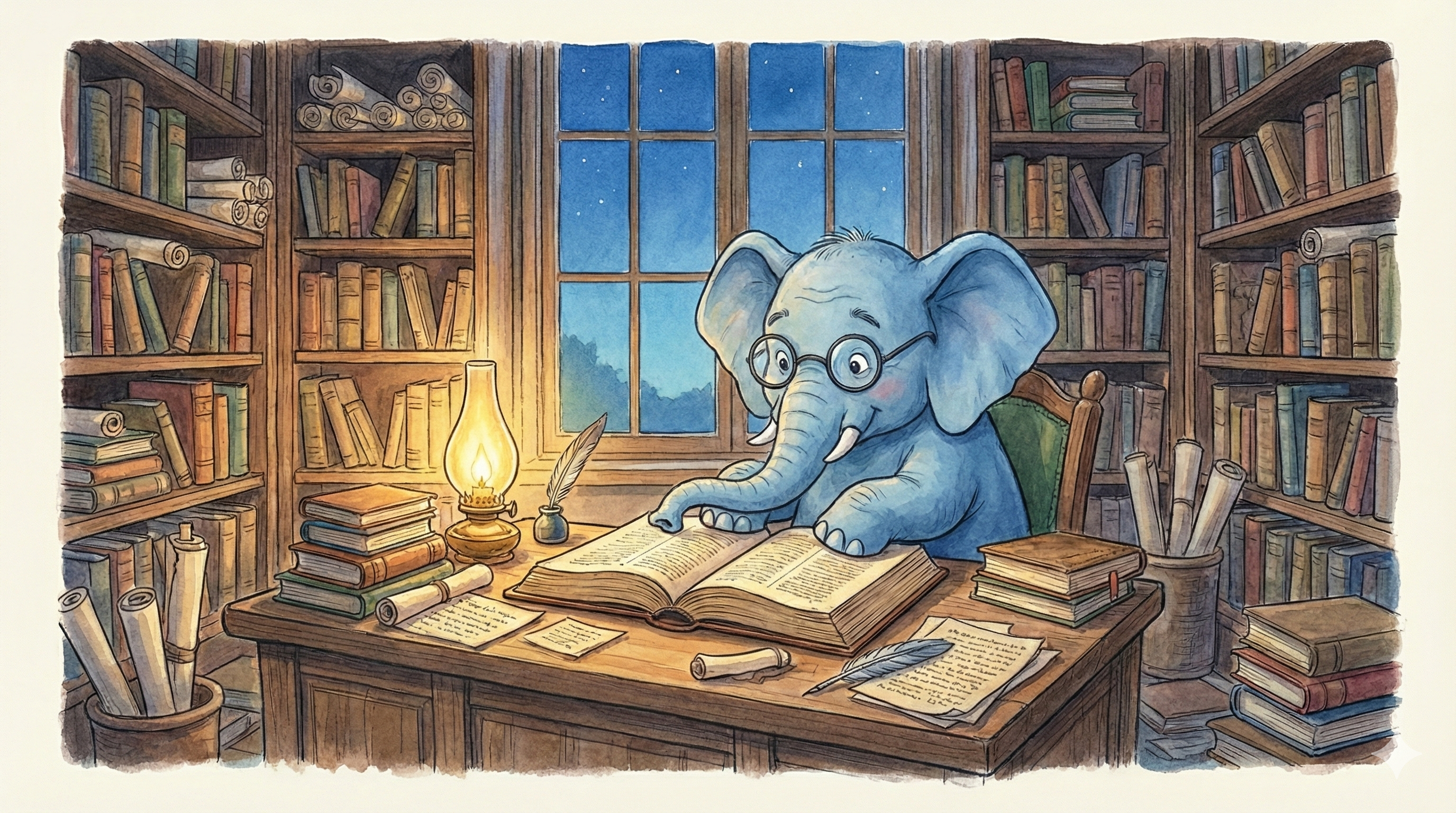
O.T. woke in the darkness, as he always did. The stars were still bright through his bedroom window, and the valley below lay silent and still. He had slept his usual two and a half hours: enough for an elephant, more than enough for a scholar with work to do.
He rose carefully from his extra-strong bed, the reinforced frame creaking only slightly under his weight. The blue elephant padded quietly to the window and looked out over his small estate. The modest country house suited him perfectly: just four rooms, but each one spacious enough for his large frame and his even larger library.
O.T. adjusted his round spectacles and made his way to his study.
The library took up the entire western room of his house. Floor-to-ceiling shelves lined every wall, packed with books, scrolls, manuscripts, and bound journals. Theological works. Historical texts. Scientific treatises. Commentaries in multiple languages. His father’s published papers on spider monkey social organization sat on one shelf. O.T.’s own published works (including his well-regarded pastoral commentary on Romans) occupied another.
But the most important book sat on his reading desk, already open from last night’s study.
Scripture.
O.T. lit the lamp on his desk with practiced care, using his trunk to strike the match and adjust the wick. Golden light filled the study. He settled into his reinforced reading chair (custom-built, like most of his furniture) and positioned his current study Bible before him.
He was working through Romans again. Always Romans. Even though he’d written a commentary on it, even though he could recite every verse from memory, there was always more to discover. That was the beauty of God’s Word: inexhaustible, living, active.
“Heavenly Father,” O.T. prayed quietly, his trunk resting gently on the open page, “thank You for Your Word. Thank You for the gift of another day to study it. Open my eyes to see wonderful things in Your law. Help me not just to know Your truth, but to love it and live it. Guide my understanding today. In Christ’s name, amen.”
He began reading Romans chapter eight, speaking the words aloud softly: “There is therefore now no condemnation for those who are in Christ Jesus…”
His trunk moved across the page as he read, following the Greek text in one column, the English in another. His mind automatically cross-referenced: Ezekiel 36 and the new heart, Jeremiah 31 and the new covenant, Genesis 3 and the promise of the seed who would crush the serpent’s head.
This was what his PhD thesis had been about: seeing Christ in the Old Testament. Christophanies (appearances of the pre-incarnate Christ). Typologies (patterns and shadows that pointed forward to the Messiah). The whole Scripture was about Jesus. Moses wrote of Him. The prophets spoke of Him. The Psalms sang of Him.
O.T. made a note in the margin of his working manuscript. He was preparing a second edition of his Romans commentary, incorporating insights from five more years of study. His trunk held the pen with practiced precision, his perfect memory supplying the exact cross-reference he needed without having to look it up.
Time passed. The stars faded. Dawn began to lighten the eastern sky.
O.T. closed his Bible with reverent care and sat back, removing his spectacles to clean them with a soft cloth. Two hours of study. His mind was full, his heart was warm, and he was ready for the day.
Watermelon and a Day’s Work
He made his way to the kitchen, a surprisingly modest room for someone of his financial success. O.T. had done very well in investments over the years. Perfect memory was remarkably useful in finance: he never forgot a market trend, a company’s history, or the lessons of economic cycles past. But he lived simply. The money went to books, to missions, to supporting the valley community, to funding The Illustrated Word ministry.
For breakfast, he sliced a generous portion of watermelon from the one he’d bought at the village market three days ago. The sweet, cool fruit was perfect. He ate slowly, methodically, savoring each bite while he reviewed his schedule for the day.
The Grace Light Festival was four days away. As official festival historian, he had several responsibilities:
- Finish the historical timeline display showing the festival’s thirty-year history
- Help Abe install the high decorations (trunk reach was invaluable)
- Verify the accuracy of Elder Thomas’s biographical information for the program
- Respond to the letter from his publisher about the Romans commentary
- Continue his research notes on mouse-elephant symbiotic relationships
- Evening: bridge at Baxter’s den
Maple had asked him yesterday (twice) if he’d finished the timeline. He had finished it four days ago. She’d asked him this morning (he’d received her note at dawn) whether he could meet with Abe about decorations. He’d already scheduled that meeting for this afternoon, as he’d told her three days ago.
O.T. sighed quietly. He understood. Maple cared deeply about the festival. She wanted everything perfect. But his perfect memory sometimes made her anxiety harder to understand. When he said he would do something, it was as good as done. He never forgot a commitment.
Still, patience was a virtue. And Maple was his sister in Christ, serving faithfully even if anxiously.
The Publisher’s Letter
After breakfast, O.T. made himself a pot of Earl Grey tea, his preferred thinking beverage. The bergamot scent filled the kitchen as he carefully poured the first cup. He carried it to his study and settled at his writing desk.
The letter from his publisher needed a response.
Dear O.T.,
We’re delighted to hear you’re working on a second edition of your Romans commentary. The first edition continues to sell well: pastors across three continents have written to express how helpful they’ve found your pastoral approach combined with rigorous exegesis.
We would be honored to publish the revised edition. Could you provide an estimated completion date and a brief overview of the new material you’re incorporating?
Yours in Christ, Edmund Sterling Cornerstone Theological Press
O.T. positioned a fresh sheet of paper and dipped his pen.
Dear Edmund,
Thank you for your encouraging letter. I estimate completion within eight months. The second edition will incorporate:
1. Expanded treatment of Romans 8:28-30 (the golden chain of redemption) with additional Old Testament typological connections 2. New section on Romans 9-11 engaging with recent scholarship on Israel and the Church 3. Pastoral applications drawn from five years of teaching this material in valley settings 4. Updated bibliography including recent commentaries and theological works
The goal remains the same: to help pastors and teachers see the whole counsel of God in Romans, to trace every doctrine back to its Old Testament roots, and to show how all Scripture testifies to Christ.
I will send the manuscript in sections as completed, if that suits your editorial process.
In His service, O.T.
He blotted the letter, folded it carefully, and set it in his outgoing correspondence box. The morning post would collect it.
Next, the festival timeline.
Timeline Delivered
O.T. pulled out the large display board he’d prepared. Thirty years of Grace Light Festival history, meticulously documented:
Year 1 (30 years ago): First festival organized by Elder Whitfield. Theme: “Light of the World.” Attendance: 47.
Year 5: Introduction of field day competitions. Attendance: 89.
Year 12: First year in current meadow location after old site flooded. Theme: “God’s Faithfulness in Every Season.”
Year 18: Devastating storm the night before; festival canceled for safety, resumed the following week. Attendance: 134.
Year 25: Elder Thomas first invited as guest preacher. Theme: “Grace Upon Grace.”
Year 30 (current): Theme: “Gratitude for Common and Special Grace.” Estimated attendance: 200+.
Every detail was accurate. O.T. had consulted the original records, interviewed longtime residents, cross-referenced dates with weather patterns and harvest records. This wasn’t just a timeline. It was a testimony to God’s faithfulness through three decades of community worship.
He reviewed it one more time, his trunk tracing each entry. Perfect. He rolled it carefully and secured it with ribbon.
By late morning, the sun was bright and warm. O.T. decided to walk to the village to deliver the timeline to Maple and meet with Abe about decorations.
The walk from his estate to the valley took twenty minutes at his steady pace. His spectacles caught the sunlight as he moved along the well-worn path. His trunk swung gently in rhythm with his steps. He passed Stanley’s burrow on the hillside. The beagle was outside, tending to something in his small garden. Stanley looked up, saw O.T., and waved with his whole body in that enthusiastic beagle way.
O.T. lifted his trunk in greeting and continued on.
Near the village, he saw Fennel in the distance, walking toward Rosemary’s bakery with Chirp on his shoulder. O.T. smiled. That young dragon was growing in wisdom. His artistic gift was a blessing to the whole community.
O.T. continued to Maple’s burrow at the village edge.
He found her outside, clipboard in hand, checking off items on what appeared to be a very long list.
“O.T.!” Maple said, looking up. “I was just about to send you another note. Did you finish the timeline? And did you confirm with Abe about the decorations? The festival is only six days away and—”
“The timeline is complete,” O.T. said gently, unrolling the display board with his trunk. “I finished it four days ago, as I mentioned when you asked on Tuesday.”
Maple blushed. “Oh. Yes. Of course. I’m sorry, I just—there’s so much to track and—”
“It’s beautifully done,” came a voice from the nearby forge. Anvil emerged, wiping his hands. The blacksmith looked at his sister with patient affection. “Maple, you asked him about this yesterday too. O.T. doesn’t forget.”
“I know,” Maple said quietly. “I’m sorry, O.T. I don’t mean to imply you’re unreliable. I just worry—”
“I understand,” O.T. said kindly. “The festival is important to you. You want to honor the Lord with excellence. That’s good. But remember: even our best efforts are gifts from Him. We do our part faithfully, and we trust Him with the outcomes.”
Maple nodded, studying the timeline. Her expression softened. “This is wonderful, O.T. Thirty years of God’s faithfulness, all laid out. People will see we’re part of a story bigger than just this year.”
“Exactly,” O.T. said. “That’s what history teaches us. We’re not the first to celebrate His grace, and Lord willing, we won’t be the last.”
Anvil examined the timeline with appreciation. “You’ve even got the year the old oak fell during the feast. I remember that.”
“Year 22,” O.T. confirmed. “No one was hurt. The tree fell away from the gathering. Providence.”
Maple carefully took the timeline. “I’ll get this to the display committee. Thank you, O.T. And I’ll try to… trust more. Remember less.”
O.T. chuckled softly. “Perhaps remember that you’ve already asked. But yes, trust more. The Lord is sovereign over even cream-colored ribbons.”
Maple smiled despite herself.
“Now,” O.T. said, “I’m meeting Abe about decorations. Is he at his workshop?”
“I am now,” said Abe, approaching from the village direction with his characteristic ambling gait. The orangutan moved on all fours until he reached them, then stood upright. “Good timing, O.T. I’ve got the banner frames ready. We just need your height to get them mounted.”
“I’ll leave you to it,” Maple said, gathering her papers. “And O.T.—thank you for your patience with me.”
After she left, Abe looked at O.T. with knowing eyes. “She asked you three times about this meeting, didn’t she?”
“Four,” O.T. said mildly. “But who’s counting?”
Abe laughed. “You are. You always are.”
They walked to The Illustrated Word workshop where Abe had stored the banner frames. The building was empty; Fennel must be elsewhere today.
Abe showed O.T. the frames: sturdy wooden constructions designed to hold fabric banners with the festival theme. “These need to go up on the posts around the meadow. Problem is, the posts are twelve feet high. I can climb them, but I can’t hold the frame and mount it at the same time.”
“But I can reach,” O.T. said, understanding immediately.
They loaded the frames onto a cart and headed to the festival meadow.
The work was methodical and satisfying. Abe would position the frame, O.T. would lift it with his trunk, hold it steady while Abe climbed the post with mounting hardware, then O.T. would make fine adjustments as Abe secured everything.
“You know,” Abe said from the top of the third post, “I’ve been thinking about your research on mice and elephants.”
“Oh?” O.T. held the frame perfectly still.
“The symbiotic relationship thing. You said elephants benefit from mice warning them about threats, and mice benefit from elephant dung fertilizing their food sources.”
“Essentially, yes. Though the research is more nuanced than that.”
“Well, this feels symbiotic,” Abe said, tightening a bolt. “You’ve got reach. I’ve got hands. Together we get the job done.”
O.T. considered this. “An apt observation. Community itself is symbiotic. Each member brings different gifts. The body has many parts.”
“First Corinthians 12,” Abe said, climbing down. “See? I pay attention when you teach.”
They moved to the next post.
“Speaking of teaching,” Abe continued, “Baxter mentioned you’re working on a second edition of your Romans commentary.”
“I am. The publisher is interested.”
“Good. The first one helped me understand justification better. Before I read it, I thought I had to do something to earn God’s favor. Your commentary showed me it’s all Christ’s work, credited to me by faith.”
O.T. felt warmth in his chest. This was why he wrote. Not for academic accolades, but for Abe and others like him to understand the gospel more clearly.
“That’s the heart of Romans,” O.T. said quietly. “Not what we do for God, but what Christ has done for us.”
They finished the last banner frame as the sun reached its highest point.
“Lunch?” Abe suggested.
“I should get back to my study. Research notes to organize.”
“Mice and elephants?”
“Indeed.”
Abe grinned. “Never stop learning, do you?”
“There’s always more to discover about God’s creation. The more I study, the more I see His wisdom in how He’s designed everything.”
They walked back to the village together. Abe headed to his workshop, O.T. toward home.
A Word with Baxter
But as O.T. passed Rosemary’s bakery, the door opened and Baxter emerged, carrying a small package.
“O.T.! Perfect timing,” the raccoon said warmly. “I was hoping to see you. Are you coming tonight for bridge?”
“Of course,” O.T. said. “Seven o’clock, correct?”
“Correct. And I wanted to ask—” Baxter lowered his voice slightly. “Could you bring your Romans commentary? I’m preparing a sermon series on adoption in Romans 8, and I’d value your insights on the background.”
“I’ll bring my working notes for the second edition,” O.T. said. “I’ve been studying adoption theology in depth recently. The Greco-Roman legal context illuminates Paul’s language significantly.”
Baxter’s eyes lit up. “That’s exactly what I need. Thank you.”
“Theology should serve the church,” O.T. said. “I’m glad to help.”
He continued home, pleased at the thought of his work helping Baxter teach the flock.
Afternoon in the Study
Back in his study, O.T. spent the afternoon organizing his research notes on symbiotic relationships. The parallels between natural systems and community life fascinated him. God’s design was consistent: whether in how mice and elephants helped each other survive, or in how the church body functioned with diverse gifts serving the common good.
He worked steadily, his perfect memory allowing him to pull together observations from dozens of sources without needing to look anything up. He knew exactly which journal had which study, which page contained which finding, which author had made which argument.
It was a gift. But like all gifts, it came with responsibility. Knowledge puffed up, as Paul warned. Unless it was coupled with wisdom (understanding how to use knowledge for good, for God, for others) it was merely impressive noise.
O.T. had seen too many brilliant scholars whose knowledge led to pride instead of humility. His father had warned him: “Son, your memory is extraordinary. But never forget: the fear of the Lord is the beginning of wisdom. Knowing many things means nothing if you don’t know Him.”
His father. The spider monkey researcher. The patient professor who had spent thirty years teaching, writing, and mentoring students. Who had modeled careful scholarship and deep faith.
O.T. pulled his father’s treatise from the shelf: Social Organization and Cooperative Behavior in Spider Monkey Communities. He opened it to the dedication page:
To my son O.T.: May you use your gifts for His glory, not your own.
O.T. closed the book gently and returned it to its place.
As late afternoon stretched toward evening, O.T. reviewed his schedule one more time. Everything for the day was complete:
✓ Morning Scripture study ✓ Letter to publisher ✓ Timeline delivered to Maple ✓ Decorations mounted with Abe ✓ Research notes organized
He had time before bridge at Baxter’s. He made another pot of Earl Grey and settled in with his Bible one more time.
Romans 12. “Do not be conformed to this world, but be transformed by the renewal of your mind…”
The renewal of the mind. That’s what study was for: not to accumulate facts, but to be transformed. To think God’s thoughts after Him. To see the world the way He sees it. To love what He loves.
O.T. read and prayed until the sun began to lower.
Then he gathered his Romans commentary notes, tucked them carefully into a leather satchel, and headed toward Baxter’s den for bridge.
Bridge at Baxter’s Den
The stone den was built into the hillside near the old bridge (hence Baxter’s affinity for the card game of the same name). O.T. had to duck slightly to enter, but the interior was surprisingly spacious.
Baxter had tea brewing, as always. The warm, herbal scent mixed with the smell of old stone and book paper.
“O.T.!” Baxter greeted him. “Come in, come in. Stanley’s already here. We’re just waiting for Stickles.”
Stanley the beagle stood from where he’d been sitting by the fire. “Evening, O.T. How was your day?”
“Productive,” O.T. said, settling carefully onto the reinforced bench Baxter kept for him. “Festival preparations are proceeding well. Maple is… managing her anxiety.”
“Ah,” Baxter said knowingly. “She asked you about the timeline again?”
“Several times,” O.T. confirmed. “But I remember: patience is a fruit of the Spirit.”
“Chirp chirp!”
Everyone turned. Stickles appeared in the doorway, moving with his characteristic careful deliberation. The porcupine’s quills gleamed in the firelight.
“Sorry I’m late,” Stickles said quietly. “I was watching the sunset from the meadow. The way the light hits the mountains this time of year—remarkable.”
“Nothing remarkable escapes you,” O.T. said warmly. “Shall we play?”
They settled around Baxter’s card table. The game was familiar, comfortable. O.T.’s perfect memory made him a formidable bridge player: he knew exactly which cards had been played, who had what suits, what the probability was of any given card appearing.
But he played for fellowship, not to dominate. Bridge was about partnership, about reading your partner’s signals, about working together toward a common goal.
The game progressed pleasantly. Between hands, they talked.
“O.T.,” Baxter said, shuffling the cards, “you brought your notes?”
“I did.” O.T. pulled out his satchel. “Romans 8:14-17. Adoption as sons. I’ve been studying the Greco-Roman legal framework Paul is drawing from.”
He spread his notes on a side table, and Baxter leaned over to examine them while Stanley dealt the next hand.
“In Roman law,” O.T. explained, “adoption gave the adopted child full legal rights: inheritance, family name, citizenship status. But it also meant complete authority transfer. The adoptee left their old family entirely and came under the new paterfamilias, the father’s authority.”
“So when Paul says we’re adopted as sons,” Stanley said thoughtfully, “he means we get all the rights of being God’s children: inheritance, His name, citizenship in His kingdom…”
“Exactly,” O.T. said. “But also—we’re no longer under the old authority. We’ve been transferred from the kingdom of darkness to the kingdom of light. New family. New father. New identity.”
“And that connects to verse 15,” Baxter said, tracing the passage. “‘You have not received a spirit of slavery to fall back into fear, but you have received the Spirit of adoption as sons.’ The contrast is slavery versus sonship.”
“Right,” O.T. confirmed. “In Roman law, a slave had no legal rights. But a son, especially an adopted son who had been chosen deliberately, had full rights and full family honor.”
Stickles spoke up quietly. “So when we were slaves to sin, we had no rights, no honor, no inheritance. But now—”
“Now we’re sons,” Baxter finished. “With all the rights that entails. Including crying out ‘Abba, Father.’”
They sat with that for a moment.
“This will preach,” Baxter said finally. “Thank you, O.T.”
They returned to the game. O.T. and Stickles were partners against Baxter and Stanley. The hands played out with the comfortable rhythm of friends who knew each other well.
During a break between games, Stanley asked, “O.T., how’s your Romans commentary revision coming?”
“Well. I’m incorporating insights from the past five years: things I’ve learned from teaching, from seeing how people respond to different explanations.”
“Like the adoption section we just discussed?” Baxter asked.
“Exactly. The first edition had solid exegesis. But now I can add pastoral application I’ve learned from watching how these truths actually help people.”
“That’s the best kind of scholarship,” Baxter said. “Not removed from life, but engaged with it.”
O.T. nodded. “My father always said: theology that doesn’t shape how we live isn’t really theology, it’s just information. The point of knowing God truly is to love Him more fully and serve Him more faithfully.”
They played until the evening grew late. O.T. won two games out of three, not because he was trying to dominate, but because his memory gave him natural advantages. Still, the fellowship was the real victory.
Walking Home Under Stars
As they prepared to leave, Baxter pulled O.T. aside.
“Thank you again for the notes. And for your patience with Maple. She’s been by here twice asking if I thought the prayer for the opening ceremony was adequate.”
“We all have our anxieties,” O.T. said gently. “Mine is different than hers, but I have them. The Lord is patient with me. I can be patient with her.”
“That’s wisdom,” Baxter said.
O.T. walked home under the stars, the same stars that had been shining when he woke that morning. A full day. A good day. Festival work advanced, scholarship continued, fellowship enjoyed, Scripture studied, friends served.
Back home, O.T. prepared for his brief sleep. He removed his spectacles and cleaned them carefully, setting them on his bedside table. He knelt beside his extra-strong bed for evening prayer.
“Heavenly Father,” he prayed, “thank You for this day. Thank You for Your Word that I studied this morning and this evening. Thank You for the gift of memory—help me use it for Your glory, not mine. Thank You for the community You’ve placed me in: for Maple’s care, Abe’s craftsmanship, Baxter’s teaching heart, Stanley’s warmth, Stickles’ quiet wisdom. Thank You for the festival, for the opportunity to remember Your faithfulness through the years. Help us to honor You in all we do. Watch over everyone in the valley tonight. In Christ’s name, amen.”
He climbed into bed, his great weight settling onto the reinforced frame. Through his window, he could see the stars. In a few hours, they’d begin to fade and he’d wake again to study, to serve, to remember.
But for now, he rested.
His last thought before sleep was gratitude: not just for the Lord’s grace, but for being part of a community where his gifts, perfectly remembered and carefully applied, could serve others and point them to Christ.
God was good. The Word was true. The fellowship was sweet.
And tomorrow would bring new opportunities to learn, to teach, to remember, and to love.