
Morning Prayer and Breakfast
The morning sun slipped through Fennel’s eastern windows, painting golden stripes across the wooden floor. The young dragon stirred on his sleeping platform, blinking as the light warmed his green scales. He stretched carefully, extending his wings just enough to shake off sleep without knocking over the water cup on the small table beside his bed.
From the corner near the fireplace came a tiny rustling sound. Fennel turned his head and smiled. Through the miniature windows of Chirp’s house, he could see movement—the little sparrow was waking up too.
“Good morning, Chirp,” Fennel called softly.
“Chirp chirp!” came the cheerful reply from inside the tiny house.
Fennel sat up and swung his legs over the edge of his sleeping platform. His tail swept across the floor as he stood, and he took a moment to appreciate, as he did every morning, the spaciousness of his home. Room to move. Room to be himself without constantly worrying about knocking things over.
He padded over to the basin near the window and poured fresh water from the pitcher. He washed his face and hands carefully, his claws retracted so he could cup the cool water properly. As he dried off with a linen cloth, he heard the tiny door of Chirp’s house open.
“Chirp chirp chirp!” Chirp sang, hopping out onto his miniature porch and shaking his feathers vigorously.
“Ready for the day?” Fennel asked.
Chirp flew up to the windowsill and began his own morning routine, preening his feathers, straightening his wings, generally making himself presentable. Fennel smiled, watching his friend work. Even sparrows had their morning preparations.
Fennel made his bed, smoothing the patchwork quilt Burleigh had given him two springs ago. He folded it neatly, tucked the edges, and stood back to admire the result. A well-made bed was a small thing, but it was the right way to start the day. It brought order to his space, made him a good steward of the home God had given him.
He knelt beside his bed, the way he did every morning.
“Heavenly Father,” he prayed quietly, “thank You for this new day. Thank You for sleep and rest, and for waking me up again. Thank You for this home, for Chirp, for the Valley and all the friends You’ve given me. Help me to serve You today in whatever I do. Please guide my steps and my hands. Give me wisdom to use this day well. Amen.”
He stood and looked around his home. The morning light made everything glow: the wooden walls, the stone fireplace, the little house in the corner where Chirp was now finished with his preening and ready for breakfast.
“Chirp!” Chirp announced, flying to Fennel’s shoulder.
The smell of fresh bread drifted through the window. Rosemary’s bakery chimney had been smoking since before dawn. Fennel’s stomach rumbled in response.
He went to the cupboard (what a luxury, to have actual cupboards!) and pulled out yesterday’s bread. He cut two thick slices, spread them with butter from the crock he kept cool in the stone-lined box near the north wall, and added a generous drizzle of honey. He poured himself a cup of milk from the pitcher and broke off small pieces of bread for Chirp, who hopped onto the table and pecked at them enthusiastically.
They ate together in comfortable silence, Fennel chewing thoughtfully while he planned his day. The Grace Light Festival was eight days away, and Maple had mentioned needing a poster. That would take a few hours. But there was other work to do too: his garden needed attention, the porch could use sweeping, and he’d been meaning to practice with the golf club Abe had made for him.
After breakfast, Fennel cleared the table and washed the dishes in the basin, using a cloth to scrub them clean and setting them to dry on the wooden rack. Chirp, meanwhile, hopped back into his little house and emerged with a tiny scrap of fabric in his beak. He was tidying too, carrying out bits of old nesting material that needed replacing.
“Good thinking,” Fennel said. “I should gather fresh pine straw for you later.”
“Chirp chirp!”
Fennel opened the eastern windows wide, letting fresh morning air flow through the house. The glass panes had kept them warm through the cool night, but now the day was brightening and the breeze was welcome.
With the morning cleaning done, Fennel stepped out onto his deep porch. The air was fresh and sweet, carrying the scent of wild roses from the forest edge and the green smell of growing things. He breathed deeply, filling his lungs, and smiled.
“What a beautiful day the Lord has made,” he said.
“Chirp chirp!” Chirp agreed from his shoulder.
Fennel descended the porch steps and walked around to the side of his house where his small garden grew. The soil was dark and rich here, and he’d planted vegetables in neat rows: carrots, beans, lettuce, and herbs. He’d also put in a few flowers near the edge, just for beauty.
He knelt and examined each row, checking for weeds and inspecting the plants. The beans had outgrown their support poles and were starting to lean. He retracted his claws completely and used his hands to gently tie the vines to the poles with strips of soft fabric, being careful not to damage the delicate stems.
The carrots were doing well, their feathery tops bright green in the morning sun. The lettuce, however, looked a bit dry. Fennel fetched his watering can from the small shed beside the house, filled it at the rain barrel, and watered each row slowly and carefully, making sure the water soaked down to the roots rather than just wetting the surface.
“See how the soil drinks it in?” he said to Chirp, who was hopping along the garden edge, occasionally pecking at seeds scattered on the ground. “Just like we need water every day, so do the plants. God made everything to need care.”
“Chirp,” Chirp agreed, finding a particularly good seed.
As Fennel worked, he noticed a few weeds trying to establish themselves between the rows. He pulled them out carefully, roots and all, and added them to his compost pile behind the shed. Waste not, want not. Even weeds could become rich soil eventually.
By the time he’d finished tending the garden, the sun had climbed higher. Fennel stood and stretched, his wings extending briefly before folding back against his sides. His hands were dirty from the good work of gardening, and he felt satisfied. This was stewardship: caring for what God had given him, helping things grow, being faithful in the small daily tasks.
Maple’s Request
He was just washing his hands at the outdoor pump when he spotted two figures coming up the path. Maple the badger was leading the way with her stack of papers, and behind her came the solid form of her brother Anvil. The badger siblings made their way toward Fennel’s gate, Maple moving with quick, anxious energy while Anvil followed at a steadier pace.
“Fennel! Oh, good, you’re outside,” Maple called, her voice tight with urgency.
“Good morning, Maple. Good morning, Anvil,” Fennel said warmly, drying his hands on a cloth.
Maple reached his garden gate and set down her papers with a thump. Anvil stopped beside her, nodding a greeting to Fennel but saying nothing yet—he had the quiet, watchful presence of someone who spoke only when needed.
“Is everything all right?” Fennel asked.
“Yes. Well, mostly. It’s just—the festival is in eight days, and there’s still so much to do. I was up half the night making lists.” She paused, catching her breath. “But that’s not why I’m here. I need your help with something.”
“Of course,” Fennel said. “What do you need?”
“A poster,” Maple said, pulling out a rough sketch. “For the Grace Light Festival. I tried to design one myself, but…” She looked at her drawing critically. “It doesn’t capture what I want it to say. And you’re so good at art. Would you be willing to create it?”
Fennel studied her sketch. She’d drawn a simple sun with rays coming out, and underneath had written the festival schedule in neat, careful letters. It was clear and functional, but he could see what she meant. It didn’t quite capture the feeling of gratitude and light and celebration.
“I’d be honored to help,” Fennel said. “When do you need it?”
“By this afternoon?” Maple said hopefully, then rushed on. “I know that’s soon, but we need to get copies made so people can post them around the valley and in the village. Last year we waited too long and some people didn’t know about the schedule changes, and I really want to make sure everyone knows this year, especially about the guest speaker we have coming—”
“This afternoon is fine,” Fennel said gently, interrupting her spiraling thoughts. “Why don’t we work on the design together for a few minutes? That way I can make sure I understand what you want.”
Maple’s shoulders relaxed slightly. “Would you? Oh, thank you, Fennel.”
“Let me get some paper and a drawing stick,” Fennel said. “We can sit on the porch and work through the design.”
He went inside, retrieved his supplies from the table, and returned to find Maple and Anvil waiting on the porch. They settled together, and Fennel spread the paper on his knee. “Tell me about the festival,” he said. “What do you want people to feel when they see the poster?”
“Grateful,” Maple said immediately. “The whole festival is about gratitude—for God’s common grace, the sun and rain and harvest, and for His special grace in Christ. I want the poster to show that somehow.”
“What are the main events?”
Maple consulted her notes. “Friday night opening ceremony at six. Saturday is the field day starting at ten—games and competitions and teaching clinics—and then the Grace Light feast at six in the evening. Sunday is worship with Elder Thomas from the neighboring valley at nine, brunch at eleven, and the closing service at dusk.”
As she talked, Fennel sketched. A large sun at the top, its rays spreading wide. Below it, small figures of valley creatures gathered together, their faces lifted toward the light. Wheat stalks and flowers at the edges. Space for the schedule clearly written.
“What about the words?” he asked. “Besides the schedule?”
Maple thought for a moment. “‘Grace Light Festival’ obviously. And maybe a verse? Something about gratitude?”
“‘Give thanks to the Lord, for He is good,’” Fennel suggested, writing it in careful letters beneath the title.
“Perfect,” Maple breathed, studying the sketch. “That’s exactly right. The sun, the community, the gratitude—yes, this is what I wanted but couldn’t draw myself.”
Fennel made a few adjustments based on her feedback. She wanted the sun rays a bit wider, the figures slightly smaller so there was more room for the schedule text. He redrew the sketch with the changes.
“Now it’s perfect,” Maple said, then bit her lip. “Well, almost. Do you think the sun should be more golden? Or is yellow better? Last year someone said the colors looked washed out, and I just want to make sure—”
“Sister,” Anvil said quietly from where he stood at the edge of the porch. His deep voice was gentle but firm. “Let the dragon do his work. You’ve given him the information. Trust his skill.”
Maple blushed. “You’re right. I’m sorry, Fennel. The sketch is wonderful. Make it however you think is best.”
“I’ll bring it to you this afternoon,” Fennel promised. “Where will you be?”
“Probably at my burrow, working on the volunteer schedule. Or if I’m not there, Anvil will know where I am.” She gathered her papers, looking relieved. “Thank you, Fennel. You’re a good friend.”
She paused at the edge of the porch. “Oh—one more thing. The ribbons for the pavilion arrived yesterday, but they’re cream instead of white. Do you think that matters? Last year everything was white, and I worry that cream might look… off.”
Fennel considered. “I think cream sounds lovely. It’s warm, like sunlight.”
“You’re right,” Maple said, though she still looked slightly uncertain. “It’s probably fine. The Lord provides, right?”
“He does,” Fennel said with a smile.
Anvil touched his sister’s shoulder gently. “Come on. I need to get back to the forge, and you have that volunteer meeting.”
“Right, yes,” Maple said, gathering her papers. She smiled at Fennel. “Thank you again. I’ll be at my burrow this afternoon if you finish the poster.”
Fennel watched the siblings head back down the path, Maple’s quick steps and Anvil’s steady ones, and he thought about how good it was that she had a brother who knew when to gently redirect her spiraling thoughts. That was love too—knowing when to speak up.
Garden Work and a Little Golf
After they left, Fennel sat on the porch for a moment, looking at the sketch in his hands. He could work on the final poster now, or he could do some other tasks first and come to it with fresh eyes later. Better to let the design settle in his mind while he attended to other things.
He swept his porch, using the broom to gather fallen leaves and pine needles into a neat pile. Chirp hopped along behind him, occasionally grabbing a particularly interesting twig for his nesting material collection. The rhythmic swish of the broom was soothing, and Fennel found himself humming as he worked.
With the porch clean, he decided it was time for a bit of fun. He went to the shed and retrieved the golf club Abe had fashioned for him: a sturdy wooden shaft with a flat head, perfectly weighted for Fennel’s size and strength.
He walked out to the flat area behind his house where the ground was level and clear. Several pine cones had fallen from the trees here, scattered across the grass. Fennel smiled. He could tidy up and enjoy himself at the same time, hitting the pine cones into the woods where they belonged.
Fennel placed the first pine cone in position, gripped the club with both hands (how useful, to have opposable thumbs!), and took a practice swing. Then he addressed the pine cone and swung.
Thwack!
The pine cone sailed through the air, arcing high before landing deep in the tree line where it would decompose naturally.
“Chirp chirp chirp!” Chirp cheered from his perch on a nearby rock.
Fennel grinned. There was something deeply satisfying about the solid contact, the feel of the swing, the way the pine cone flew. Useful work, clearing the yard, but enjoyable too—and God had made enjoyment good.
He set up another pine cone and swung again. And again. Some flew straight and true. Others curved off to the side or dribbled along the ground. But each swing was practice, each attempt a chance to improve his technique, and the clearing was definitely getting tidier.
After working through all the scattered pine cones, Fennel’s arms felt pleasantly tired and his mind was clear. The area behind his house was neat again, ready for the next batch of cones that would inevitably fall. He returned the club to the shed, thanked God silently for the gift of work that could also be play, and headed back inside to work on the poster.
Creating the Poster
He set up at his table near the window where the light was best and gathered his supplies: good paper, brushes, colored inks. He studied the sketch he’d made with Maple, then began the final version.
He worked slowly and carefully, mixing colors until they were exactly right. Gold and yellow for the sun, bright but not harsh, warm like sunlight on skin. Green for the wheat and flowers, the green of growing things, of life and provision. Soft browns and grays for the gathered creatures, each one distinct enough to recognize but unified in their upward gaze toward the light.
He added the text in his clearest handwriting:
GRACE LIGHT FESTIVAL Give Thanks to the Lord, for He is Good
Friday, Opening Ceremony - 6pm Saturday, Field Day - 10am | Grace Light Feast - 6pm Sunday, Worship with Elder Thomas - 9am | Brunch - 11am | Closing Service - Dusk
“Chirp chirp?” Chirp asked, hopping closer to examine the work.
“Do you like it?” Fennel asked.
The sparrow chirped enthusiastically, tilting his head to examine the details.
Fennel stepped back to look at the whole poster. The composition felt balanced. The colors were warm and inviting. The text was clear and readable. It had captured what Maple wanted: gratitude, light, community, celebration—without being too complicated.
“I think it’s ready,” he said.
He set it aside to dry and glanced at the position of the sun through the window. Late morning, approaching midday. His stomach reminded him that breakfast had been several hours ago.
By the time he’d tidied his supplies and cleaned his brushes, the ink had dried enough to transport safely. He carefully rolled up the poster.
Lunch with Baxter
“How about we go to the village for lunch?” Fennel suggested to Chirp. “I’d like to show Baxter the poster, and Rosemary probably has something good at the bakery.”
“Chirp chirp!” Chirp agreed, flying to Fennel’s shoulder.
Fennel headed down the path toward the village.
The walk was pleasant, the path winding through meadows dotted with wildflowers. As Fennel walked, he saw Stanley the beagle in the distance, trotting along the hillside trail with his characteristic steady gait. Stanley lifted his nose, caught Fennel’s scent, and waved a paw in greeting. Fennel waved back, and Stanley continued on his way.
Near the village square, Fennel spotted Cedar the fox slipping quietly out of The Illustrated Word, a leather satchel over his shoulder. The fox moved with his usual careful grace, his eyes scanning the ground as if looking for something specific.
“Good morning, Cedar,” Fennel called.
Cedar looked up and nodded, offering a small smile but no words. He continued on his way, and Fennel didn’t take offense. Cedar rarely spoke unless he had something important to say, and that was just how God had made him. Words weren’t the only way to communicate.
The bell above Rosemary’s bakery door jingled as Fennel stepped inside. The warm smell of fresh bread and cinnamon wrapped around him like a hug, and he immediately felt welcome.
“Fennel!” Rosemary the baker called from behind the counter, her tall chef’s hat bobbing as she turned. It was nearly as tall as she was, and it somehow made her seem both official and cheerful at the same time. “Good morning! Or is it afternoon already? Time flies when you’re baking. Just pulled honey scones from the oven—perfect timing!”
“Good morning, Rosemary,” Fennel said. “Is Baxter here?”
“Back corner, dear, by the window. His usual spot.” She was already wrapping scones in paper. “Take these to him, would you? And there’s fresh tea on the table. I’ll bring you both a proper lunch in a moment—I’ve got vegetable soup that’ll warm your scales right up.”
Fennel found Baxter the raccoon sitting by the window, his ringed tail curled around his chair. The raccoon looked up from a small book he was reading and smiled warmly.
“Fennel! Good to see you, friend. Sit, sit.” He moved his book aside to make room.
Fennel set down the scones and poured himself a cup of tea from the pot on the table. The chairs here were regular-sized, which meant they were a bit small for him, but he’d learned to settle carefully. Chirp hopped off his shoulder and onto the table, eyeing the scones with interest.
“I wanted to show you something,” Fennel said, carefully unrolling the poster. “I’m making this for the Grace Light Festival. What do you think?”
Baxter studied it carefully, his wise eyes moving across every detail: the sun’s rays, the gathered community, the symbols of harvest, the carefully lettered text. His whiskers twitched slightly as he read the verse.
“It’s beautiful, Fennel,” he said finally. “The way you’ve shown the community gathered under God’s light—that’s exactly right. And the verse you chose is perfect. ‘Give thanks to the Lord, for He is good.’ That’s the heart of it, isn’t it? Not thanks for what we get, but thanks for who He is.”
He pointed to the wheat and flowers with one paw. “These are lovely touches too. Symbols of His provision. Common grace: sun and rain and harvest, all pointing to His goodness.”
“Thank you,” Fennel said, feeling warmed by the affirmation. “I wanted it to show gratitude without being too complicated. Something even young children could understand.”
“You’ve succeeded,” Baxter said. “This will serve the community well.”
Rosemary appeared then with two bowls of steaming soup and a basket of fresh bread. “Eat up,” she commanded cheerfully. “Can’t make good art on an empty stomach.” She set down a tiny dish with crumbled bread for Chirp, who chirped his thanks.
They ate together, Fennel savoring the rich vegetable soup: carrots, potatoes, beans, herbs, all in a savory broth. Baxter took a bite of scone and smiled with satisfaction.
“Rosemary’s done it again,” he said. “These are perfect.”
They sat in comfortable silence for a moment, drinking tea and watching the village square through the window. A family of rabbits hopped past. Someone was sweeping the steps of the general store. A cart rolled by loaded with hay. Village life in its ordinary rhythm.
“How’s Maple doing with all the festival planning?” Baxter asked.
Fennel chose his words carefully. “She’s working very hard. She cares deeply about honoring the Lord through the festival. I think she wants everything to be just right.”
Baxter nodded knowingly, his whiskers twitching. “Maple has a good heart. She cares deeply—sometimes deeply enough that it feels like carrying a heavy burden. The line between faithful care and anxious control can be thin.”
“She mentioned the ribbons came in cream instead of white,” Fennel said. “She was worried it might look wrong.”
“And what did you tell her?”
“That cream sounds lovely. Warm, like sunlight.”
Baxter smiled. “Good answer. Sometimes we need someone to remind us that God’s provision doesn’t have to match our exact specifications to be good.” He paused. “You’re being a good friend to her, Fennel. That’s important. She needs someone who can help her see that the festival’s success doesn’t rest entirely on her shoulders.”
“I hope I’m helpful,” Fennel said.
“You are,” Baxter assured him. “Just by being patient, by listening, by gently redirecting her focus from her plans to God’s provision. That’s pastoral care, even if you don’t think of it that way.”
They finished their lunch talking about other things: the weather, the growth of the crops, the upcoming sermon from Elder Thomas. When Fennel finally stood to leave, Baxter walked him to the door.
“The poster really is excellent,” he said. “Maple will be pleased.”
“I hope so,” Fennel said. “I need to bring it to her this afternoon.”
Delivering the Poster
After leaving the bakery, Fennel walked toward Maple’s burrow on the edge of the village. He found her outside, checking items off a long list, muttering to herself as she worked through the many details.
“Fennel!” Maple said, looking up. “Is it ready?”
“It is,” Fennel said, unrolling the poster for her.
Maple’s eyes went wide. She was silent for a long moment, studying every detail. “Oh, Fennel,” she said finally. “It’s… it’s perfect.” She touched the edge gently, as if afraid she might smudge it. “The light, the community, the gratitude—you captured everything I wanted to say but couldn’t draw myself.”
She looked up at him, and her eyes were bright. “Thank you. This is beautiful.”
“I’m glad you like it,” Fennel said sincerely.
Maple bit her lip, studying the poster again. “The only thing is… do you think the sun should be more golden? Or is yellow better? I just want to make sure it’s bright enough to really show—” She stopped herself, took a breath. “No. I’m doing it again, aren’t I? Overthinking.” She smiled apologetically. “It’s perfect, Fennel. The yellow is warm and joyful, exactly right.”
“I’m glad you’re pleased with it,” Fennel said. She carefully rolled up the poster. “Now I just need to figure out how to make copies for everyone…”
She trailed off, looking thoughtful.
“I could ask around,” Fennel offered. “Maybe someone knows how—”
“No, no,” Maple said, waving her paw. “You’ve done more than enough. I’ll figure it out. Melody mentioned something about The Illustrated Word having equipment that might work, and O.T. would probably know about printing methods from various civilizations… I’ll talk to them.” She tucked the poster under her arm carefully. “Thank you, Fennel. Truly. This is a gift.”
Afternoon at Home
As Fennel walked home that afternoon, Chirp riding contentedly on his shoulder, he thought about the day so far. Prayer and breakfast. Garden work. Helping Maple. Golf practice. Creating the poster. Lunch with Baxter. All of it woven together—work and rest, service and friendship, duty and delight.
“Thank You, Lord,” Fennel prayed quietly as he walked. “For giving me work to do and hands skilled enough to do it. For friends to serve and ways to help. For Maple’s trust and Baxter’s wisdom. For all these good gifts.”
“Chirp chirp,” Chirp agreed.
Back home, Fennel spent the afternoon on various tasks. He gathered fresh pine straw for Chirp’s nesting material and helped his friend arrange it in the little house.
Then Fennel noticed something that needed attention. One of the tiny shutters on Chirp’s house had come loose from its hinges. The miniature hardware was delicate, and Fennel had to work very carefully. He fetched his smallest tools and a magnifying lens from his art supplies.
Sitting at his table with Chirp watching from his shoulder, Fennel examined the tiny hinge. One of the pins had worked its way out. He retrieved it, cleaned both the pin and the hinge carefully, then used a very small amount of adhesive to secure it properly before gently tapping the pin back into place with the lightest touch of a small mallet.
“There,” he said, testing the shutter. It opened and closed smoothly now. “Good as new.”
“Chirp chirp!” Chirp said approvingly, hopping down to inspect the repair himself.
The work had required patience and a steady hand, but it felt good to care for his friend’s home this way—the same way the community had cared for them both by building these houses in the first place.
He also checked the stones in his fireplace, replacing a few that had cracked from repeated heating and cooling.
He also spent time simply sitting on his porch, watching the valley and praying. This was work too, in its way: being still, resting in God’s presence, letting his mind settle and his heart be grateful.
As the afternoon stretched toward evening, Fennel went inside and began preparing supper. He chopped vegetables from his garden—carrots, beans, a bit of lettuce—and put together a simple stew. While it simmered, he sliced bread and set out butter and cheese.
Evening with Friends
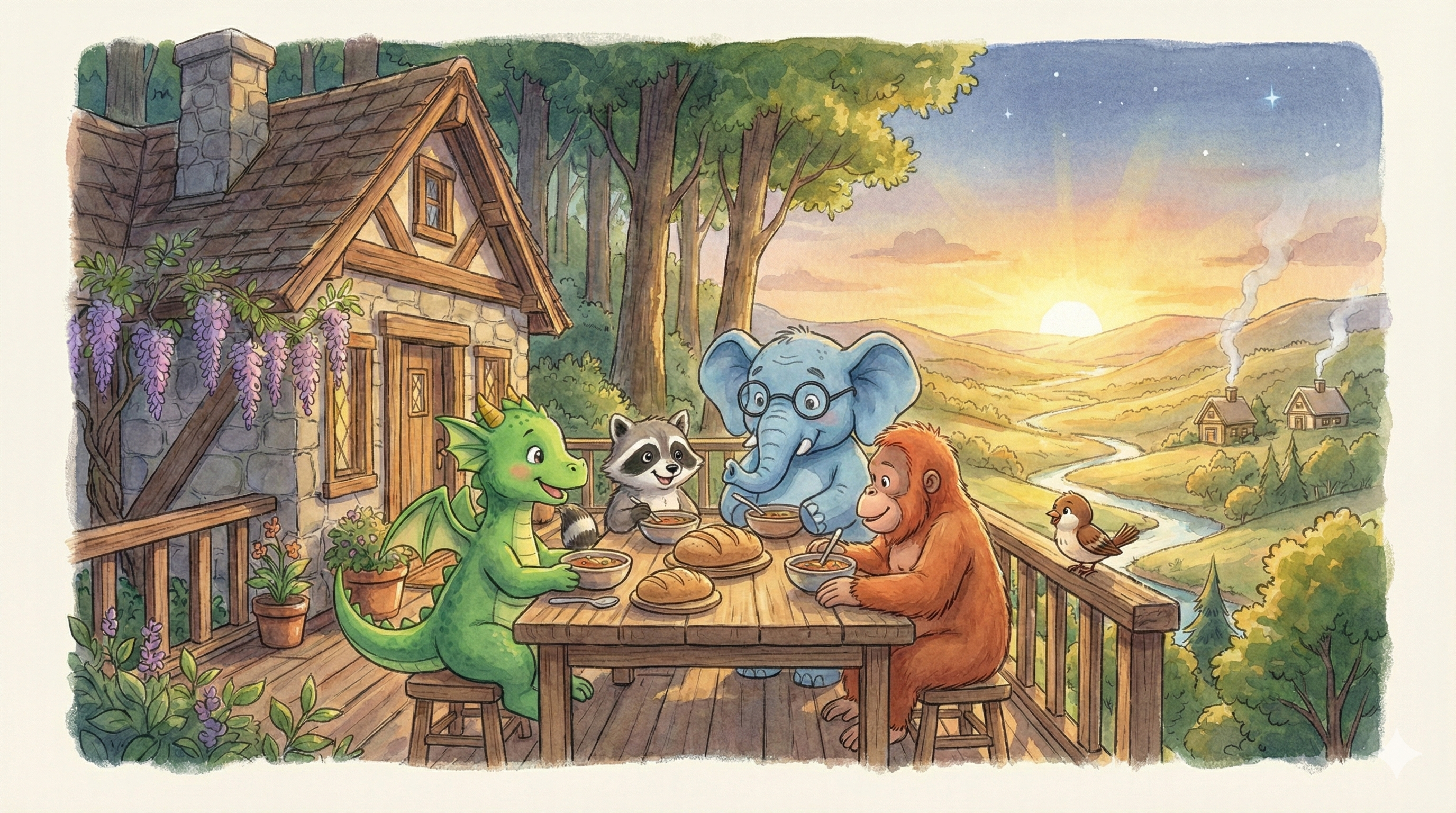
He was just ladling stew into his bowl when he heard voices on the path. He went to the door and smiled. Stickles the porcupine was approaching slowly, his quills gleaming in the late afternoon sun. Behind him came O.T. the blue elephant, his great bulk moving steadily up the path. And from the direction of the village came Abe the orangutan, moving with his characteristic ambling gait.
“Evening, Fennel!” Abe called. “Hope you don’t mind visitors.”
“I was hoping you’d come,” Fennel said honestly. “I have stew and plenty to share.”
They gathered on the porch, settling into comfortable positions. Fennel brought out extra bowls and bread, and they shared the simple meal as the sun began to lower in the west.
“Beautiful evening,” O.T. observed, his trunk gesturing toward the valley spread below them.
“The Lord’s been generous with good weather lately,” Baxter said, appearing on the path below. He climbed the steps to the porch. “Thought I’d find you all here. Room for one more?”
“Always,” Fennel said, fetching another bowl.
As they ate, conversation wandered comfortably from topic to topic. Stickles mentioned seeing a rare bird near the stream. Abe talked about a new project at his forge. O.T. shared something he’d been reading about ancient agricultural festivals.
When the meal was finished and the bowls cleared away, someone suggested singing. Fennel wasn’t sure who started it, but suddenly Baxter was humming a familiar tune, and they all joined in:
“Praise God from whom all blessings flow, Praise Him all creatures here below, Praise Him above, ye heavenly host, Praise Father, Son, and Holy Ghost.”
Their voices blended—Baxter’s warm tenor, O.T.’s deep bass, Abe’s enthusiastic if slightly off-key contribution, Stickles’ quiet harmony, and Fennel’s own voice finding its place in the music. Chirp added his own chirping descant from his perch on Fennel’s shoulder.
They sang other songs too. Hymns they all knew, melodies that spoke of God’s faithfulness and grace. The music rose into the evening air, and Fennel thought about how good it was to gather like this, to lift their voices together in praise.
Between songs, as they caught their breath, Fennel mentioned the poster. “Maple’s wondering how to make copies,” he said. “She wants to distribute them around the valley and village so everyone knows the schedule.”
O.T.’s ears perked forward. “Interesting challenge. There are several historical methods for reproducing images: woodblock printing, movable type, lithography. Of course, most require specialized equipment.”
“The Illustrated Word has some printing capability,” Abe said thoughtfully. “Basic press work for the teaching materials. I wonder if it could be adapted for poster reproduction.”
“We’d need to consider the scale,” O.T. mused. “And the level of detail. A simple text announcement is easier to reproduce than a detailed illustration.”
“Worth investigating,” Baxter said. “The festival serves the whole community, so it makes sense to ensure everyone knows about it.”
They talked about it for a while longer, voices mixing ideas and possibilities, but not coming to any firm conclusions. That was all right—it wasn’t Fennel’s problem to solve anymore. He’d created the poster. Others could figure out how to reproduce it. That was the beauty of community: everyone contributing what they could, trusting others to add their part.
As full darkness settled over the valley, the gathering began to break up. Stickles needed to get back to his hollow before it was completely dark, his night vision not being as good as some of the others. O.T. had early morning responsibilities. Abe wanted to secure his workshop properly before bed.
“Thank you for supper,” Baxter said, gripping Fennel’s hand warmly. “And for the fellowship. These evenings are good for the soul.”
“They are,” Fennel agreed. “Come back anytime.”
Closing the Day
After his friends left, Fennel tidied the porch, then brought the supper dishes inside to wash them. As he worked at the basin, he could hear tiny settling-in sounds from the corner—Chirp had already retreated to his little house and was arranging his nest for the night. Through the miniature windows, Fennel could see Chirp closing the tiny shutters, the one Fennel had repaired that afternoon working smoothly now.
Fennel smiled at the sight, then finished preparing for bed. He washed his face and hands again, brushed his scales clean of the day’s dust, and closed the windows against the cooling night air. He checked that everything was in its proper place for the night.
Then he knelt beside his sleeping platform, as he did every evening.
“Heavenly Father,” he prayed, “thank You for this day You’ve given me. Thank You for morning sunshine and evening fellowship. Thank You for work to do—the garden, the poster, the small tasks of caring for this home. Thank You for Maple’s trust and for the chance to serve her. Thank You for lunch with Baxter and his wise words. Thank You for Stickles and O.T. and Abe coming to share supper and songs. Thank You for Chirp’s faithful friendship.”
He paused, thinking over the day.
“Help me to sleep well and wake ready for tomorrow. Give Maple peace about the festival preparations. Guide those who are working on the poster reproduction. Watch over all of us in the valley tonight. Thank You for making us a community, for giving us each other. All these things I pray in Jesus’ name. Amen.”
“Chirp,” came a sleepy voice from the miniature house—Chirp’s version of amen.
Fennel climbed onto his sleeping platform and pulled the quilt up to his shoulders. Through the window, he could see stars beginning to appear in the darkening sky. The valley was settling into night: smoke from dying fires, windows going dark, the peaceful quiet of everyone finding rest.
He thought about the day that was ending. Nothing dramatic had happened. Nothing extraordinary. Just a day in the valley—prayer and work, service and friendship, creation and fellowship. The ordinary rhythm of life lived for God’s glory.
Tomorrow would bring new work, new opportunities to serve, new reasons to give thanks. But tonight, Fennel was content to rest, knowing that the Lord who made the sunset would also make the sunrise, and that His mercies were new every morning.
The last thing Fennel heard before sleep took him was Chirp’s gentle snoring from the little house in the corner, and he smiled.
God was good. Life was good. And he was exactly where he belonged.