
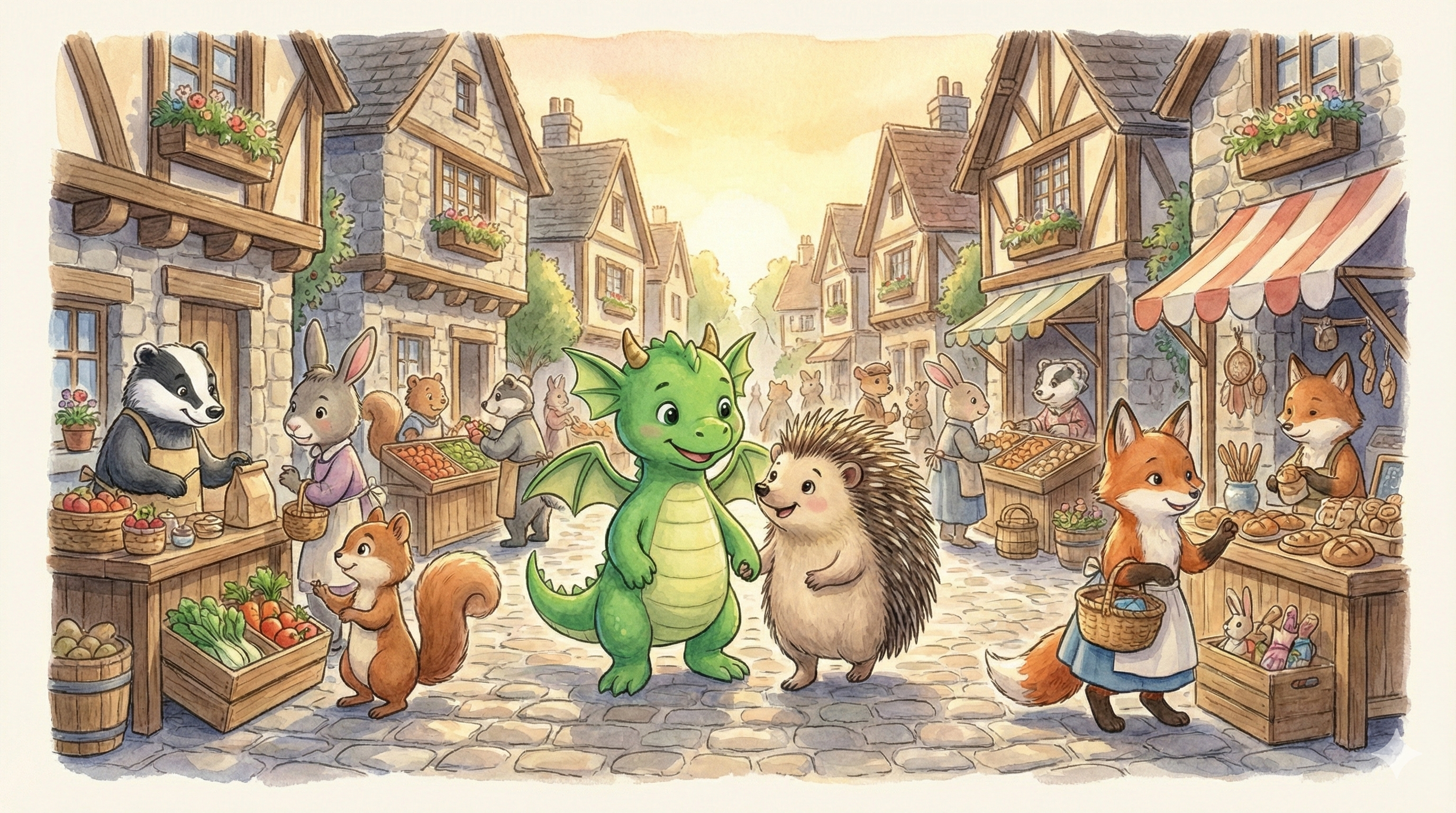
Into the Village
Fennel the dragon stood at the edge of the meadow, looking down at the Valley Village. He’d been living in the Valley for over a year now, in his home with the eastern windows and deep porch, but he’d never actually visited the village proper. The animal community—Baxter, Stickles, O.T., all his friends”lived scattered around the Valley in dens and hollows and burrows. But the village was where the people lived. Humans and a few larger animals in actual houses with chimneys and gardens and a town square.
“Why haven’t we gone before?” Chirp the sparrow asked from his shoulder.
“I don’t know,” Fennel admitted. “I suppose… I didn’t think they’d want a dragon walking through their streets.”
“Fennel!” Stickles the porcupine had emerged from the tree line, his quills gleaming in the morning sun. “Are you going to the village?”
“Thinking about it,” Fennel said. “Have you been?”
“A few times,” Stickles nodded. “To trade for supplies”clay for my pottery, good paper for pressing flowers. The people are kind. Some of them, anyway.” He paused. “I was actually heading there today. Would you like to come with me?”
Fennel looked at the little porcupine, then at the village below. “Yes,” he decided. “Yes, I would.”
Mr. Davis and His Grief
The path down to the village was well-worn but steep. Fennel walked carefully, conscious of his size and his tail. Stickles moved with his characteristic deliberate pace beside him, noticing things Fennel would have missed—a bird’s nest in a low bush, a patch of mushrooms that hadn’t been there last week, the way the morning light fell differently now that autumn was deepening.
As they approached the first houses, Fennel felt his heart beating faster. A few people were out in their gardens or walking toward the town square. When they saw him, some stopped and stared. A small child pointed. “Mama, a dragon!”
The mother—a sheep in a blue apron”smiled. “So it is, little one. That must be Fennel. Baxter mentioned him at meeting last week.”
“Meeting?” Fennel asked, surprised that the woman addressed him so naturally.
“Oh yes,” she said, coming closer. “The Lord’s Day meeting. We gather every first day to worship. Baxter comes sometimes”he says you live up near Whispering Woods now?”
“I do,” Fennel said, feeling more at ease. “You… you worship the Lord here?”
“Well of course,” the sheep said, as if it were the most obvious thing in the world. “Where else would we worship? I’m Mrs. Winters, by the way. This is my daughter Lily.”
“Hello,” Fennel said, bowing his head slightly to the little lamb.
Lily giggled. “You’re very green.”
“I am,” Fennel agreed. “It’s how God made me.”
“Mrs. Winters!” Stickles called. “Is the pottery shop open today? I need to order some storage vessels.”
“Should be,” Mrs. Winters replied. “Though Mr. Davis has been… well, he’s been troubled lately. His wife passed three months ago and he hasn’t been the same. Won’t come to meeting anymore. Won’t hardly talk to anyone.”
Fennel and Stickles exchanged glances. “Perhaps we should visit him,” Stickles said quietly.
Old Harry and His Fear
The pottery shop was a small building near the town square, its door painted green and its windows displaying various clay vessels and bowls. A sign hung above: Davis Pottery - Fine Earthenware.
Fennel had to duck significantly to fit through the door, and even then his tail barely made it. Inside, the shop was cool and dim, smelling of clay and kiln-smoke. Shelves lined the walls, displaying bowls and cups and plates, all expertly made.
Behind the counter stood a badger—elderly, with gray streaking his black and white fur. He looked up when they entered, and Fennel saw that his eyes were tired and sad.
“Stickles,” the badger said. “Back already? And you’ve brought… a dragon.”
“This is my friend Fennel,” Stickles said gently. “Fennel, this is Mr. Davis. The finest potter in three valleys.”
Mr. Davis waved a paw dismissively. “I’m adequate. What do you need?”
Stickles approached the counter. “Six storage jars, if you have time. Medium size, with good seals. For preserving herbs and pressed flowers.”
Mr. Davis nodded, making a note. “Two weeks. Maybe three.”
An awkward silence fell. Fennel looked around at the pottery, noticing how beautiful it was—each piece carefully formed, well-proportioned, glazed in earth tones that seemed to capture the colors of the Valley itself.
“These are wonderful,” Fennel said. “You have real skill.”
“Skill is just practice,” Mr. Davis said flatly. “Do it long enough, you get adequate.”
“My friend O.T. would say,” Stickles ventured carefully, “that skill is a gift from God. The maker of all things gives some the gift of making things themselves.”
Mr. Davis’s expression darkened. “If God gives gifts, He also takes them away. And what He takes is often more precious than what He gives.”
The words hung in the air like smoke. Fennel felt Chirp shift on his shoulder, felt Stickles’s quiet tension.
“You mean your wife,” Fennel said softly.
Mr. Davis looked up sharply. “You’re new here. How do you know about Martha?”
“Mrs. Winters mentioned… she said you’ve been grieving.”
“Grieving.” Mr. Davis said the word like it tasted bitter. “That’s a polite word for what this is. Martha and I had forty years together. Forty years of making pottery side by side. She threw the vessels, I fired them. She decorated, I glazed. Every piece you see here is as much hers as mine.” His voice cracked. “And then God took her. Three months ago. No warning. Just… gone.”
Tears were running down his face now, and he didn’t bother to wipe them away. “Everyone says ‘she’s with the Lord now’ and ‘you’ll see her again’ and ‘God has a plan.’ But none of that makes this house less empty. None of that gives me someone to talk to over breakfast. None of that explains why a good God would take the best thing in my life.”
Fennel felt his own throat tighten. He didn’t know what to say. What could a dragon say to grief this deep?
But Stickles moved closer to the counter, his quills very still. “You’re right,” he said quietly. “None of those things make the house less empty. They don’t stop the hurt. And I won’t pretend I understand your pain”I’ve never lost someone I loved like that.”
Mr. Davis looked at the porcupine, surprised by the honesty.
“But,” Stickles continued, “I know this: God doesn’t promise to spare us from grief. He promises to be with us in it. The Psalms are full of people crying out to God in pain”real pain, like yours. ‘How long, O Lord? Will you forget me forever?’ That’s in Scripture. God doesn’t silence our grief. He enters it with us.”
“She’s still gone,” Mr. Davis said, but his voice was softer now.
“She is,” Stickles agreed. “And that’s terrible. And you’ll carry that absence with you. But Mr. Davis… did Martha know Jesus?”
The badger nodded. “She loved Him. She prayed every morning. She sang hymns while she worked.”
“Then she’s not just gone,” Stickles said. “She’s home. Really home. And one day”when your work here is done, when you’ve made all the pottery God has for you to make”you’ll go home too. And Martha will be there. The separation is real, but it’s not forever.”
Mr. Davis was quiet for a long time. Then: “I haven’t prayed since she died. I’ve been too angry.”
“God can handle your anger,” Fennel found himself saying. “He’s big enough for it.”
The badger looked at him—really looked at him—for the first time. “You’re very young to be wise.”
“I’m not wise,” Fennel said. “But I know God is good even when I don’t understand what He’s doing. I didn’t understand why He brought me to this Valley. I didn’t understand why the community built me a home when I’d done nothing to earn it. I don’t always understand His ways. But I’m learning to trust His heart.”
Mr. Davis took a shaky breath. “I need… I need time. But maybe… maybe I could come to meeting again. Next Lord’s Day.”
“We’d be glad to see you,” Stickles said. “And Mr. Davis? It’s okay to still be sad. Coming to meeting doesn’t mean pretending everything’s fine.”
The badger nodded. “Three weeks for those jars.”
“Three weeks is perfect.”
Prayer Rock
They left the pottery shop and walked through the village square. The morning was warming up, and more people were out now—shopping at market stalls, chatting by the well, leading children to school.
“That was hard,” Chirp said quietly.
“It was,” Fennel agreed. “But good, I think. Maybe.”
They passed the market, where a fox was selling vegetables from his cart. As they walked by, Fennel heard him calling out: “Fresh turnips! Best carrots in the valley! Guaranteed by Old Harry!”
Fennel paused. There was something about the fox’s voice”too loud, too jovial, like someone trying very hard to convince everyone (including himself) that everything was wonderful.
“Old Harry?” Stickles said, stopping. “You’ve changed your name?”
The fox looked over, and Fennel saw his smile falter for just a moment before returning even brighter. “Ah, Stickles! And a dragon friend! Yes, yes, Old Harry”has a better ring to it than Harold, don’t you think? More memorable for the customers!”
“I suppose,” Stickles said, but he was watching the fox carefully. “How’s business?”
“Wonderful! Excellent! Best year yet!” Harry gestured at his cart with enthusiasm. “Can’t complain when the Lord provides, eh? Blessed to be a blessing, that’s what I always say!”
But Fennel noticed that the cart was only half full, and what vegetables were there looked a bit wilted. He noticed that Harry’s coat was worn at the elbows, and his smile didn’t quite reach his eyes.
“Harry,” Stickles said gently, “how are you really?”
The fox’s smile finally cracked. “Well, to be honest…” He looked around to see if anyone else was listening. “To be perfectly honest, it’s been a rough season. Drought hit the crops hard, competition from the new farms up north, and I’ve got three kits at home to feed and…” He shook his head. “But the Lord will provide, won’t He? That’s what we’re supposed to believe. Just have faith and everything works out, right?”
There was something desperate in the way he said it, like he was trying to convince himself. Like he’d been told this so many times that he felt guilty for his situation, as if his financial struggles meant his faith was insufficient.
“The Lord does provide,” Fennel said carefully. “But that doesn’t mean life doesn’t get hard. And it doesn’t mean we can’t ask for help.”
“Oh, I couldn’t ask for help,” Harry said quickly. “Other people have real problems. I should just be more grateful for what I have. Work harder. Pray more. Have more faith.”
“Harry,” Stickles said, “who told you that?”
The fox looked uncomfortable. “Well, no one exactly told me, but… that’s how it works, isn’t it? If you’re having trouble, it means you’re not trusting God enough. If you’re struggling, you must be doing something wrong.”
“That’s not in Scripture,” Fennel said. Even as a relatively new believer, he knew that couldn’t be right. “Job was righteous, and terrible things happened to him. The apostles had great faith, and most of them were martyred. Jesus himself said ‘in this world you will have trouble.’”
Harry blinked. “But… but everyone’s always so happy at meeting. Everyone talks about how blessed they are and how God is providing and…”
“And maybe,” Stickles said gently, “they’re also afraid to admit when things are hard. Maybe we’ve made church a place where everyone wears their best face instead of their real face.”
Harry was quiet for a moment. Then: “I’m scared. My wife is scared. We don’t know how we’re going to make it through winter. And I feel like I can’t even pray about it because I’m supposed to already have faith that God will fix it, and if I’m still worried then my faith must be weak, and…” He stopped, overwhelmed.
“Harry,” Fennel said, “come with us.”
“Where?”
“To Prayer Rock. Do you know it?”
Harry nodded. “Everyone knows Prayer Rock. But it’s the middle of the day. I have vegetables to sell.”
“How many customers have you had this morning?”
“Well… none yet, but…”
“The vegetables will keep,” Stickles said. “Come on.”
Help for the Asking
Prayer Rock was a large, flat stone outcropping on a hill overlooking the village. According to Baxter, it had been used as a prayer spot for generations—a place where people came to be alone with God, to think, to wrestle with hard questions.
When they reached it, Fennel settled himself on the rock, careful not to take up too much space. Chirp flew to a nearby branch. Stickles and Harry sat near the edge, looking out over the Valley.
“Let’s pray,” Fennel said. “Really pray. Not the prayers where we pretend everything’s fine. Real prayers.”
Harry looked uncertain. “I don’t know if I remember how.”
“Just talk to God like He’s here with us,” Stickles suggested. “Because He is.”
There was a long silence. Then Harry began, his voice shaky: “God, I… I don’t know what to say. I’m scared. My business is failing and I don’t know how to feed my family. I keep thinking I should trust You more, but the trust doesn’t make the money appear. I feel like I’m failing as a provider and as a believer. I don’t know what You want from me.”
Another silence. Then Stickles: “Lord, help Harry to know that struggling doesn’t mean his faith is weak. Help him to know that You see him, that You care about his family, that asking for help isn’t a failure. And help us”the church, the community”to be a place where people can be honest about their struggles instead of pretending to be fine.”
Fennel added: “And God, if there’s something we can do to help Harry, please show us. Help us to be the answer to someone else’s prayers instead of just praying and walking away.”
When they finished, Harry was crying. “Thank you,” he whispered. “I’ve felt so alone.”
“You’re not alone,” Stickles said firmly. “Starting now. We’re going to talk to Baxter. And Mrs. Winters. And the others at meeting. If the church is supposed to be a family, then we help family members who are struggling. No shame. No judgment. Just love.”
“I don’t deserve”—
“None of us deserve grace,” Fennel interrupted gently. “That’s the whole point of grace. God gives it anyway. And we’re supposed to give it to each other.”
Mrs. Thompson’s New Beginning
They walked back to the village together, Harry walking with a lighter step despite his tears. When they reached the square, they found Mrs. Winters talking with an elderly rabbit named Mr. Perkins.
“Mrs. Winters,” Stickles said, “could we talk with you about something?”
She saw Harry’s face and understood immediately. “Of course. Mr. Perkins, would you excuse us?”
They found a quiet bench near the well, and Stickles explained Harry’s situation. Mrs. Winters listened without interrupting, nodding occasionally.
When he finished, she said simply: “We’ll help, of course. I have extra preserves from summer. Mr. Miller has winter squash to spare. We’ll organize it”not as charity, but as family caring for family. And Harry…” She looked at the fox seriously. “You’re going to let us help. Understood?”
Harry nodded, too emotional to speak.
“Good. Now I suggest we all go see Mrs. Thompson. She lives at the edge of the village and rarely comes out. I’ve been worried about her.”
The Long Way Home
Mrs. Thompson lived in a small cottage with a tidy garden, though the garden was clearly more than she could maintain alone. When they knocked, a voice called out: “Who is it?”
“Mrs. Winters, ma’am. And some friends. May we visit?”
The door opened to reveal a very old woman, her gray hair pulled back in a neat bun, wearing an elegant purple dress with a shawl over her shoulders. She held a cane and wore a monocle on a chain. When she saw Fennel, her eyes widened behind the monocle. “My goodness. A dragon.”
“I hope I’m not frightening,” Fennel said.
“Frightening? No, dear. Surprising, certainly. Come in, come in”though you’ll have to mind your head. And your tail.”
The cottage was small but cozy, filled with the smell of lavender and old books. Mrs. Thompson settled into a chair by the window and gestured for them to sit where they could.
“To what do I owe this unexpected pleasure?” she asked.
“We were just… visiting,” Mrs. Winters said. “Checking on neighbors. I realized we haven’t seen you at meeting in some time.”
“Ah.” Mrs. Thompson smiled sadly. “My legs aren’t what they used to be. The walk to the meeting house is difficult now. I’ve been… well, I’ve been feeling rather cut off from things.”
“Do you know Jesus?” Fennel asked directly.
The elderly woman looked at him with surprise, then something like hunger. “I… I’m not sure. I’ve lived in this village my whole life. I’ve heard the stories”baby Jesus in the manger, Jesus dying on the cross. I know the hymns. But actually knowing Him? I think perhaps I’ve only known about Him.—
Stickles leaned forward. “Would you like to know Him? Really know Him?”
“I’m old,” Mrs. Thompson said. “Too old to start now, surely.”
“No one is too old,” Mrs. Winters said gently. “The thief on the cross came to Jesus in his final hours and Jesus welcomed him.”
“But what would I even say?” Mrs. Thompson asked. “I don’t know the right words.”
“There aren’t magic words,” Fennel said. “Jesus just wants your heart. He wants you to believe that He’s the Son of God, that He died for your sins and rose again, and that He loves you. And then… you trust Him. You follow Him. You let Him be your Lord.”
Mrs. Thompson was quiet, tears forming in her eyes. “I’ve felt so alone,” she whispered. “So forgotten.”
“God hasn’t forgotten you,” Chirp said—his first words in a while, and everyone turned to look at the little sparrow. “Chirp chirp chirp.” Which somehow everyone understood meant: He brought us here today. You’re not forgotten.
“Would you like to pray?” Stickles asked. “To tell Jesus you want to know Him?”
Mrs. Thompson nodded, unable to speak. They gathered around her chair”Mrs. Winters holding one hand, Stickles near the other side, Fennel’s head bowed close, Chirp watching from his shoulder.
“Lord Jesus,” Mrs. Thompson began, her voice trembling, “I don’t know how to do this right, but these friends say that’s okay. I believe You are who You say You are. I believe You died for me”even for me, old and useless as I am. I’m sorry for living my whole life without really knowing You. Please… please forgive me. Please come into my heart. I want to know You. I want to follow You. However many days I have left, I want them to be Yours.”
She opened her eyes, and tears were streaming down her face. But she was smiling—really smiling, in a way that transformed her whole face.
“I feel different,” she said wonderingly. “Is that… is that real? Or am I being foolish?”
“It’s real,” Mrs. Winters said, her own eyes wet. “Welcome to the family, sister.”
“You’re not alone anymore,” Stickles added. “You never will be again.”
Mrs. Thompson looked around at them—a sheep, a fox, a porcupine, a dragon, and a sparrow, gathered in her small cottage. “I thought God had forgotten me,” she said. “But He sent you. Why did He send you?”
“Because He loves you,” Fennel said simply. “And because we’re supposed to love each other. Now… how do we get you to meeting on Lord’s Days? Because you shouldn’t miss it now.”
“I have a wagon,” Harry said suddenly. “It’s just a vegetable cart, but it has wheels. I could come get you. Every Lord’s Day.”
“And I’ll make you a proper walking stick,” Stickles offered. “One that’s the right height and has a good grip.”
Mrs. Thompson looked at them all, overwhelmed. “I don’t deserve this kindness.”
“None of us do,” Mrs. Winters reminded her. “But that’s grace. That’s the whole point.”
They stayed and talked with Mrs. Thompson for another hour, telling her about the Lord’s Day meetings, about the community, about what it meant to follow Jesus. She asked questions—so many questions, like someone who’d been thirsty for years and finally found water.
When they finally left, the sun was beginning its descent toward evening. They walked back through the village together, past the shops and houses, past the town square where the market was closing for the day.
“What a day,” Mrs. Winters said. “We left this morning for a simple errand and God turned it into… into all of this.”
“Do you think Mr. Davis will really come to meeting?” Harry asked.
“I think he will,” Stickles said. “Maybe not next week. Maybe not the week after. But eventually. Grief needs time.”
“And Harry,” Mrs. Winters said firmly, “you come to my house tomorrow. We’re organizing that help whether you like it or not.”
Harry smiled—a real smile this time. “Thank you. I’ll come.”
They reached the edge of the village where the path split—one direction back to the animal community, another to the various houses, another up toward Fennel’s home near Whispering Woods.
“Before we part,” Mrs. Winters said, “let’s pray together.”
They formed a circle there on the path—a sheep, a fox, a porcupine, a dragon, and a sparrow. An unlikely group. A beautiful family.
Mrs. Winters prayed: “Thank You, Lord, for this day. Thank You for bringing us together. Thank You for Mr. Davis and his grief”help him to find You in it. Thank You for Harry and his honesty—help us to support him as family should. Thank You for Mrs. Thompson and her new beginning”what a joy to see someone come to You! Help us to be a community that really loves each other, that shares burdens, that doesn’t pretend to be perfect but points each other to You who is. Give us eyes to see who needs You, courage to share You, and wisdom to do it with love. In Jesus’ name, amen.”
“Amen,” they all echoed.
As Fennel walked home with Chirp and Stickles, the evening light painting the Valley in gold, he felt a deep contentment. They hadn’t planned to share the gospel today. They hadn’t set out with an agenda. They’d just gone to the village, paid attention to people, listened to their hurts, and pointed them to Jesus.
“Stickles,” Fennel said as they climbed the hill toward home, “how did you know what to say to Mr. Davis? And to Harry?”
Stickles was quiet for a moment, watching the path carefully as always. “I didn’t really. I just… I listened. I noticed. And I remembered that Jesus met people where they were. He didn’t give the same message to everyone. He gave them what they needed. The grieving need comfort. The pretending need permission to be honest. The lost need to be found.”
“And Mrs. Thompson?”
“She needed to know she wasn’t forgotten. That it wasn’t too late. That God still wanted her.”
They reached Fennel’s home just as the first stars were appearing. Fennel looked out over the Valley, at the lights beginning to glow in the village below, and thought about Mrs. Thompson in her cottage, probably still smiling, probably still marveling at what had happened.
“Chirp,” he said to his friend, “remind me tomorrow to ask Baxter if anyone else in the village might need a visit.”
“Chirp chirp!” Chirp agreed enthusiastically.
“Because this,” Fennel said, settling onto his porch and looking at the stars, “this is what we’re supposed to do. Not just live here and be comfortable. But actually love people. Actually tell them about Jesus. Actually be the family God wants us to be.”
Stickles nodded slowly. “I’ll come with you next time too. If you’d like.”
“I’d like that very much.”
And somewhere in the village below, in a small cottage by the garden, an elderly woman was praying for the first time as a child of God, thanking Him for dragons and sparrows and porcupines who cared enough to visit. Thanking Him for not forgetting her. Thanking Him for coming to her, even in her final season of life, and saying: “Come, follow Me. It’s never too late. You’re Mine now. Welcome home.”
The End
“But how can they call on him to save them unless they believe in him? And how can they believe in him if they have never heard about him? And how can they hear about him unless someone tells them?” - Romans 10:14