The Train at the Station
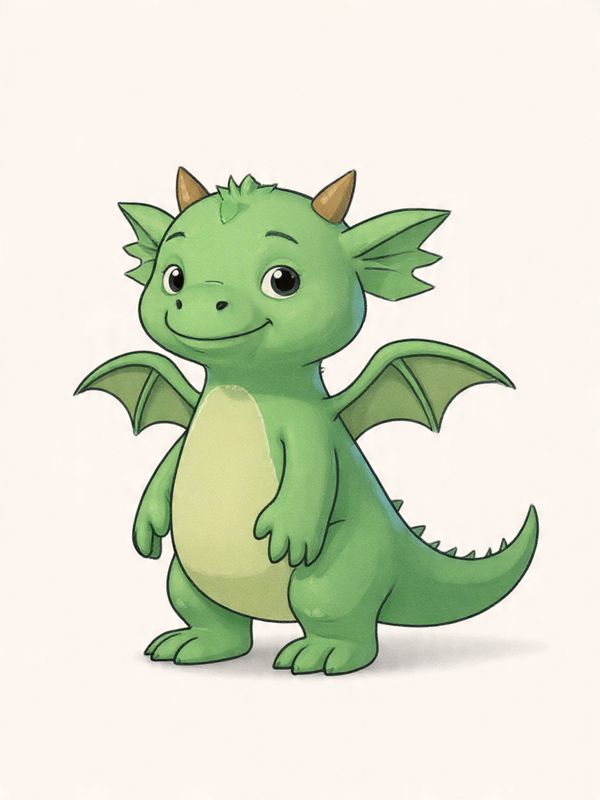
The morning sun streamed through Fennel’s eastern windows, waking him as it always did in his new home. The dragon stretched on his sleeping platform, careful not to knock anything over with his tail, and smiled at the sight of Chirp the sparrow emerging from his miniature house in the corner.
“Morning!” Fennel called.
“Chirp chirp!” Chirp sang back, fluttering up to perch on Fennel’s head.
They stepped out onto the porch (Fennel still marveled at having a porch) and looked down at the Valley spread below. Everything was exactly as it should be: the stream singing its eternal song, smoke rising from breakfast fires, the familiar shape of Whispering Woods against the morning sky.
And something new.
Down past the old stone bridge, where Fennel had never seen anything but meadow grass, a set of railroad tracks curved through the landscape like two silver ribbons. And sitting on those tracks, huffing gentle clouds of steam into the cool air, was a train.
“A train!” Fennel said, his scales tingling with curiosity. “Right here in the Valley!”
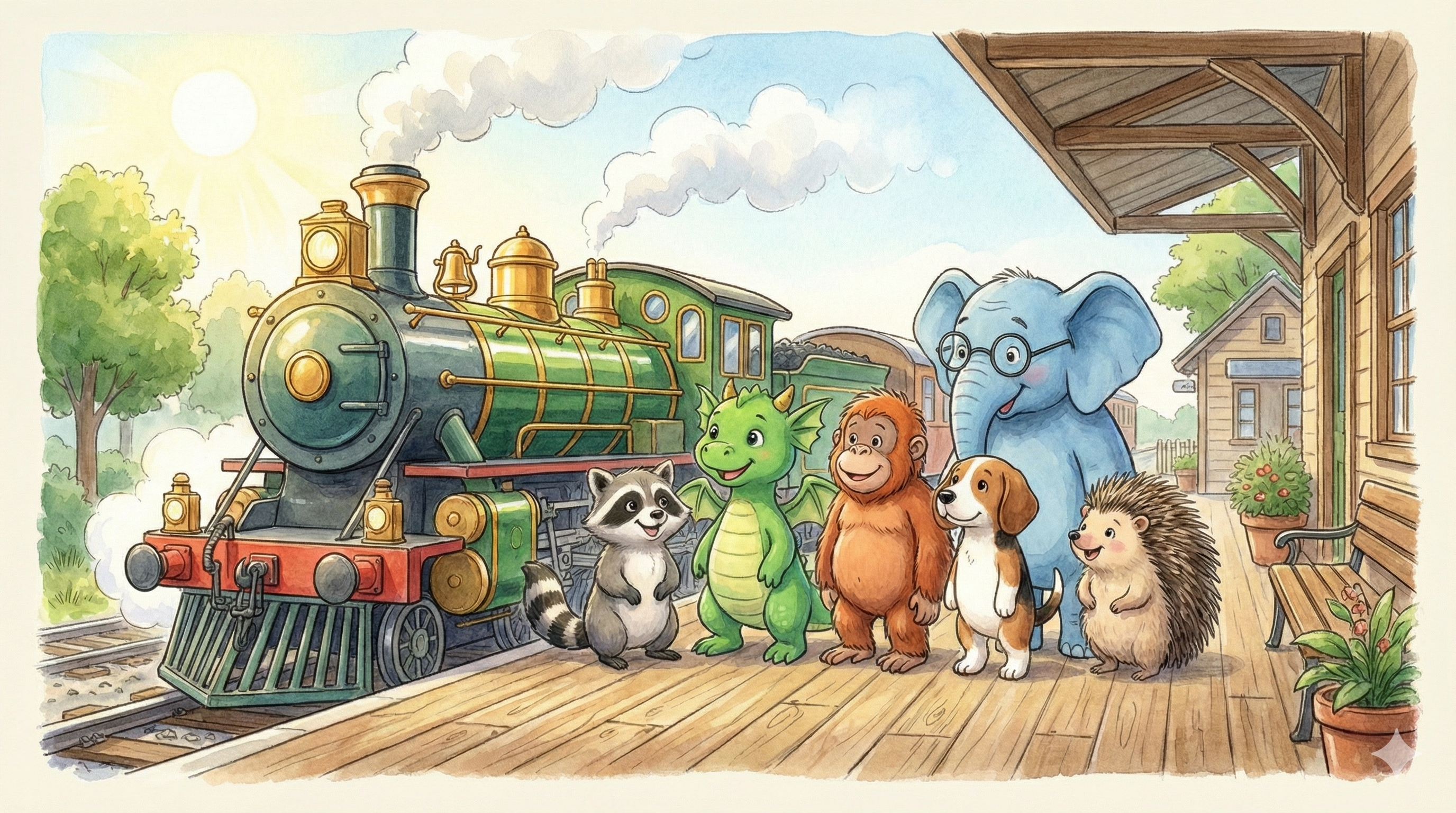
He’d heard about trains from Baxter, who sometimes told stories of the world beyond their home. But he’d never imagined one would come here. The locomotive was painted deep green with gold trim, and behind it stretched three passenger cars with windows that gleamed in the morning light.
Fennel started down the path from his home, Chirp riding on his shoulder, both of them eager to investigate.
By the time they reached the station, which was really just a small wooden platform with a peaked roof, a crowd had already gathered. Stickles the porcupine was there, his quills gleaming like pins in the sunlight, standing very still as he watched the train with quiet fascination. Baxter the raccoon had brought his walking stick and a small travel bag. O.T. the blue elephant stood to one side, his trunk raised slightly as he examined the train with obvious interest. Abe the orangutan had already climbed halfway up a platform post to get a better view.
“I’m an ape, not a monkey,” Abe was explaining to a confused squirrel. “We climb better.”
Stanley the beagle sat contentedly nearby, his round body relaxed in the morning sun.
“Fennel!” called Baxter, his ringed tail swishing as he waved. “Come see the notice board.”
Fennel hurried over, Chirp still perched between his ears. A large poster had been tacked to the wooden board beside the platform:
GRAND EXHIBITION Three Days Only The Big City Experience Wonders from Around the World! Special Return Fare: Journey There and Back
Below the main text, someone had written in careful letters: “Train departs this morning. Returns tomorrow evening.”
“The Big City,” Fennel read aloud, his green scales catching the light. “What’s that like, Baxter?”
The raccoon stroked his whiskers thoughtfully. “I visited once, many years ago. Tall buildings. Many, many animals all in one place. Museums and markets and monuments.”
“According to Herodotus,” O.T. announced, his blue ears perking forward, “the first great exhibitions were held in ancient Persia to showcase achievements from across the known world. The tradition continues—humans and animals gathering to share what they’ve learned and made.”
Stickles tilted his head, studying the poster with careful attention. “It says ‘wonders from around the world.’ I’d like to see how other places do things. How they solve problems we have here.”
“Not too far,” Baxter said gently. “A few hours by train. We’d arrive by afternoon, spend the evening seeing the sights, stay overnight, see more in the morning, and catch the evening train home tomorrow.”
“I’ve never been on a train,” Fennel said, staring at the locomotive. Steam puffed from its stack in friendly clouds.
“None of us have,” said Abe, dropping down from the post with all four hands. “That’s why we should go. How else do you learn what trains are like except by riding one?”
“Chirp chirp chirp!” Chirp agreed enthusiastically.
“I think we should go,” Fennel said. “All of us. Together.”
Stickles nodded slowly. “I’d like to see it. All those different ways of making and building and solving problems.”
O.T. nodded, his trunk curling with satisfaction. “The scriptures say there is a time for every purpose under heaven. A time to stay home and a time to venture out. This seems like a venturing time.”
“Then it’s settled!” Abe clapped two of his hands together. “Let’s find the conductor and buy our tickets.”
Into the World Beyond
The conductor was a dignified badger with silver-streaked fur and a blue uniform with shiny brass buttons. He stood beside the train’s steps with a clipboard and a patient expression.
“Tickets for six, please,” Baxter said. “Or rather, seven if you count Chirp.”
“Small birds ride free,” the badger said, checking his pocket watch. “That’ll be six tickets, return fare. Board whenever you’re ready. We depart in ten minutes.”
They climbed aboard, Abe going first to help Stickles up the steps, O.T. having to duck his head significantly to fit through the door, Fennel careful with his tail, Stanley hopping up with surprising agility for such a round beagle, and Baxter bringing up the rear with his walking stick and bag.
Inside, the passenger car smelled like wood polish and coal smoke and something else, anticipation, maybe. Rows of seats upholstered in deep red fabric ran along both sides, with windows that could slide open to let in the breeze. Gas lamps hung from the ceiling, unlit in the bright morning but ready for evening.
They chose seats near the middle. Fennel sat by the window with Chirp on his shoulder. Stickles took the seat beside him, already watching the platform through the window with careful attention. Baxter and O.T. shared a bench one row back, already deep in conversation about what they hoped to see at the Exhibition. Abe claimed a seat by himself so he could sketch things he saw along the way. Stanley settled comfortably across the aisle, his round body perfectly suited for train travel.
A whistle blew—sharp and clear like a cardinal’s call but louder, much louder.
“We’re moving!” Fennel gasped.
And they were. The train shuddered, then began to roll forward with a rhythmic chuff-chuff-chuff that seemed to say ad-ven-ture, ad-ven-ture, ad-ven-ture with each turn of its great wheels.
The Valley began to slide past the window. Fennel pressed his snout to the glass, watching the familiar landmarks drift by: the old stone bridge, the willow tree where they’d once had a picnic, the bend in the stream where the water ran fastest. He’d walked past these places a hundred times, but he’d never seen them like this—all at once, from above, moving past like memories.
“Chirp?” said Chirp, sounding uncertain.
“I know,” Fennel whispered. “It feels strange, doesn’t it? Leaving home.”
Beside him, Stickles was watching intently out the window. “Look how the willow branches move differently in the train’s wake,” he said quietly. “Everything looks different when you’re moving past it instead of walking through it.”
“It’ll be there when we get back,” Baxter said from behind them, his voice steady and warm. “Home doesn’t go anywhere just because we do.”
The train picked up speed, and soon the Valley was behind them. Now the tracks ran through open countryside Fennel had never seen. Rolling hills covered in grass that bent like waves in the wind. A farmer’s field where a horse looked up, startled by the train’s noise. A forest of oak trees, their branches reaching toward the sky like prayers.
Fennel’s nervousness began to melt into wonder. The world was so big. Bigger than the Valley. Bigger than Whispering Woods. Bigger than he’d imagined even in his most ambitious daydreams.
“Look!” O.T. called out, his trunk pointing through the window. “A river!”
The tracks ran alongside a wide river, its water sparkling in the sun. Boats with white sails drifted along, and birds Fennel didn’t recognize swooped and dove for fish. Chirp pressed against the window, watching the other birds with obvious interest.
“Different kind of sparrow,” Stanley observed, noticing what Chirp was looking at. “But still family, in a way.”
The hours passed in a pleasant blur of scenery and conversation. Abe sketched the mountains they saw in the distance. O.T. recited poetry from various traditions about travel and homecoming—verses from the Psalms, lines from a medieval Persian poet, a passage from an ancient Chinese philosopher. Baxter shared stories of his own travels when he was younger. Stickles watched everything, his eyes tracking birds they passed, the way light fell differently on eastern-facing slopes, the architecture of distant farmhouses.
Fennel found himself thinking about how God had made so many different places. The Valley was one thing, cozy and familiar and perfect for a small dragon. But these hills, this river, those distant mountains—God had made them too. Each one different. Each one beautiful in its own way.
“Baxter?” Fennel asked during a quiet moment. “Why did God make the world so big?”
The raccoon tilted his head, considering. “What do you think?”
Fennel watched the countryside roll past. “Maybe… so there would always be something new to discover? So we wouldn’t get bored?”
“Maybe,” Baxter agreed. “And maybe so we could see how creative He is. Every flower in the Valley is different if you look close enough. Every tree has its own shape. Now imagine that multiplied across the whole world—millions of valleys and rivers and mountains, each one showing something about who God is.”
“He must be very big,” Fennel said softly.
“And yet He knows every sparrow,” Baxter replied, glancing at Chirp. “Including that one.”
“Chirp chirp,” Chirp agreed, preening his feathers contentedly.
The Grand Exhibition
They arrived at the Big City in the early afternoon. The train pulled into a station that made their little wooden platform look like a toy. This station was enormous—a cathedral of iron and glass, with a vaulted ceiling that seemed to reach toward heaven itself. Steam from a dozen trains mingled with the afternoon light, creating ghostly pillars. The noise was overwhelming: whistles and bells and the rumble of luggage carts and the calls of conductors and the chatter of hundreds—no, thousands—of animals all moving in different directions.
“Stay together,” Baxter said firmly as they disembarked. “The city can be confusing if you’ve never seen it before.”
Stickles pressed close to Stanley, who kept a steady, reassuring presence. O.T.’s ears swiveled, taking in every sound. Abe climbed onto O.T.’s back with permission, using his height advantage to watch for the exit. Fennel kept his tail tucked close and his eyes wide.
They emerged from the station onto a street that made Fennel’s head spin. Buildings rose on either side, five and six stories tall, their windows reflecting the afternoon sun. Carriages rattled past on cobblestones. Signs hung everywhere: BAKER, BOOKSHOP, TAILOR, TELEGRAPH OFFICE. Animals of every description hurried by—mice and foxes and otters and deer and creatures Fennel couldn’t even name.
“The Exhibition is two streets over,” Baxter said, consulting a map he’d purchased. “Follow me.”
They walked through the city, and Fennel tried to take it all in. The shop windows full of things he’d never seen. The street vendors selling roasted chestnuts and hot cider. The sound of music drifting from somewhere—a violin, maybe, playing a sad, sweet melody.
The Grand Exhibition was held in an enormous building with columns at its entrance and flags from many nations snapping in the breeze above. Inside, it was even bigger than the train station. Hall after hall filled with wonders: inventions and art and natural specimens and cultural treasures from around the world.
They saw a working model of a water mill. Paintings of landscapes from countries whose names Fennel couldn’t pronounce. A telescope that could see the moons of distant planets. A collection of butterflies pinned under glass, their wings every color imaginable. A library containing books in twenty languages. A demonstration of electricity that made everyone gasp.
O.T. was in his element, his perfect memory absorbing everything. “The largest butterfly is the Queen Alexandra’s birdwing, native to Papua New Guinea. The water mill was perfected in Persia in the third century BC, though earlier versions existed in ancient China. That painting employs techniques developed by Dutch masters in the 1600s…”
Abe studied the mechanisms with intense focus. “These gears transfer rotational force while changing speed and torque. Brilliant engineering.”
Baxter paused longest at an exhibit of ancient manuscripts, his eyes soft with reverence as he looked at fragments of scripture copied by hand centuries ago.
And Stickles… Stickles moved slowly through it all, his quills gleaming as he stopped to examine things others rushed past. He noticed how the water mill’s grain chute was angled just so. He studied the joints in the telescope’s brass fittings. He looked carefully at the way light fell through the library’s windows onto the ancient books.
They explored for hours, taking in exhibit after exhibit. The scale of human achievement was staggering, so much skill, so much knowledge, so much creativity gathered in one place from across the world.
That evening, they found a small restaurant near their inn and shared a meal, everyone talking at once about what they’d seen.
“Did you notice the precision in those clock mechanisms?” Abe said.
“Fifteen different languages in the same hymnal,” Baxter marveled. “All praising the same God with different words.”
“The taxonomy exhibit showed species from six continents,” O.T. added. “According to Linnaeus’s system, revised by later naturalists—”
Stickles was quiet, pushing food around his plate, his brow furrowed.
“What are you thinking about?” Stanley asked gently.
“Something I saw,” Stickles said slowly. “Or… something everyone saw, but didn’t see. If that makes sense.”
“What was it?” Fennel asked.
“I need to go back,” Stickles said. “Tomorrow morning, before we leave. I need to look at something again.”
What Stickles Saw
The next morning, after breakfast, Stickles led them back to the Exhibition hall. He moved with purpose now, navigating through the corridors until he reached the main entrance. There, he stopped.
“Look,” he said quietly, pointing downward.
They all looked. Set into the floor just inside the entrance was a round stone medallion, dark granite, worn smooth and slightly polished by thousands upon thousands of passing feet. Most visitors walked right over it without glancing down, their eyes drawn to the grand exhibits ahead. But etched into its surface were words:
To the Greater Glory of God All Skill From the Divine Hand All Beauty From the Eternal Source May These Works Point Beyond Themselves
The group stood silent, reading and rereading the inscription.
“I walked over this yesterday,” Fennel said softly. “Multiple times. I never looked down.”
“None of us did,” Baxter admitted.
“But it changes everything,” Stickles said, his voice gaining strength. “Look around. What did we see yesterday?”
“Human achievement,” Abe said slowly. “Impressive engineering. Remarkable art.”
“But look at what we were supposed to see,” Stickles continued. “Not human achievement ending in itself. Human achievement as gift. As stewardship. As response to God’s gifts.” He gestured back toward the exhibits they’d seen. “That water mill—yes, brilliant engineering. But who made the water that turns it? Who made minds that could understand how to redirect that water?”
“God did,” Chirp said—or rather, “Chirp chirp,” but everyone understood.
“And those paintings,” Stickles went on, warming to his theme. “Beautiful landscapes from around the world. But who made the landscapes? Who gave artists eyes to see beauty and hands to capture it?”
“The butterflies,” O.T. said, his trunk curling in realization. “We marveled at the collection. But who created butterflies in the first place? Who gave them those colors, those patterns, those designs that artists can only attempt to copy?”
“All of it,” Baxter said quietly. “Everything in this Exhibition. Every invention, every artwork, every discovery—they’re not ending points. They’re signposts. They’re humans and animals saying ‘look what God let us do with what God gave us.’”
Fennel felt something shifting in his chest. “So when we went home yesterday feeling amazed but also… I don’t know, somehow small? Like the Valley was small compared to all this?”
“We were seeing it wrong,” Stickles finished. “The Valley isn’t small. It’s particular. God gave us that particular place with particular gifts—the stream, the meadow, the woods, each other. And our job isn’t to wish we had the gifts of the Big City or Persia or Papua New Guinea. Our job is to steward what we were given. To take our particular gifts and our particular place and say ‘look what God let us do here.’”
The morning sun streamed through the Exhibition hall’s high windows, painting everything in gold. Around them, other visitors were starting to arrive, most walking right over the medallion without seeing it.
“God works in unexpected ways through the most unlikely means,” Stanley said softly. “We came to see grand spectacles. And the truth was carved in stone beneath our feet the whole time.”
“Waiting for someone slow enough to notice it,” Fennel added, looking at Stickles with new appreciation.
Stickles’ quills rustled—not with anxiety, but with quiet satisfaction. “I just… I look at things carefully. That’s how I’m made. God uses that.”
“He does,” Baxter agreed. “He uses O.T.’s memory and Abe’s understanding of how things work and all of our gifts. Different gifts, different places, all pointing back to the same Source.”
They stood there a while longer, letting the revelation settle into them. The Exhibition was still impressive. The achievements were still remarkable. But now they saw them rightly—not as proof of human greatness, but as evidence of God’s generosity. Not as accomplishments that made their Valley seem small, but as examples of what happens when any creature, in any place, with any gift, says “I’ll use what I’ve been given to reflect the One who gave it.”
“I’m ready to go home,” Fennel said finally. “Not because this isn’t amazing. But because I want to go steward what we’ve been given. I want to live in my home—the one the community built for me—and remember that even that is a gift. I want to see the Valley with new eyes.”
“Me too,” Stickles said. “I want to go back to my hollow and look at my pressed flowers and think about how God made those flowers and gave me eyes to notice them and hands to preserve them and friends who helped me understand what it all means.”
“We received something we didn’t come looking for,” Baxter said. “We came for spectacle. God gave us sight. That’s grace—always more than we knew to ask for.”
The Journey Home
They spent the rest of the morning walking through the Exhibition one more time, but now with different eyes. Every exhibit became a question: Who made the materials this was built from? Who gave this artist their vision? Who designed the natural laws that make this invention possible?
At midday, they returned to the inn for their bags and a final meal before heading to the station. The afternoon train would take them home.
As they ate, O.T. was uncharacteristically quiet. Finally, he spoke. “I’ve been thinking about what Stickles showed us. About that medallion. I remember thousands of facts about that Exhibition—dates, measurements, specifications. But I walked over the most important truth without seeing it. Knowledge without wisdom to interpret it… I’m grateful God gave me you all. Different eyes see different things.”
“And when we share what we see,” Baxter said gently, “we all see more truly.”
They finished their meal and made their way to the station. The afternoon train was waiting, its green-and-gold paint gleaming in the sunlight. They boarded, found their same seats, and settled in for the journey home.
As the train pulled away from the Big City, Fennel watched the tall buildings grow smaller. He didn’t feel sad to leave. He felt… complete. Like they’d received something they didn’t even know they’d come for.
“What did you learn?” O.T. asked the group as the countryside began to replace the city outside the windows.
“I learned,” Abe said thoughtfully, “that all my understanding of mechanisms and engineering—it’s not mine. It’s God’s gift through me. I can look at gears and see how they work because God made both the world’s laws and my mind to understand them.”
“I learned,” said Stickles slowly, “that paying attention matters. That moving slowly and noticing small things isn’t a limitation—it’s how I’m designed to serve. God uses careful observers just as much as He uses people with perfect memories or strong hands.”
“I learned,” Stanley offered, “that revelations often come from unlikely sources. We could have visited a hundred exhibitions and never learned what we learned because someone carved truth in stone and waited for someone to notice it.”
Baxter nodded. “I learned that knowledge and wisdom are both gifts, and we need both. Facts without meaning are just facts. But meaning comes from paying attention to what facts point toward.”
“And you, Fennel?” O.T. asked. “What did you learn?”
Fennel watched the river appear alongside the tracks again, running back toward home. “I learned that God made the world big and diverse on purpose—not so we’d be jealous of other places, but so we could see how creative He is. Every place is particular. Every place has particular gifts. The Big City has its gifts. Papua New Guinea has its gifts. Persia has its gifts. And the Valley… the Valley has its gifts too.”
“Chirp chirp chirp,” Chirp added emphatically.
“And,” Fennel continued, “I learned that going home isn’t about escaping or retreating. It’s about returning to your particular place to steward your particular gifts. I have a home now—a real home with walls and windows and a porch. And I want to go back to it and remember that even that is grace. Even that is God saying ‘here, I made this place for you. Now live in it faithfully.’”
“Better,” Stickles said with a small smile. “We went away to learn how to come home rightly.”
The afternoon unfolded gently as the train carried them back. O.T. recited passages he’d memorized, not just from the Exhibition labels, but from Proverbs and Psalms about wisdom and stewardship. Abe showed them his sketches, each one now annotated with questions about who made the materials, who gave the maker their skill. Baxter read aloud from the book he’d purchased, and the poems about homecoming resonated differently now.
When the mountains that ringed the Valley came into view, Fennel’s heart lifted. There—that peak that looked like a sleeping dragon. There—the pass where the stream began. There—the dark smudge of Whispering Woods.
“Home,” Stanley said softly, and everyone nodded.
The little wooden platform appeared around a bend in the tracks, exactly as they’d left it. The train slowed, its wheels squealing gently against the rails, and came to a stop with a final hisssss of steam.
They disembarked, thanking the conductor. Their feet found the familiar ground of home.
The evening light was perfect—the golden hour, when everything glowed. The meadow grass rippled in the breeze. The stream sang its eternal song. The willow tree’s branches swayed in welcome. Smoke rose from distant chimneys, other animals of the Valley preparing dinner and settling in for the evening.
And Fennel saw it all differently now. Not as small or limited or provincial. But as particular. As specifically given. As the place where God had said “this is yours to steward.”
“Well,” said Baxter, shouldering his bag and gripping his walking stick. “A successful journey. We went to see wonders and came home knowing we live among them.”
“All three parts are important,” O.T. agreed. “The going, the seeing, and the understanding.”
“Same time next year?” Abe asked with a grin, but everyone knew he was mostly joking. Once was enough for now. Maybe once would be enough forever. The world was big and full of wonders, yes. But so was home, when you understood what home was for.
They walked together up the path from the station, their shadows stretching long in the sunset. Stickles would go to his hollow under the pine tree—to his pressed flowers, each one a gift he’d been given eyes to notice and hands to preserve. Baxter to his den near the old stone bridge—to his books and tea and the wisdom he shared so generously. O.T. to his place—wherever that was—with his perfect memory full of facts that pointed toward truth. Abe to his workshop in the oak grove—to his tools and projects, all expressions of the skill God had given him. Stanley to his cozy burrow on the hillside—to his patient presence that helped others feel heard.
And Fennel would return to his home. The one with eastern windows and a deep porch. The one the community had built for him with love. The one where Chirp had his own miniature house in the corner.
“Thank you for going with me,” Fennel said before they parted ways.
“Thank you for suggesting it,” Baxter replied. “We all needed to see what Stickles helped us see.”
“I just noticed something small,” Stickles said modestly.
“The smallest things often matter most,” Stanley observed. “God works that way.”
They said their goodnights, and Fennel walked the last path up to his home, Chirp on his shoulder, the evening cool but not cold, the familiar stones beneath his feet. He could see his house on the hillside, solid and welcoming, smoke from his chimney curling into the darkening sky.
He reached his porch and stood there for a moment, looking down at the Valley spread out below. The first stars were appearing. Chirp flew to the doorway of his miniature house, settling in with a contented chirp.
“Lord,” Fennel prayed quietly, “thank you for the journey. Thank you for showing us through the smallest means—a medallion, a careful observer—that all gifts come from you. Thank you for making the world big and diverse to show us your creativity. But thank you also for giving me this particular place. This home. This Valley. These specific gifts to steward. Help me to be faithful with what you’ve given me. Help me to remember that my job isn’t to wish for someone else’s gifts or someone else’s place. My job is to say ‘look what God let me do here.’ Amen.”
A peace settled over him, the kind that feels like warm sunlight or a gentle hand or coming home after a long journey. The Valley was still the Valley. His home was still his home. Nothing had changed while he was gone.
And yet everything had changed, because now he understood.
This wasn’t just where he lived.
This was where he was called to serve.
“Chirp?” Chirp murmured sleepily from his little house.
“I know,” Fennel said, stepping inside his home and closing the door. “Home. We’re home. Exactly where we’re supposed to be.”
And under the watching stars, with the stream singing its song and the wind whispering through Whispering Woods, Fennel the dragon settled into his home—the home built by love, the home in his particular place, the home where he would steward the particular gifts God had given him.
Exactly where he was meant to be.