
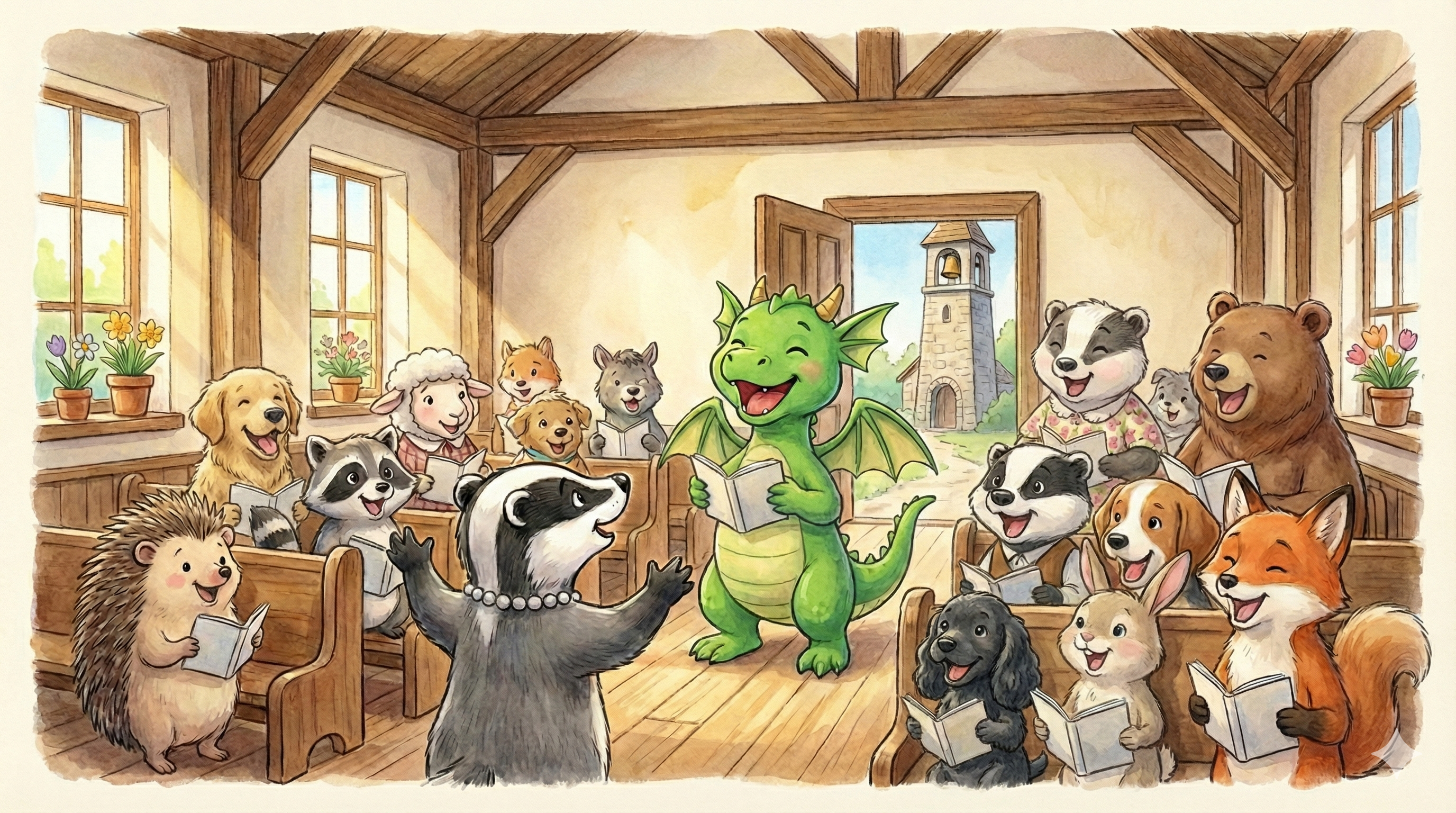
First Day of Choir
The first warm day of spring had arrived after a long winter, melting the last patches of snow and coaxing green shoots from the earth. Fennel the dragon stood on his porch watching the sun rise over the awakening Valley, his wings spread slightly to catch the warmth. Chirp the sparrow was flitting between branches, excited by the returning birdsongs.
In the quiet morning, Fennel heard something unexpected: singing.
It was faint, coming from the direction of the village, but unmistakable. Multiple voices, harmonizing, rising through the fresh spring air. He spread his wings and flew toward the sound, curious.
The village meeting house stood at the center of town, smoke rising from its chimney. Through the windows, Fennel could see animals and people gathered inside. He landed gently and approached the door.
“Fennel!” Mrs. Winters spotted him and waved him in. “Perfect timing! We’re just starting choir practice.”
“Choir practice?” Fennel asked, ducking carefully through the doorway.
“For the Easter service,” she explained. “We’re learning new hymns. Would you like to join us?”
Fennel looked around at the gathered singers”maybe twenty animals and people of various species, all holding sheets of paper with words written on them. He recognized many faces from The Illustrated Word sessions: Harry the fox with his family, Mrs. Thompson leaning on her cane but smiling, Mr. Davis the badger looking more peaceful than Fennel had seen him in months.
And there, standing quietly in the back corner, was Cedar the fox.
“I… I don’t know if I can sing,” Fennel admitted.
“Everyone can sing,” said a cheerful badger Fennel hadn’t met before. “I’m Melody”I lead the choir. And the secret is, it’s not about having a perfect voice. It’s about joining your voice with others to make something beautiful together.”
She turned to the group. “Let’s start with ‘Christ the Lord Is Risen Today.’ From the top!”
Melody hummed a starting note, and the choir began to sing.
Fennel listened, amazed. Individual voices—some strong, some wavering, some perfectly in tune and some not quite—all blended together into something that was indeed beautiful. Mrs. Thompson’ thin, elderly voice wove together with Harry’s uncertain baritone. Mr. Davis sang with his eyes closed, his grief transforming into something like worship.
And Cedar…
Cedar’s voice rose pure and clear above the others. Not dominating—supporting. Finding harmonies that no one else could reach. His quiet speaking voice had given no hint of this gift.
When the song ended, Melody beamed. “Beautiful! Cedar, that descant on the final verse was perfect. Could you teach it to the sopranos?”
Cedar nodded, his usual quiet self, but there was a light in his eyes that Fennel had never seen before.
They practiced for an hour. Fennel tried to join in, his dragon voice deeper than most. By the end, he was singing too—not well, perhaps, but joyfully.
As they were leaving, Fennel walked alongside Cedar.
“I didn’t know you could sing like that,” he said.
Cedar shrugged, a small smile on his face. “Most things I’m quiet about. But singing… singing is different. When I’m singing to God, the words come easy. It’s like my voice knows what my mouth can’t say.”
“It’s beautiful,” Fennel said. “Really beautiful.”
“Thank you.” Cedar paused. “You know, your voice fits well in the bass section. You should keep coming to practice.”
The Silent Bells
Over the next three weeks, Fennel attended every choir practice. He brought Chirp, who added his small sparrow voice to the sopranos. Stickles the porcupine came once, curious, but decided he preferred to listen rather than sing—his gift was in observing, not performing, and that was fine.
But one thing troubled the choir: the church bells.
The meeting house had a bell tower, but the bells hadn’t rung in years. No one quite knew why”they’d simply stopped working, and no one had known how to fix them.
“It seems wrong,” Mrs. Thompson said one evening after practice. “Spring has come, new life everywhere, and we’re preparing to celebrate the Resurrection. But the bells that should ring out over the valley are silent. It’s like… like the valley itself can’t proclaim the good news.”
“Bells can’t sing,” Harry pointed out.
“Can’t they?” Melody asked. “The Psalms say ‘Let everything that has breath praise the Lord.’ But they also talk about trumpets and harps and cymbals. Things that don’t breathe but still make joyful noise. The bells were made to praise God too”to call people to worship, to mark holy days, to remind the valley that God is here.”
Fennel thought about this. “Has anyone tried to fix them?”
“No one knows how,” Mrs. Winters admitted. “We’d need someone who understands how bells and towers work. Someone with the knowledge and the skill.”
Fennel’s scales prickled with recognition. “I know exactly who we need.”
Fixing What Was Broken
The next day, Fennel flew to find O.T. and Abe. He found them both at The Illustrated Word workshop, reviewing plans for a new set of teaching panels.
“I need your help,” Fennel said. “The village church bells are broken. Have been for years. Can you fix them?”
O.T. the blue elephant and Abe the orangutan exchanged glances.
“According to campanology”the study of bells”there are multiple reasons bells might fail,” O.T. said, his trunk curling thoughtfully. “The clapper could be broken, the wheel mechanism could be jammed, the mounting could be loose, the rope could be frayed…”
“So you know about bells?” Fennel asked hopefully.
“I know the theory,” O.T. said. “I’ve never actually worked on one.”
“But I have,” Abe said, grinning. “Well, not a church bell specifically. But bells are just machines”levers, pulleys, pivots. If O.T. can tell me how they’re supposed to work, I can make them work. And I can reach places most mechanics can’t.—
“When can we start?” Fennel asked.
“Right now,” Abe said, already gathering tools.
The Bells Ring Again
The bell tower was accessed by a narrow ladder inside the meeting house. Abe climbed easily, making quick work of it. Fennel flew up through the outside opening, careful not to knock anything with his wings in the confined space. O.T. stayed below, ready to consult when needed.
At the top, they found three bells—small, medium, and large”all mounted on wooden wheels with ropes hanging down through holes in the floor.
“Fascinating,” Abe said, examining the mechanism. “Each bell is mounted on a wheel that rotates. When you pull the rope, the wheel turns, swinging the bell. The clapper inside strikes the bell as it swings.”
He tested each wheel. None of them budged.
“They’re stuck,” he called down to O.T. “What would cause that?”
O.T.’s voice echoed up from below. “Check the pivots”the points where the wheels rotate. They likely need lubrication. Also check for debris in the mechanism. Birds sometimes nest in bell towers.”
Abe investigated while Fennel held a lantern to provide light. Sure enough, years of accumulated dust, bird nests, and general neglect had gummed up the works. The pivots were bone-dry and rusty.
“This is going to take some work,” Abe said. “We’ll need to clean everything, oil the pivots, check the structural integrity of the mounts, replace the ropes…”
“How long?” Fennel asked.
“If we work together? Maybe a week. If we do it right.”
They worked methodically. Abe climbed and cleaned and repaired, his strength and dexterity making him invaluable in the confined space. Fennel assisted where his dragon strength was needed—holding heavy bells steady while Abe worked on the wheels, breathing gentle fire to warm metal that needed to be shaped, using his ice breath to rapidly cool newly forged parts.
O.T. visited daily, consulting his vast knowledge of historical bell-making and mechanics. “According to a treatise from the 14th century,” he’d say, or “Medieval bell-founders discovered that…” His knowledge guided their work.
Word spread through the village that the bells were being repaired. People stopped by to watch, to offer encouragement, to bring food and hot drinks for the workers.
Cedar came one afternoon, watching silently for a while. Then he said quietly, “The bells will ring for the Easter service, won’t they?”
“That’s the plan,” Abe said, wiping grease from his hands.
Cedar smiled—rare and genuine. “Good. The singing needs bells. We need all the voices we can get.”
Easter Morning
Five days before Easter, Abe declared the work complete.
“Everything’s cleaned, oiled, and properly mounted,” he announced. “The ropes are new and strong. The clappers move freely. They should ring.”
“Should?” Fennel asked nervously.
“Won’t know until we try,” Abe said with a grin.
They’d gathered a crowd in the meeting house—Baxter, Stanley, Stickles, Mrs. Winters, Melody, and many others. The choir was there too, including Cedar.
“The moment of truth,” Abe said. He climbed down to the floor where the ropes hung. “Let’s start with the small bell.”
He pulled the rope.
For a moment, nothing. Then—
DING!
Clear and bright, the small bell rang out. The sound echoed through the tower and out over the valley.
People cheered. Abe pulled again, establishing a rhythm. Ding, ding, ding!
“Now the medium bell!” O.T. called up.
Stanley grabbed that rope and pulled. The medium bell swung and struck.
DONG!
Deeper than the small bell, it harmonized beautifully.
“And the large!” Baxter took the thick rope for the largest bell and pulled with all his weight.
BOOONG!
The deep, resonant tone rolled out over the valley like thunder. Like an announcement. Like a declaration.
Together, the three bells began to ring—high, middle, low, all finding their rhythm, all joining their voices in a song without words.
Fennel stood in the meeting house, listening to the sound wash over him. It was joyful. It was triumphant. It was worship.
“They’re singing,” Cedar said softly beside him. “The bells are singing.”
And then, without anyone conducting or directing, the choir began to sing too. Starting with Cedar’s clear voice, then joined by Mrs. Thompson, then Harry, then all of them, singing “Christ the Lord Is Risen Today” while the bells rang above them.
Fennel joined in, his deep dragon voice adding to the harmony. Chirp sang from his shoulder. Even Stickles, who didn’t usually sing, hummed along quietly.
The bells rang. The voices sang. And together—metal and flesh, mechanical and organic, high and low and everything between—they made a joyful noise to the Lord.
After the Service
The Easter service was three days later.
The morning dawned bright and clear, the kind of spring day that makes everything feel possible. The meeting house was packed”every bench filled, people standing along the walls, children sitting on the floor in front. And there were faces Fennel hadn’t seen all winter.
A large bear stood near the back, blinking sleepily but smiling. “First time out of the den since autumn,” she said to Fennel. “Heard the bells ringing this morning and knew”winter’s over. Time to worship. I’m Burleigh, by the way.”
“Fennel,” he said, nodding respectfully to the bear.
A groundhog family had come, the mother yawning but determined. “We heard the bells even underground,” she explained. “Woke us from our sleep. We couldn’t miss Easter. Not when the bells are calling.”
Several chipmunks had emerged, their fur still thick from winter, chattering excitedly about the music they’d heard echoing through the earth.
Fennel realized with wonder: the bells hadn’t just called the valley to worship. They’d literally awakened those who’d been sleeping through the dark months. The sound of resurrection had roused those who were dormant, calling them to witness new life.
The service began with the bells—all three ringing together, calling the valley to celebrate. Then the choir processed in, singing.
Cedar’s voice soared above the others, finding harmonies that made the simple hymn into something transcendent. But he wasn’t performing—he was worshiping. His gift wasn’t about being heard, but about helping others hear.
Baxter preached about the resurrection—Christ conquering death, rising to new life, making all things new. “He didn’t stay in the tomb,” Baxter said. “Death couldn’t hold Him. And because He lives, we live too. Winter doesn’t last forever. Sleep gives way to waking. Death gives way to life.”
Then came the part Fennel had been both dreading and anticipating: congregational singing.
Melody stood. “We’ve prepared something special. The choir will lead, but everyone is invited to sing. Don’t worry about having a perfect voice. Just raise whatever voice God gave you and join the song.”
The choir began “Crown Him with Many Crowns.” And one by one, the congregation joined in.
Mrs. Thompson’ thin, wavering voice. Mr. Davis’ grief-roughened baritone. Harry’s uncertain tenor. Children’s high, enthusiastic voices. Burleigh’s deep, rumbling bass, still hoarse from months of sleep. The groundhog family’s eager harmonies. Animals and people, young and old, skilled and unskilled, newly awakened and long awake—all singing together.
Fennel sang too. His deep dragon voice reinforcing the lower harmonies. Chirp sang. Stickles surprised everyone by joining in on the chorus. Stanley’s warm tenor rang out clearly.
And through it all, the bells rang.
When they reached the final verse—“Crown Him the Lord of life, who triumphed o’er the gravesomething happened that Fennel would remember forever.
The singing and the ringing synchronized perfectly. Every voice, every bell, every breath and strike and note aligned in one moment of perfect harmony. It wasn’t planned. It wasn’t rehearsed. It was simply… grace.
The sound filled the meeting house and spilled out through the windows and doors, rolling across the spring-green valley. And for that moment, heaven and earth seemed to touch.
When the song ended, there was silence. Complete, profound silence.
Then Baxter’s voice, gentle but full: “That was worship. That was praise. Not because we sang perfectly, but because we sang together. Because we offered what we had”voices rough and smooth, bells long silent now restored, gifts different but all given back to the One who gave them.”
He looked around at the congregation. “Some of you can sing beautifully. Some of you can barely carry a tune. Some of you fixed bells. Some of you showed up faithfully to practice. Some of you just opened your mouths and tried. But together”together we made something that none of us could make alone. That’s the body of Christ. That’s the church.”
After the service, Fennel found Cedar standing outside, looking up at the bell tower.
“Thank you,” Cedar said quietly.
“For what?” Fennel asked.
“For getting the bells fixed. For bringing Abe and O.T. It felt… it felt incomplete before. Like we were singing but the valley itself was silent. Now the whole valley can sing.”
Fennel understood. “Your voice is a gift,” he said. “The way you sing”it’s not just beautiful. It helps everyone else sing better. It lifts the whole choir.”
Cedar looked embarrassed. “I just… when I’m singing, I’m not thinking about words or what to say. I’m just offering what I have to Him. And that’s easier for me than talking.”
“God made you that way on purpose,” Fennel said. “Quiet most of the time, but with a voice that comes alive in worship. That’s not a contradiction. That’s design.”
Cedar nodded slowly. “I used to think being quiet was a problem. That I should force myself to talk more. But maybe… maybe God wants some of us to save our words for the moments that matter most. For worship. For truth. For beauty.”
“Maybe,” Fennel agreed.
They stood together in the warm spring air, listening to the bells ring out the evening hour. Inside, people were singing again—spontaneous, joyful, not performing but celebrating.
“You know what I love about the bells?” Cedar said. “They can’t choose whether to ring or not. Someone has to ring them. But when they’re rung”when they’re used for what they were made for”they sing perfectly. Every time. No wrong notes. Just pure, clear sound.”
“We’re not like that,” Fennel observed. “We can choose whether to sing or not. We can sing well or poorly. We can worship or stay silent.”
“Yes,” Cedar said. “But that makes it mean more, doesn’t it? When we choose to raise our voices even though we’re not perfect. When we choose to add our small sound to the larger song. The bells ring because someone pulls the ropes. But we sing because we want to. Because we love Him. Because we can’t help but respond to what He’s done.”
Fennel thought about this—about all the different voices in the valley. And about Mrs. Thompson, who’d spent seventy-three years not knowing Jesus and now sang with tears running down her face. And Mr. Davis, who sang through his grief. And Harry, who sang even though he was still scared about money. And Burleigh, just emerged from winter’s sleep, singing with a voice still hoarse but full of joy.
Each one different. Each one bringing their own voice. All of them responding to the same truth: Christ is risen.
“The Lord provides the voices that sing and ring to His glory,” Fennel said softly, the words coming almost like a prayer.
“He does,” Cedar agreed. “And He made them all different on purpose. High and low. Loud and quiet. Skilled and learning. Metal and flesh. All of them needed. All of them beautiful when they’re singing about Jesus.”
From inside the meeting house, the congregation launched into “Up from the Grave He Arose.” Imperfect, enthusiastic, utterly joyful.
And above it all, the bells rang.
Fennel spread his wings—not to fly, but to feel the warm breeze, to sense the vibrations of the music, to be present in this moment when everything in the valley seemed to be singing.
“Come on,” he said to Cedar. “Let’s go add our voices.”
They went back inside, into the warmth and the light and the music. Cedar’s clear voice found the harmony. Fennel’s deep voice found the melody. And together with all the others—all the different voices, all the unique gifts, all the imperfect, willing, grateful hearts—they sang.
They sang of Christ who died and rose again. They sang of the empty tomb. They sang of death defeated and life eternal.
And the bells rang, and the voices sang, and heaven and earth joined together in worship of the risen Lord.
The End
“Let everything that has breath praise the Lord! Praise the Lord!” - Psalm 150:6
“Make a joyful noise to the Lord, all the earth! Serve the Lord with gladness! Come into his presence with singing!” - Psalm 100:1-2