
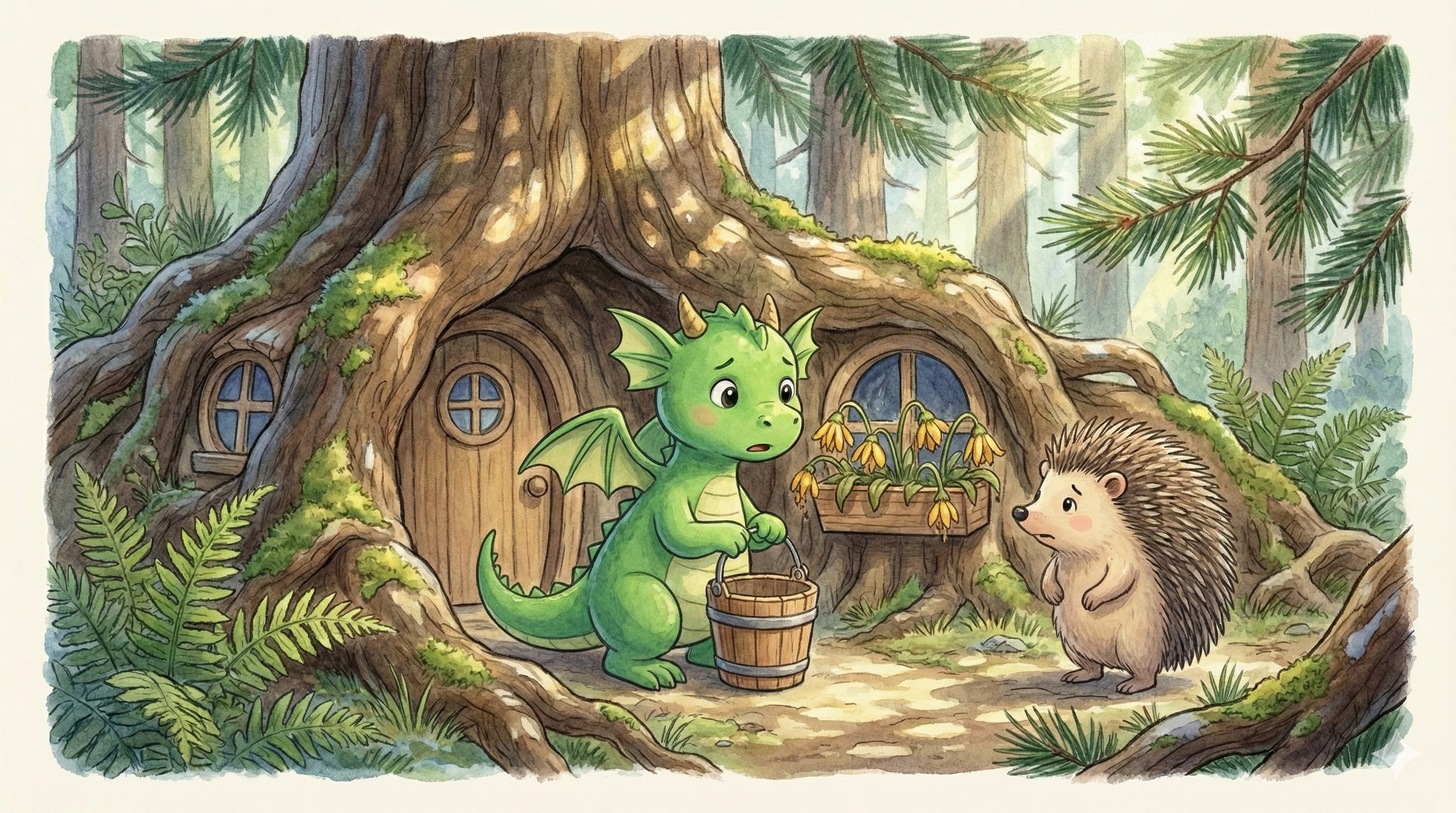
Stickles’s Struggling Flowers
Fennel the dragon noticed it on a Tuesday morning.
He’d come to visit Stickles the porcupine in his cozy hollow beneath the roots of the old pine tree in Whispering Woods, bringing fresh berries he’d picked by the stream. Chirp the sparrow rode on his shoulder, singing a cheerful song about sunshine and friendship. But when Stickles opened his door, Fennel saw something that made his heart sink.
The flowers in the window boxes looked sad.
Not dead, exactly. But wilting. The bright yellow petals drooped toward the soil. The leaves curled at their edges. Even the violets in the clay pot by the door seemed to be giving up, their purple blooms faded and tired.
“Good morning!” Stickles said, his quills gleaming in the dappled sunlight. He took the berries with obvious appreciation. “Oh, these look wonderful. Thank you, Fennel.”
“You’re welcome,” Fennel said, but his eyes kept drifting to the flowers. “Stickles… are your plants feeling all right?”
The porcupine glanced at the window boxes and sighed. “I know. They’ve been struggling lately. I think it might be the weather—we haven’t had much rain. Or maybe the soil is wrong? I’ve tried talking to them, but plants don’t answer the way friends do.”
He smiled, trying to make light of it, but Fennel could see the worry in his eyes. Stickles loved his flowers. His whole hollow was decorated with pressed blooms from previous seasons, each one carefully preserved and mounted on the walls like treasured memories.
“I’m sure they’ll perk up soon,” Stickles said, inviting Fennel inside for tea.
But Fennel couldn’t stop thinking about those drooping petals.
A Well-Meaning Mistake
That afternoon, after leaving Stickles’ hollow, Fennel stood by the stream with Chirp and considered the problem. The flowers were thirsty. That seemed obvious. They needed water. And Fennel knew where to find plenty of water.
“We should help,” Fennel said decisively. “Stickles is our friend, and his flowers are suffering. God made us to help each other, right?”
“Chirp chirp,” Chirp agreed, though there might have been a note of uncertainty in his voice.
Fennel found an old bucket near the miller’s shed (left there for carrying water to the vegetable garden). It took some effort for a young dragon to carry a full bucket without spilling, but Fennel was determined. He filled it at the stream and carefully made his way back through Whispering Woods, water sloshing against the sides.
Stickles wasn’t home (he’d mentioned visiting Baxter that afternoon to borrow a book). Perfect. Fennel could water the flowers as a surprise. Stickles would come home to happy, healthy plants, and he’d be so grateful.
Fennel poured water into the window boxes, watching it soak into the dry soil. The earth drank it eagerly. Good. The plants must have been very thirsty indeed. He poured more into the violets’ pot, filling it until water pooled on top of the soil.
“There,” Fennel said with satisfaction, setting down the empty bucket. “That should help.”
“Chirp?” Chirp said, sounding uncertain.
“What’s wrong?”
The sparrow hopped from Fennel’s head to the window box and pecked at the soggy soil, then looked up at Fennel with what might have been concern.
“They needed water,” Fennel explained. “Look how dry they were. Plants need water to grow. Everyone knows that.”
Chirp tilted his head but didn’t argue. They left the bucket beside the door (Fennel thought Stickles might want to water the flowers again later) and headed home as the sun began to set.
Making It Worse
The next morning, Fennel returned to check on the flowers.
They looked worse.
The yellow blooms hadn’t perked up; if anything, they drooped even more. The violets’ leaves had turned an alarming shade of pale green, almost yellow at the tips. Even the stems seemed to sag.
Fennel’s stomach twisted with confusion. How could they look worse? He’d given them water. Plants needed water. What had gone wrong?
Maybe… maybe they needed more water? Maybe one bucketful hadn’t been enough?
He filled the bucket again at the stream and returned to Stickles’ hollow. The porcupine still wasn’t home (he’d mentioned something about helping Baxter organize his library this week). Fennel poured another bucket of water into the window boxes and the violet pot.
The soil was already damp from yesterday, but surely the plants would know how much to drink. They’d take what they needed and leave the rest, wouldn’t they? That’s how it worked.
“Chirp chirp chirp!” Chirp said, more insistently this time.
“What?” Fennel asked, a bit defensive now. “I’m trying to help.”
But as he walked away, his tail dragging slightly in his confusion, Fennel felt a small seed of doubt take root in his mind. What if he was missing something? What if helping wasn’t as simple as just doing the obvious thing?
Facing the Damage
By the third day, the flowers looked truly terrible.
The yellow blooms had fallen off entirely, leaving just stems and withering leaves. The violets’ pot smelled sour—a damp, unpleasant odor that made Fennel’s nostrils wrinkle. Some of the leaves had turned completely yellow and fallen off.
Worse, Stickles was home this time.
Fennel arrived with his bucket of water, having decided that consistent watering must be the key, that he just needed to keep at it until the plants recovered,and found the porcupine sitting on his doorstep, staring at the ruined window boxes with obvious distress.
“Oh, Fennel,” Stickles said when he saw the dragon approaching. His voice was thick with sadness. “I don’t know what happened. The flowers just got worse and worse. I think they might be dying.”
Fennel’s scales felt cold despite the warm morning sun. “I… I brought more water?”
“Water?” Stickles looked at the bucket, then at the window boxes, then at Fennel. “Have you been watering them?”
“I wanted to help,” Fennel said in a small voice. “You said they were struggling, and I thought… they looked so thirsty, and plants need water, and I wanted to surprise you by making them better…”
Stickles’ quills rustled as he stood up and examined the soil in the window boxes. He pressed his paw into the earth, and water immediately squelched up around it. The soil was completely saturated—muddy, almost.
“Oh, Fennel,” Stickles said again, but this time there was no sadness in his voice. Just… weariness. Maybe disappointment. “You drowned them.”
“What?”
“Too much water. The roots can’t breathe when the soil is this wet. They’ve been sitting in mud for three days.” He touched one of the fallen yellow petals. “They’re dying because of too much water, not too little.”
Fennel felt like he’d been hit in the chest. The bucket slipped from his claws and clattered against the stone step. “But… but I was trying to help. I thought—”
“I know what you thought,” Stickles said, and now there was definitely an edge to his usually gentle voice. “You thought you knew what they needed without asking anyone. You thought you could fix my problem without actually understanding the problem. And now my flowers—the ones I’ve been growing for two years, the ones I talk to every morning—are probably going to die.”
“I’m sorry!” Fennel’s voice cracked. “I didn’t mean to—I was just trying to—”
“I know you didn’t mean to,” Stickles said, his quills standing up more than usual. “But that doesn’t unwater my flowers, does it? Meaning well doesn’t fix damage done.”
Chirp huddled against Fennel’s neck, silent for once.
Fennel wanted to say more—to explain, to apologize better, to somehow make it right. But the words stuck in his throat. He’d made everything worse. He’d hurt his friend while trying to help him. And now Stickles was angry, and the flowers were dying, and it was all Fennel’s fault.
“I should go,” Fennel whispered.
Stickles didn’t argue.
What Stanley Knew
Fennel spent the rest of that day in his corner of the Valley, curled up in miserable silence. Chirp tried to comfort him with soft chirps and by pressing against his scales, but nothing helped. The weight in Fennel’s chest grew heavier with each passing hour.
He’d ruined everything. He’d hurt Stickles. He’d killed the flowers. And he’d done it all while trying to be helpful.
What kind of friend was he?
As the sun began to set, Fennel heard someone approaching. He looked up and saw Stanley padding toward him, the beagle’s round body and patient eyes exactly the kind of presence Fennel both wanted and didn’t deserve.
“Can I sit with you?” Stanley asked.
Fennel nodded miserably.
Stanley settled down beside him, not touching but close enough that Fennel could feel his warmth. For a long moment, the beagle said nothing. He just sat there, breathing steadily, watching the sunset paint the Valley in shades of amber and rose.
Finally, Fennel spoke. “I ruined Stickles’ flowers.”
“I heard,” Stanley said quietly.
“I was trying to help.”
“I know.”
“I thought I knew what to do.”
“Did you?” Stanley asked, not accusingly, just curiously. “Or did you think you could figure it out on your own without asking for help?”
Fennel’s tail twitched. “I… I thought it was obvious. Plants need water. They were wilting. So I gave them water.”
“But you didn’t know if that was actually the problem,” Stanley observed. “You saw wilting and assumed it meant one thing. You didn’t ask Stickles. You didn’t ask Baxter, who knows about plants. You didn’t even stop to think that there might be other reasons for wilting besides thirst.”
“I wanted to help!” Fennel’s voice rose. “I wanted to be useful! I wanted to fix it!”
“I believe you,” Stanley said, his voice still gentle. “But wanting to help and actually helping aren’t always the same thing. Sometimes the most helpful thing is admitting you don’t know what to do and asking someone who does.”
Fennel slumped. “Now Stickles is angry at me. And the flowers are dying. And I can’t undo what I did.”
“No,” Stanley agreed. “You can’t. Some mistakes have consequences we can’t erase. That’s part of being a creature in God’s world—our actions matter. They have real effects.”
“That’s terrible,” Fennel whispered.
“It’s serious,” Stanley corrected. “But it’s not hopeless. You can’t undo the damage, but you can admit what you did wrong. You can learn from it. You can ask for forgiveness. And you can work to make things right where possible.”
“Stickles might not forgive me.”
“He might not,” Stanley said honestly. “Forgiveness is a choice he gets to make, not something you can demand. But you can still apologize properly—not just ‘I’m sorry’ but explaining what you did wrong and what you’ve learned. That’s repentance. That’s how we honor both the person we hurt and the God who calls us to love better.”
Fennel looked at Stanley, this round, patient beagle who had somehow become exactly the friend he needed. “How do you always know what to say?”
Stanley smiled. “I don’t, always. But I know that God is patient with us when we fail, and He asks us to be patient with each other. I know that mistakes don’t mean you’re a bad friend—they mean you’re a friend who’s still learning. And I know that the Valley is full of people who love you, even when you mess up.”
“Even Stickles?”
“Especially Stickles,” Stanley said. “But give him time. He’s hurt right now. Those flowers meant something to him. Let him feel that hurt. Then, when he’s ready, apologize properly. And mean it.”
They sat together as the stars began to appear, and Fennel felt the terrible weight in his chest shift slightly. Not gone—he’d still ruined Stickles’ flowers, still hurt his friend, still acted foolishly. But maybe… maybe it wasn’t the end of everything. Maybe mistakes could be places to grow, not just places to fail.
“Thank you,” Fennel said quietly.
“That’s what friends do,” Stanley replied. “We sit with each other. Especially in the hard parts.”
Seeking Wisdom from Baxter
Two days later, Fennel gathered his courage and went to find Baxter.
The raccoon was sitting by the old stone bridge, reading a book in the morning light. His ringed tail swished gently as he turned a page. When he saw Fennel approaching, he set the book aside and waited patiently.
“I need help,” Fennel said without preamble. “I made a terrible mistake, and I need to understand what I did wrong so I can apologize properly and maybe… maybe fix some of it.”
Baxter’s eyes were kind. “Tell me what happened.”
Fennel explained everything: the wilting flowers, the buckets of water, the good intentions and terrible results. Baxter listened without interrupting, his expression thoughtful.
When Fennel finished, Baxter was quiet for a moment. Then he said, “Do you know why the flowers were wilting in the first place?”
“No,” Fennel admitted. “I just saw they looked thirsty.”
“Many things can make flowers wilt,” Baxter explained. “Too little water, yes. But also too much sun. Or not enough sun. Or poor soil. Or pests eating the roots. Or disease. Or even just the natural end of their blooming season. You saw one symptom and assumed one cause. That’s called jumping to conclusions.”
“I should have asked,” Fennel said miserably.
“Yes,” Baxter agreed. “But there’s more to it than that. You also acted without the knowledge to act wisely. Enthusiasm is good. Wanting to help is good. But wisdom—understanding how things actually work before you try to fix them—that’s necessary too. Otherwise, your help becomes harm, no matter how pure your intentions.”
“God must be disappointed in me,” Fennel said quietly.
Baxter tilted his head. “Why do you think that?”
“Because I failed. Because I hurt someone while trying to help. Because I was stupid and proud and—”
“Stop,” Baxter said gently but firmly. “God isn’t surprised by your failure. He knows you’re young and still learning. He knows you meant well. But He also wants you to learn from this—to grow in wisdom, not just good intentions. Do you know what Proverbs says about the simple who hate knowledge?”
Fennel shook his head.
“It says they’re fools. Not because they don’t know things yet, we all start not knowing, but because they refuse to learn. They keep acting without wisdom, over and over, never changing. That’s not you. You’re here, asking for help, trying to understand. That’s the opposite of foolishness. That’s the beginning of wisdom.”
Fennel’s tail lifted slightly. “So… what should I do?”
“First,” Baxter said, “apologize to Stickles. Not just ‘I’m sorry’ but really apologize: tell him what you did wrong, what you’ve learned, and that you understand why he’s hurt. Don’t make excuses. Don’t expect him to immediately forgive you. Just own what you did.”
“Okay,” Fennel said, though his stomach twisted at the thought.
“Second,” Baxter continued, “let’s see if we can help the flowers. I don’t know if we can save them all, but maybe some. We’ll need to repot them in fresh, dry soil. Let the roots breathe. Maybe add some nutrients. O.T. might remember some techniques—his grandmother was an excellent gardener.”
“Really?” Hope flickered in Fennel’s chest. “We might be able to fix some of it?”
“Some of it,” Baxter cautioned. “Not all. Some damage can’t be undone. But we can try. That’s part of repentance too—not just saying sorry, but working to make right what you made wrong, where possible.”
“Will you help me?” Fennel asked.
Baxter smiled. “Of course. That’s what we’re for: helping each other, especially when we’ve made mistakes. None of us gets through life without failing sometimes. The question is whether we learn and grow, or whether we just keep making the same mistakes.”
Making It Right Together
They gathered that afternoon at Stickles’ hollow: Baxter, O.T., Abe, Stanley, and Fennel. Chirp perched on Fennel’s head, offering silent support.
Stickles opened the door looking wary. When he saw the group, his quills rustled uncertainly.
“I owe you an apology,” Fennel said before anyone else could speak. “A real one. Not just ‘I’m sorry’ but… I was wrong. I saw your flowers wilting and I thought I knew how to fix them without asking you or anyone who actually understood plants. I acted on assumption instead of wisdom. I kept watering them even when it wasn’t helping because I wanted to be the one who fixed it. I valued being useful more than actually being useful. And I hurt you and killed your flowers because of my pride and foolishness. I’m sorry. I was wrong. And I understand if you’re still angry.”
The hollow was quiet. Stickles looked at Fennel for a long moment, his dark eyes unreadable.
“I am still angry,” Stickles said finally. “Those flowers… I grew them from seeds. I talked to them every morning. They were part of my home.” His voice caught. “But I also know you didn’t mean to hurt me. And I know you’re sorry. Really sorry, not just ‘got caught’ sorry.”
“I am,” Fennel whispered.
Stickles sighed. “I forgive you. Not because the flowers are okay, they’re not. Not because it doesn’t hurt, it does. But because you’re my friend, and friends forgive each other when they truly repent. That’s what God does for us, so that’s what I’m supposed to do too.”
Relief flooded through Fennel like rain after drought. “Thank you.”
“However,” O.T. interjected, his trunk gesturing toward the sad window boxes, “we might be able to salvage something. My grandmother had a technique for root-drowned plants. We need to repot them in fresh, aerated soil immediately. Abe brought clay pots with drainage holes—properly made ones.”
“I used all four hands,” Abe said, holding up the pots proudly. “Built them yesterday once I heard what we needed.”
“And I brought compost from my garden,” Baxter added. “Good soil with nutrients.”
“I can help dig,” Stanley offered. “And mostly just be here, which is my specialty.”
They worked together through the afternoon. It was delicate, careful work, removing the waterlogged plants from their boxes, gently untangling the roots (some of which were already rotting), repotting them in the fresh soil Baxter provided, placing them where they’d get proper sunlight. O.T. recited his grandmother’s instructions from memory with perfect accuracy. Abe’s pots proved ideal—well-made with good drainage. Stanley stayed near Stickles, offering quiet companionship as the porcupine watched his plants being tended.
And Fennel? Fennel did exactly what he was told. When Baxter said “hold this stem gently,” he held it gently. When O.T. said “add soil here,” he added soil there. When Abe said “pass me that pot,” he passed that pot. He didn’t try to take charge. He didn’t assume he knew better. He just helped where he was asked to help and stayed quiet otherwise.
Not all the plants survived. Three of the yellow flowers were too far gone, their roots completely rotted. But four others showed promise—with proper care, Baxter thought they might recover. The violets were touch and go, but O.T. was cautiously optimistic about two of them.
By evening, Stickles’ window boxes held new pots with salvaged plants, properly spaced and positioned. It wasn’t the same as before. The boxes looked sparse now, missing the full blooms they’d had. But it was something. A beginning. A chance.
“Thank you,” Stickles said to all of them, but especially to Fennel. “For not just apologizing but trying to make it right.”
“I can’t give back what I killed,” Fennel said quietly. “But I can help you start again. And I can do it right this time—by listening to people who know more than I do.”
Baxter placed a paw on Fennel’s shoulder. “That’s wisdom, young dragon. Real wisdom.”
What the Mistake Taught
That night, as Fennel prepared for sleep in his corner of the Valley, he thought about everything that had happened. The mistake. The damage. The apology. The forgiveness. The work to make things right.
“Lord,” he prayed, Chirp nestled against his neck, “thank you for patient friends who forgive. Thank you for showing me that good intentions aren’t enough—I need wisdom too. Thank you for not giving up on me when I fail. Help me to remember this lesson. Help me to ask for help instead of assuming I know. Help me to value doing things right more than being the hero who fixes things. And help Stickles’ flowers grow again. Amen.”
“Chirp,” Chirp whispered, which Fennel understood to mean amen, and also I love you.
Outside, the stars watched over the Valley. In Whispering Woods, in a hollow beneath a pine tree, a porcupine watered his newly potted plants with exactly the right amount of water—not too much, not too little—and whispered words of encouragement to roots that might yet recover.
Some damage couldn’t be undone. That was true.
But some mistakes could become the soil where wisdom grew. And some apologies, when genuine and backed by changed behavior, could heal what seemed broken beyond repair.
Not perfectly. Not immediately. But truly.
And that, Baxter would have said if anyone asked, was worth more than never making mistakes at all.
The Valley slept, and in his corner, Fennel dreamed of flowers blooming in proper soil with proper water and proper sun—not because he’d forced them to grow, but because he’d learned to let others show him how.