
Just Shelter
Fennel the dragon woke in his cave as the first light of dawn filtered through the entrance.
The cave wasn’t bad, as caves went. He’d chosen it carefully when he first arrived in the Valley: high enough on the hillside to avoid flooding, with an entrance angled so the wind didn’t blow straight in. He’d lined the floor with thick layers of pine straw that made a soft bed, and the rock walls held heat well when he breathed fire on them in the evening. It was dry, it was warm enough, it was safe.
It was shelter.
But as Fennel stretched and looked around at the bare rock walls, he felt the same restless feeling he’d been trying to ignore for weeks. Chirp was already awake, perched on a small outcropping near the entrance (the only perch available in a space made of solid stone). The little sparrow shifted his weight, and Fennel noticed (not for the first time) how awkward it was for a bird to live in a cave. No proper branches. No cozy nest. Just rock and more rock.
“Morning,” Fennel said quietly.
“Chirp,” Chirp replied, but there was something in his tone—not complaint exactly, but not contentment either.
Fennel looked around his cave again with fresh eyes. The rock formations made it impossible to have any furniture. No shelves, no cupboards, no place to set anything that wasn’t the uneven floor. No windows, just the entrance that let in light and air. No kitchen space, though dragons didn’t need much for cooking. But still. It was small. Functional. Bare.
He thought of Stickles the porcupine’s hollow, decorated with pressed flowers and drawings from friends. Of Baxter’s den with its bookshelves and comfortable corners and the smell of tea always brewing. Of the Miller family’s cottage with its windows facing the stream and its rooms full of life and laughter.
Everyone had somewhere that was more than just shelter.
Fennel had… a cave.
“I’m being ungrateful,” he said aloud. “This cave is perfectly good. It keeps us dry. It’s warm when I heat the rocks. We should be thankful.”
“Chirp chirp,” Chirp said, which somehow managed to sound both agreeable and unconvinced.
They made their way down to the stream for morning water. Smoke rose from Baxter’s den (the raccoon was probably making breakfast tea). In the distance, lamplight glowed in windows. The Valley was waking up, and everyone was waking up in a home, not just a shelter.
Fennel felt something he’d been pushing down for a long time: longing. Not for survival, he had that. Not for safety, the cave provided that. But for something more. For a place that was his in a deeper way. A place where Chirp could have a proper nest. Where he could have a view of the Valley. Where there was room for more than just sleeping and staying dry.
A place that felt like home, not just a place to survive.
A Friend Asks the Hard Question
“You live in a cave, don’t you?”
The question came that afternoon from Stanley, who had found Fennel sitting by the stream, watching water striders skate across the surface.
Fennel’s tail twitched. “It’s a good cave. Dry. The entrance is angled so wind doesn’t blow in. I heat the rocks with fire breath and it stays warm.”
“But it’s still just a cave,” Stanley observed gently, settling his round beagle body beside Fennel. “Shelter, but not a home.”
“What’s the difference?” Fennel asked, though something in his chest told him he already knew the answer.
Stanley was quiet for a moment, his patient eyes studying the stream. “A shelter keeps you alive. A home lets you live. Shelter is about survival. Home is about flourishing.”
Fennel looked down at his claws. “The cave works. It’s functional. I shouldn’t complain.”
“You’re not complaining,” Stanley said. “You’re feeling something true—that you deserve more than just functional. That Chirp deserves more than a rock ledge to perch on. That having walls and a roof isn’t the same as having a place that’s truly yours.”
“But building a whole house…” Fennel’s voice trailed off. “That’s so much to ask.”
“Have you asked?”
“No,” Fennel admitted. “It seemed like… too much. Everyone has their own homes to maintain. Why should they spend time building something for me when I already have shelter?”
Stanley tilted his head. “Because you’re part of this Valley. Because we’re a community. Because when one of us needs something, not just survival but what makes life good, the rest of us want to help provide it. That’s not charity, Fennel. That’s family.”
“But I don’t have anything to give back,” Fennel protested. “If someone builds me a home, what do I offer in return?”
“Yourself,” Stanley said simply. “Your presence. Your friendship. Your participation in this life we’re all sharing together. You don’t pay for love, Fennel. You receive it and then you pass it forward.”
Chirp landed on Fennel’s head and chirped emphatically, as if agreeing with every word Stanley said.
“I wouldn’t even know what kind of home to build,” Fennel said quietly. “Or where. Or how.”
Stanley stood up, his tail wagging slightly. “Then it’s a good thing you have friends who do know. Come on. We’re going to talk to Baxter.”
Gathering the Village
Baxter listened to Stanley’s explanation with his characteristic thoughtfulness, stroking his whiskers as he considered. They sat in his den, warm from the fire, smelling of herbs and old books, and Fennel felt grateful for the invitation even though his tail did take up considerable floor space.
“I’ve seen your cave,” Baxter said finally. “It’s a clever shelter. You chose well: good drainage, angled entrance, high enough to stay dry. But Stanley’s right. It’s a cave, not a home. You can’t have cupboards when the walls are uneven rock. You can’t have windows. No place for Chirp to properly nest. No kitchen. No view. And you’re too large for most existing structures, so you’d need something purpose-built anyway.”
He leaned forward, his ringed tail curling behind him. “Abe the orangutan builds things all the time. O.T. the blue elephant has extensive knowledge of architecture from various cultures. And between all of us, we have enough paws and hands and trunks to construct something suitable.”
“But where?” Fennel asked. “Everyone’s homes are already established. There’s not much space left in the good spots.”
“What about the clearing near Whispering Woods?” Baxter suggested. “The one with the flat stone outcropping? It’s elevated enough to avoid flooding, sheltered by the trees but open to the south for sun. And it’s not too far from the rest of us.”
Fennel knew the spot. He’d been there many times (it was beautiful, with a view of the whole Valley). “That’s… that’s a really good spot,” he said slowly. “But building a whole home? That seems like so much work.”
“It is work,” Baxter agreed. “Good work. The kind that brings a community together. The kind that means something.” He leaned forward, his ringed tail curling behind him. “Fennel, why do you think God brought you to this Valley?”
The question caught Fennel off guard. “I… I don’t know. I just ended up here.”
“Nothing just ends up anywhere,” Baxter said. “You’re here because this is where you belong. And part of belonging is letting others help you belong. You’ve spent a year living in that cave, not wanting to be a burden. But you know what? That’s actually preventing us from being the community God wants us to be. We’re supposed to care for each other. You’re supposed to let us.”
Fennel felt something tight in his chest begin to loosen. “You really want to do this?”
“I really want to do this,” Baxter confirmed. “And I think everyone else will too. Let’s find out.”
The Valley Comes Together
Word spread through the Valley faster than Fennel would have thought possible. By evening, animals were gathering at the clearing near Whispering Woods: not just to look, but to plan.
Abe climbed the stone outcropping, examining it from multiple angles. “Good foundation. Natural drainage. We can build into the rock face here, use it as the back wall. Save materials and provide thermal mass for winter heating.”
“According to architectural records from the Eastern Mountains,” O.T. announced, his trunk gesturing as he recalled, “dragon dwellings require high ceilings, twelve feet minimum, and wide doorways. Dragons need space to turn around without knocking things over with their tails. Also, good ventilation. Dragons run warmer than most mammals.”
“I can help with the stonework,” said Mrs. Miller. “Beavers know water and stone. I’ll make sure the foundation is solid.”
“I’ll do the carpentry,” Abe said. He grinned, holding up his hands. “Having four of these helps.”
“I visited your cave yesterday,” Stickles said quietly, his quills catching the evening light. “I hope you don’t mind, I was gathering moss nearby and… I noticed things.” He paused, choosing his words carefully. “The rock formations mean there’s nowhere flat to set anything. The moisture on the north wall, it’s slight, but it’ll get worse in winter. And Chirp…” He looked at the little sparrow. “Birds need proper nesting material, soft things, not just stone ledges. I kept thinking about how hard it must be to make a cave feel like home when caves aren’t meant for that.”
“I can gather moss for insulation,” Stickles continued. “And I know where the best clay is for chinking between stones: the kind that stays flexible in cold weather and doesn’t crack.”
“I’ll coordinate,” Baxter said. “Make sure we have all the materials and that work progresses in the right order.”
Stanley sat beside Fennel, who was watching all of this with something between wonder and overwhelm. “How do you feel?” the beagle asked softly.
“Like I don’t deserve this,” Fennel whispered.
“None of us deserve the good gifts we’re given,” Stanley replied. “That’s what makes them grace. You can’t earn grace. You can’t pay it back. You can only receive it with gratitude and then pass it forward when someone else needs it.”
“Chirp chirp chirp,” Chirp agreed emphatically, perched on Fennel’s head.
“Will Chirp live with you?” Stanley asked.
Fennel looked up at his friend—the sparrow who had been with him since he first arrived in the Valley, who had shared the cave’s shelter and every uncertain morning. “Do you want to?” he asked.
“Chirp!” Chirp said, which clearly meant of course, you silly dragon, where else would I possibly live?
Despite everything—the confusion, the feeling of unworthiness, the strangeness of accepting such a gift—Fennel smiled.
Construction
Construction began the next morning.
Fennel wanted to help, but Abe gently redirected him. “You’re going to help by telling us what you need. Where do you want windows? How high should the sleeping platform be? Do you want a fireplace or will your own warmth be enough for heating?”
It felt strange, being asked what he wanted. Fennel had spent so long adapting to whatever space was available, making himself fit into gaps and corners. Now someone was asking him to design a space around himself.
“Windows facing east,” he decided. “So I can see the sunrise.”
“Good,” O.T. approved, marking this on the sketch they were creating. “Morning light is psychologically beneficial. Multiple studies across various species confirm this.”
“And maybe… maybe a covered porch?” Fennel suggested hesitantly. “So when it rains, I can still be outside but stay dry?”
“Excellent idea,” Baxter said. “A dragon needs access to fresh air. A deep porch with a good roof will give you that.”
The work took shape over the following days. Mrs. Miller and her family quarried stone from the outcropping and a nearby hillside, carefully selecting pieces that would fit together well. Abe constructed the wooden frame, working with an efficiency that amazed everyone. Stickles gathered armfuls of moss and knew exactly which clay had the right consistency for sealing gaps.
O.T. supervised, his perfect memory ensuring that each step followed proper building sequences. “According to master builders from various traditions, the key is proper foundation settling before you add weight above. We must wait three days after laying the stone before adding the roof frame.”
Stanley mostly stayed near Fennel, who found himself alternating between excitement and anxiety as his home took shape.
“What if I don’t like it once it’s done?” Fennel worried on the third day.
“Then we’ll change it,” Stanley said simply. “Homes grow with their occupants. Nothing’s permanent except God’s love. Everything else can be adjusted.”
“What if everyone decides I’m not worth all this effort?”
“Then everyone would be wrong,” Stanley replied. “But they won’t, because you are worth it. Not because of what you do or don’t do. Just because you’re you. Because God made you and placed you here and we love you.”
Fennel wanted to argue, but Chirp pecked his ear gently—a tiny reminder to accept the gift being offered.
Walls Built by Love
The walls rose. The roof frame went up. Abe installed a door—specially made, wide and tall enough for a young dragon. Windows went in, real glass traded from a traveling merchant who happened through the Valley. The porch took shape, deep and covered just as Fennel had imagined.
Inside, the ceiling soared, not as high as a cathedral but high enough that Fennel wouldn’t feel cramped. The sleeping platform was raised slightly off the floor, sized perfectly for a dragon to curl up comfortably. There was a corner for storage, hooks for hanging things, and a small fireplace (“even if you don’t need it for heat, everyone enjoys watching flames,” Baxter explained).
As the construction continued, something unexpected happened. The project became a gathering point. Animals would stop by after their day’s work, not just to help but to visit. To talk. To share meals on the emerging porch. To tell stories while Abe hammered or Mrs. Miller mortared.
“It’s like your home is already lived in,” Stanley observed one evening, “even before you’ve moved in. It’s already full of community.”
“That’s what homes are, really,” Baxter added, sitting beside them and watching the sunset paint the Valley in gold and crimson. “Not buildings. Not walls and roofs, though those help. But the love that fills them. The connections they shelter. The belonging they represent.”
Fennel thought about his year living in the cave, of having shelter but not a home. Had he really been homeless? Or had the Valley itself been his home all along, just without walls that welcomed others in?
Dedication
Two weeks after construction began, the home was finished.
The entire Valley gathered for what Baxter called “the dedication.” They stood in the clearing as evening fell, the new structure solid and beautiful behind them. It looked like it had always been there, built into the stone, sheltered by trees, facing the sunrise spot with its deep porch and wide door.
“Before Fennel enters his home for the first time,” Baxter said to the assembled animals, “I want to say something about what we’ve built here. Yes, we’ve built walls and a roof. We’ve created shelter. But more than that, we’ve made visible something that was always true: Fennel belongs here. He is one of us. His home in this Valley isn’t new, we’ve just finally given it walls.”
O.T. stepped forward, his trunk raised. “The ancient wisdom teaches that a community is only as strong as its care for those who have least. By building this home, we haven’t made Fennel less homeless. We’ve made ourselves more whole.”
“From stone and wood and care,” Mrs. Miller added, “we’ve built something that will outlast all of us. This home will stand here long after we’re gone, a testament to what happens when a community loves one of its own.”
Stickles, usually so quiet, spoke up: “And Fennel, when you’re inside on cold nights, I hope you remember that these walls aren’t just keeping you warm. They’re hugging you. Each stone was placed by someone who loves you.”
Abe grinned. “Also, the door is properly hung and won’t stick. You’re welcome.”
Everyone laughed, and the solemnity broke into celebration. But Fennel felt tears on his scales—the first time he’d cried since arriving in the Valley, and these were different from tears of loneliness or fear. These were tears of being known. Of being loved. Of belonging.
“Would you like to go inside?” Stanley asked gently.
Fennel nodded. With Chirp on his shoulder, he walked to the wide door. His door. He pushed it open—it swung smoothly, as Abe had promised—and stepped into his home for the first time.
The space was perfect. Not because it was fancy or elaborate, but because it was his. Dragon-sized. Dragon-shaped. Made for exactly who he was. The evening light came through the eastern windows, painting everything gold. The stone walls still held the day’s warmth. The ceiling soared above him, giving him room to be fully himself without worrying about knocking things over.
And there, in the corner near the fireplace—Fennel’s breath caught.
A tiny house. A perfect miniature replica of his own home, complete with its own peaked roof, tiny windows, and a small porch. It was bird-sized, built with the same care and attention as the larger structure, with a proper entrance and what looked like a cozy nesting space inside.
Chirp flew immediately to investigate, landing on the miniature porch. He hopped inside, emerged, chirped with delight, and hopped in again. “Chirp chirp chirp chirp!” he sang—the happiest sounds Fennel had ever heard from his friend.
“They built you your own home,” Fennel said, his voice thick with emotion. “Inside my home. So we’re together but you have your own space.”
“Chirp!” Chirp agreed emphatically, settling into his tiny house with obvious satisfaction.
Fennel looked around again—at his sleeping platform, at the windows, at the space that was his and at the tiny house that was Chirp’s. They weren’t just in a home. They each had a home, side by side, exactly as it should be.
The others crowded onto the porch, not entering without invitation but wanting to see his reaction. Fennel turned to look at them—these animals who had spent two weeks building him a home, who had given him not just shelter but belonging.
“Thank you,” he said, and the words felt completely inadequate. “I don’t… I don’t know how to thank you enough.”
“You don’t have to,” Baxter said simply. “This is what we do. This is who we are. We take care of each other.”
“But what can I give back?” Fennel asked. “How do I repay this?”
“You live in it,” Stanley said. “You be you. You welcome others in when they need shelter or friendship or just a place to rest. You pass forward what you’ve received. That’s how community works—not in debts paid but in love circulated.”
The Morning After
That night, after everyone had left, after the celebration and the meal shared on his new porch and the final well-wishes, Fennel lay down on his sleeping platform for the first time. Through the doorway of the miniature house, he could see Chirp already asleep in his own cozy nest, tiny snores barely audible.
The home was quiet. But not empty-quiet. Full-quiet. The kind of silence that comes from being exactly where you’re supposed to be.
Fennel could hear the wind outside, but it didn’t cut through him anymore. He could hear rain beginning to fall, autumn rain, cold and steady, but none of it touched him. He was warm. He was dry. He was home.
But more than that—and this was the thing that settled deepest in his chest—he was home because he belonged. The walls didn’t make him belong. They just reflected a truth that had always existed: he was part of this Valley, part of this community, part of this family.
“Lord,” Fennel prayed into the darkness, “thank you for this home. For these walls and this roof and this space that’s mine. But more than that, thank you for the love that built it. Thank you for friends who saw I needed more than just shelter. Thank you for Stanley who asked the question, and Baxter who organized, and Abe who built, and everyone who gave time and effort and care. Help me to live here in a way that honors this gift. Help me to welcome others the way I’ve been welcomed. And help me to remember that the real home was always the community itself—these walls just make it easier to see. Amen.”
“Chirp,” Chirp murmured sleepily, which meant amen, and also goodnight.
Fennel closed his eyes and felt himself sink into sleep—real sleep, the kind that comes from being safe and warm and exactly where you belong. Tomorrow he would wake up in his home, in his Valley, among his people. Tomorrow he would live into this gift, learning what it meant to have a place that was his.
But tonight, on his first night in walls built by love, Fennel the dragon simply rested. He had been warm enough in the cave (heated rocks saw to that), but this was different. This was the warmth of walls that welcomed. The warmth of home.
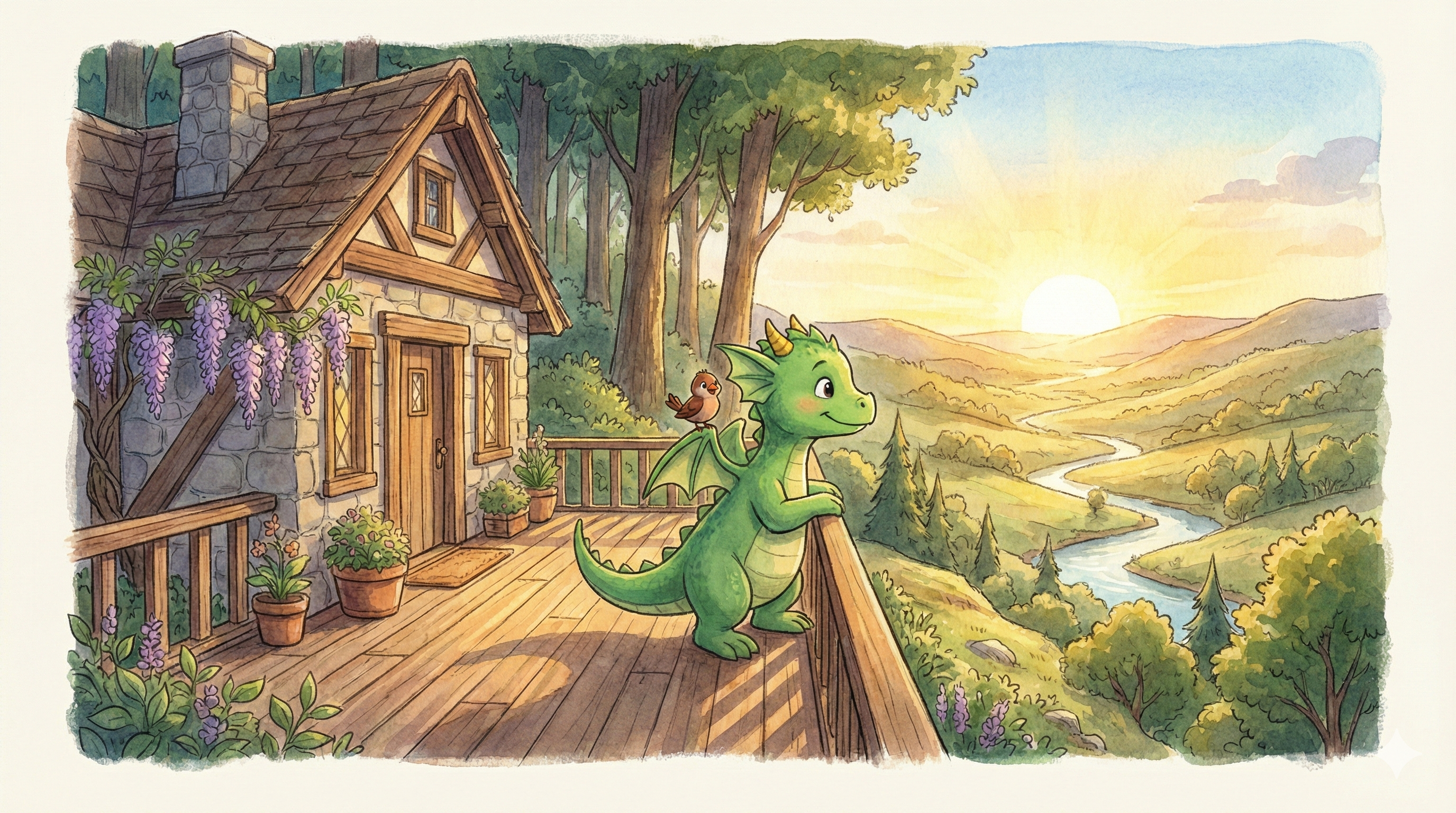
The next morning, Fennel woke to sunlight streaming through his eastern windows, exactly as he’d hoped. Chirp was already awake, singing his morning song from the doorway of his miniature house. The home was warm, warmer than the cave had ever been.
Fennel stood and stretched, his tail sweeping across the floor without hitting anything. He walked to the door and opened it onto his porch.
The Valley spread before him, morning mist rising from the stream, smoke from breakfast fires curling into the autumn air. And down the path, he could see Stickles approaching with what looked like a basket of fresh berries. Behind him came Baxter with a kettle. In the distance, O.T. was making his way up the path.
“Morning!” Stickles called. “We thought we’d bring breakfast. Christen the new porch properly.”
“House warming,” Baxter explained, reaching the porch and setting down his kettle. “It’s traditional. The day after you move in, friends come to share a meal. Makes the home official.”
They settled on the porch—which was indeed perfectly sized for gatherings—and shared berries and tea as the sun rose higher. Others arrived: Stanley, Abe, Mrs. Miller with her kits. The porch filled with conversation and laughter and the comfortable feeling of family.
“This is what the porch is for, isn’t it?” Fennel said to Baxter. “Not just shelter from rain. But for this. For gathering.”
“Every part of a home serves love in some way,” Baxter replied. “Walls shelter. Roofs protect. But porches? Porches welcome. They’re the space between outside and inside, the place where community happens.”
Stanley leaned against Fennel’s side. “You have a home now. Walls and roof and door. But you always had a home in the deeper sense. These walls just make it easier for everyone to find you when they want to be together.”
“Chirp chirp!” Chirp agreed, stealing a berry from the communal basket.
Fennel looked around at his porch full of friends, at his Valley spreading below, at his home standing solid and sure behind him. And he understood something he hadn’t quite grasped before:
Home wasn’t where the hearth was. Home was where God placed you among people who loved you. Where you were known and welcomed and belonged. The hearth just helped you see it more clearly. The walls just made the belonging more tangible.
But the home—the real home—had been there all along, waiting for him to recognize it.
He just needed walls to help him see.
And now he had them.
“More tea?” Baxter offered, refilling cups.
“Yes,” Fennel said, settling contentedly among his friends on his porch in his home in his Valley. “More tea. And more of this. Always more of this.”
Because this—this gathering, this love, this community—was what home really meant. The building was just the blessing that made it easier to see the grace that had been there from the beginning.
And for Fennel, that was more than enough.