
Morning
The first light came in through the east-facing porthole above Abe’s sleeping loft — a small, round window he had fitted himself, positioned precisely so the sun would strike his pillow at dawn and serve as an alarm clock that required no winding. He had calculated the angle the previous winter, marked the wall with a pencil stub, and cut the opening with a bore saw on a crisp November morning. It worked perfectly. It always worked.
Abe the Orangutan opened his eyes, blinked once, and was awake.
He did not lie in bed thinking about things. That was not his way. He swung his legs over the edge of the sleeping loft, gripped the rail with his lower hands, and dropped to the floor in a single fluid motion — four limbs working in easy coordination, the way God had made him, the way that still occasionally surprised visitors who had not seen an orangutan navigate a loft before. He straightened up, rolled his shoulders, and looked around his home with the quiet satisfaction of a craftsman surveying work well done.
The house was, by any measure, a fine piece of construction. Abe had built it himself, over the course of two summers, from oak and pine and local stone. It sat at the edge of the oak grove, its back wall nestled against a gentle rise in the hill, its front facing south toward the village. The ceiling was low by some standards — not oppressively so, but Abe had long since learned that high ceilings were mostly wasted space, and he preferred a house that fit him rather than one that made him feel small.
He crossed to the kitchen, which occupied the western corner of the main room, and opened the dish cabinet. The doors swung out and the shelves inside rotated forward on a spring mechanism he had designed three years ago — a simple pivot system that brought the back row of dishes to the front without any reaching or shuffling. He retrieved a mug, a bowl, and a small plate, set them on the stone counter, and closed the cabinet. The shelves rotated back. The doors swung shut. Neat.
He filled the kettle from the tap — a gravity-fed pipe system that drew from a cistern on the hill above, which he refilled periodically by redirecting the runoff from his roof. While the water heated on the wood stove, he opened the pull-out pantry panel beside the hearth: a tall, narrow cabinet whose shelves slid out on wooden rails, each shelf clearly labeled with its contents in Abe’s compact, economical script. Oats on the second shelf. Dried fruit on the third. Honey in the small crock at eye level.
For the milk, he opened the cold box — a cavity he had cut into the north foundation wall, vented to the outside through a short pipe that angled upward into the shaded hillside behind the house. Cool air from the earth moved steadily through it, keeping the interior perhaps ten degrees colder than the room. Milk stayed fresh three days longer than it had before the cold box. He considered this one of his better ideas. He poured a measure of milk for his porridge and set the crock back inside.
He prepared his porridge the same way every morning — oats, water, a fistful of dried blueberries, a drizzle of honey, the milk — and ate standing at the counter, looking out the south window at the oak grove beginning to glow in the early light. He ate efficiently, not hastily. There was a difference.
After breakfast, he rinsed his dishes and set them in the solar-powered washer he had built into the counter — a clever box fitted with a small heating element and a solar panel on the south-facing roof above. On sunny days it ran a quiet cycle and returned dishes clean and dry by the time he came home for lunch. He had been quite pleased with it. He loaded his bowl, mug, and plate, closed the lid, and pushed the latch.
He dressed, brushed his reddish-orange fur with the wide-toothed comb that hung by the door, and said his morning prayer at the threshold — brief, direct, characteristic of him:
“Father, You made this day and You fill it. I am Your creature and my hands are Yours. Let the work I do today bring You glory — and keep me from rushing past what matters. I ask it in Jesus’ name. Amen.”
Then he picked up his tool roll from its hook, tucked it under his arm, and stepped out into the morning.
The Walk to the Workshop
The workshop was not attached to the house. Abe had considered it — an attached workshop would have been more convenient — but he had decided against it on two grounds. First, a workshop attached to a house meant the house smelled of sawdust and varnish, which Abe found acceptable but which would have made a house less marketable if he ever chose to sell, and he liked to build things with an eye to their future. Second, a separate workshop meant a walk to work, and a walk to work was time to think. He had found that his best ideas came to him on that walk.
The path ran from his front door, through the edge of the oak grove, down a gentle slope, and then along the base of the hill to a low stone building half-hidden beneath three enormous oak trees. He had built the workshop first, before the house — a craftsman’s pragmatism, building his means before his comfort — and it showed. The workshop was the older building, its stone walls darker with age, its roof thick with moss. But it was solid. Abe did not build things that were not solid.
The morning air was cool and bright, with the particular freshness of early spring — a smell of mud and new grass and oak sap, of the world waking up from winter. Small birds were calling from somewhere in the canopy above, and the light filtered down through leaves that were still new enough to be translucent, pale green and glowing.
He thought about the Widow Harrow’s shelves on the way down. Tapered shelves, she had said — narrower at the top, wider at the bottom, for stability. He would need to cut them from good straight oak stock, sand them smooth, and fit them to the brackets without shim work if possible. He had enough oak plank. He ran through the cuts in his mind as he walked, timing each one, calculating the order. By the time he reached the workshop door, he had the whole sequence worked out.
He lifted the latch — hand-forged iron, his own work — and pushed the door open.
The Workshop
The smell hit him first, the way it always did: sawdust, linseed oil, beeswax, iron, leather, and something underneath all of it that was simply the smell of work itself, accumulated over years in the wood and stone. Abe breathed it in with something close to gratitude. It was his favorite smell in the world.
The workshop was a single large room with high stone walls, a wooden ceiling with exposed beams, and three deep-set windows on the south side that let in good working light. Directly inside the door, on the left, was the tool wall: a full expanse of pegs and brackets holding saws, chisels, planes, mallets, drawknives, gouges, and a dozen other instruments, each one hanging in its designated place, each one clean and sharp. Abe sharpened his tools every Friday evening the way other people read before bed. He could not work with a dull edge; it offended him in a way he found difficult to explain.
In the center of the room stood the main workbench — a massive slab of elm, four inches thick, fitted with two vises on the front face and one on the end. The surface was marked by years of work: gouges from chisels, burns from hot metal, stains from oil and paint and pitch, the accumulated record of everything he had made on it. He would not have traded it for a new bench. Not for anything.
To the left of the bench, the lumber rack: a system of horizontal pegs along the wall, each level labeled by species and thickness. Oak on the left, pine on the right, a few special boards of cherry and walnut on the top tier for particular projects. The rack was his inventory system — at a glance he knew what he had and what he needed.
On the wall beside the door hung the task board — a square of smooth pine, perhaps three hands wide, fitted with a grid of small wooden pegs. Hanging from the pegs were tags: each one a folded strip of birch bark, inscribed with a task, a customer’s name, and a rough priority mark. The system was his own invention, and he was privately pleased with how well it worked. Tags waited on the left side of the board when work was pending; he moved them to the right when complete. At a glance he could see the whole of his current workload and its state.
He ran a lower hand down the left side, reading:
Mend gate post — Rosemary’s Bakery — before end of week.
Repair three kitchen shelves, oak, tapered — Widow Harrow — urgent.
New sign, carved, painted — The Illustrated Word — Fennel — no rush.
Meeting hall benches, set of six — community project — long-term.
He tapped the Widow Harrow tag. Shelves first, then Rosemary’s gate post. He could get to Fennel’s sign later in the week. The benches were an ongoing project with no deadline — the meeting hall had adequate seating for now, but the old benches were aging and Abe had offered to build new ones at his own pace. He worked on them when other tasks were done, which meant they were coming along steadily.
In the far corner, the long-term projects: the meeting hall benches, currently in three stages of completion. Two were fully shaped, their legs mortised and their seats planed smooth. Two more were in frame, their joints cut but not yet glued. Two were still just rough stock, waiting their turn. He had been working through them methodically, one pair at a time, fitting the bench work between other jobs.
He set his tool roll on the bench, unrolled it, and got to work.
The Widow Harrow’s shelves went quickly. He had good oak stock already dried and ready, and his mental plan from the walk held up perfectly. He worked through the cuts in order — rough cuts first with the cross-cut saw, then the bench plane to true the faces, then the smoothing plane to finish, then the taper cuts on the table saw he had built from salvaged parts and a bicycle wheel. By midmorning, three shelves lay on the bench, smooth and properly tapered, ready for final fitting and oil. He ran his lower hands along the grain, checking for any roughness his eyes might have missed. Ape hands were good for that — four of them, each one sensitive in a slightly different way, and all of them better for fine texture work than a single pair.
He oiled the shelves with linseed oil and set them to cure on the drying rack near the south windows while he moved to the gate post.
Rosemary’s gate post was a simpler job — the post had cracked at the base where moisture had gotten in over the winter, and needed to be reinforced with a sleeve of oak before the crack could travel further. He cut the sleeve, fitted it, glued it with his own pine resin glue (which he still made himself, though many of the Valley residents had switched to purchased glue, because he preferred to know exactly what was in his materials), and bound it with twists of thin copper wire while it set.
He checked the time — midmorning — and moved to the bench work. He spent an hour on the two meeting hall benches in frame, fitting their joints with care and gluing them up one at a time, holding each joint in the vise while the glue set. The benches were for the whole community. There was something satisfying in that. He would not rush them.
He was cleaning up the bench — wiping down the surface, returning tools to their places, the end-of-session ritual that he performed with the same care as the work itself — when his stomach reminded him it was past noon. He had been absorbed enough not to notice. This happened with some regularity.
He rolled down his sleeves, latched the workshop door, and headed up toward the village for lunch.
Lunch, and the Leak
He ate at the small outdoor table behind Rosemary’s bakery most fine days — a plate of whatever she had going, eaten in the fresh air with a good view of the square. Today she had set out a potato and leek soup, dark bread, and a wedge of hard cheese, and Abe was halfway through his soup when he heard rapid footsteps on the cobblestones and looked up.
Mrs. Thompson was moving across the square at a pace considerably faster than her usual. She was a small woman of late years, grey-haired and bright-eyed and normally quite composed, but today her expression was the expression of someone who has discovered a problem and is actively looking for someone to hand it to. There was a distinct smear of something damp on her sleeve.
She saw Abe and immediately changed course.
“Oh, Abe, thank goodness,” she said, arriving at his table slightly out of breath. “My roof. There’s water coming in. I’ve had to put out three bowls and the ceiling cloth is quite soaked through and I don’t know what to do.”
Abe set down his spoon. “When did it start?”
“This morning. I noticed after breakfast — I heard a dripping and thought one of the water pots had overflowed, but no, it was the ceiling. By the time I found all the spots it was coming in from four places.” She clutched her hands together. “I’ve put a cloth over my writing table but the ink pot was already splashed. There’s a whole sentence that’s gone now. A whole sentence.”
“Four spots in the same area, or spread out?”
She thought. “Mostly in the back half. Near the bedroom wall.”
Abe picked up his bread, folded it around the last of his cheese, and stood. “I’ll come and have a look.”
“Now? You haven’t finished your lunch.”
“It’s a portable lunch,” he said, holding up the bread-and-cheese configuration.
Inside the House
Mrs. Thompson’s cottage was a tidy, warm little house set on the village lane, with a flower box under the front window and a bright blue door that she repainted every spring. Inside, it smelled of beeswax polish and dried herbs, and the various bowls she had deployed were already catching a steady drip from four points on the ceiling — a low, musical plinking that did not belong in a well-ordered home.
Abe stood in the center of the main room and looked up.
He could see the staining on the plaster — four dark wet patches, spreading slowly as he watched, each one with its drip-point at the center. The largest was directly above Mrs. Thompson’s writing table. The ceiling cloth, a square of woven cotton she had stretched across the wooden ceiling boards, had wicked a significant amount of water before she had noticed, and its corners were heavy with it.
“The ceiling boards,” he said. “Have they ever leaked before?”
“Never. In eleven years, never a drop.”
He moved through the rooms, looking at each wet patch from below, noting its position and shape. The back bedroom had two drip points, both along the north-facing pitch of the roof. The main room had two more, both in the same quadrant. He walked the perimeter of the back half of the cottage, touching the walls just below the roofline, checking for water tracking down behind the plaster.
“Some of these ceiling boards will need to come out once things dry — the water’s been sitting on them long enough that they’ll have softened. These two here, and possibly this one.” He pointed. “The plaster will want re-setting as well, once it’s dry, and the ceiling cloth will need replacing. We’ll get to all of that. First I need to find what’s letting the water in.” He paused. “I’m going up to have a look. No ladder — I’ll just go up and come straight back down.”
“No ladder?” said Mrs. Thompson.
Abe looked at her, and at his four hands, and back at her.
“Ah,” said Mrs. Thompson.
On the Roof
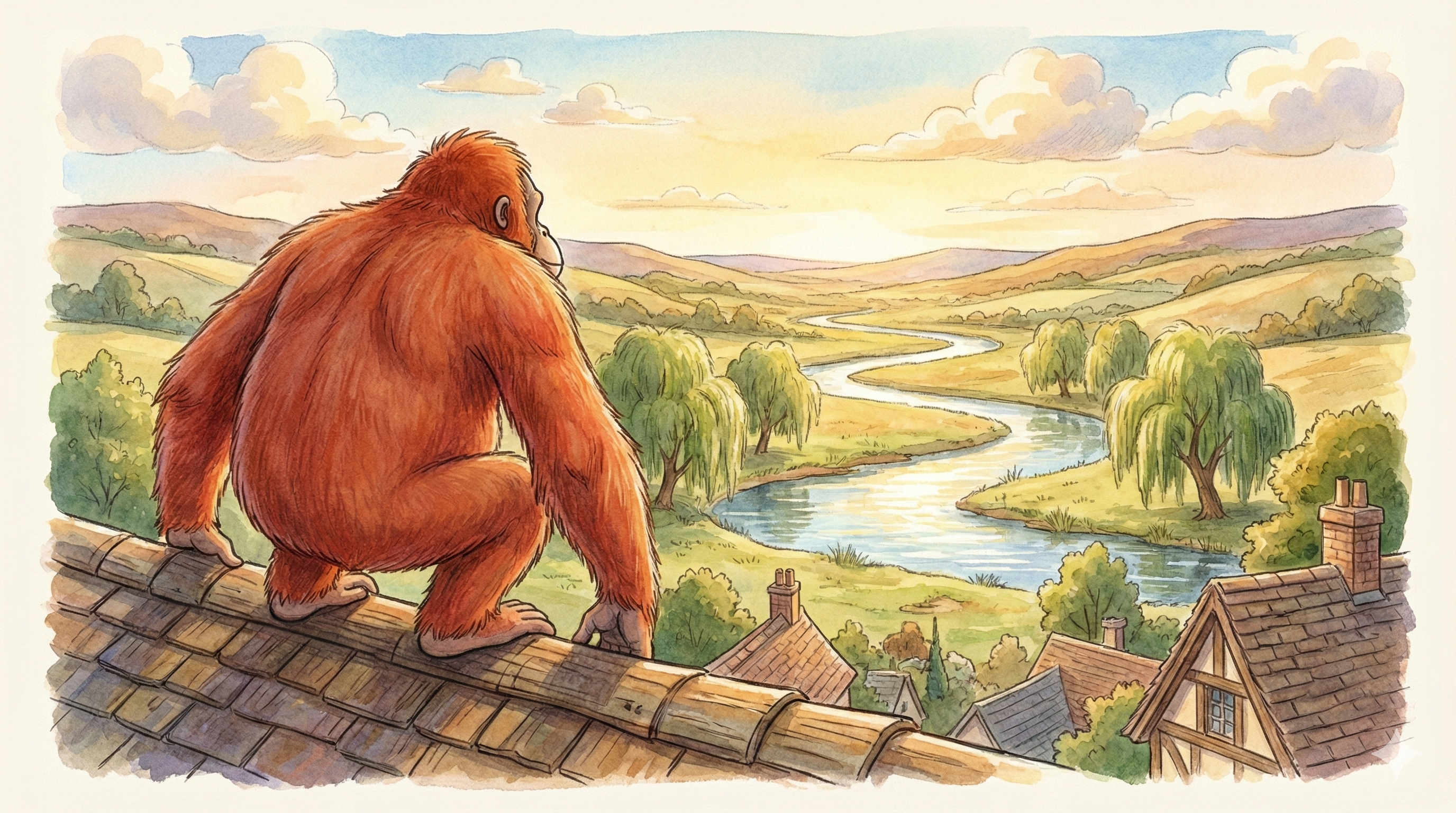
He went up the north face of the cottage the way he went up any vertical surface that presented adequate purchase: quickly, efficiently, without fuss. His lower hands found the window ledge, his upper hands found the gutter, and then he was at the eaves and moving up the pitch of the roof in a smooth, unhurried movement, his four limbs distributing his weight across the shingles in a way that a two-limbed creature would have needed a ladder to attempt. He was simply built for this. He reached the ridge and stood upright, or near enough.
And stopped.
The Valley was lovely from here. He did not often take time to notice it, but the view from Mrs. Thompson’s rooftop commanded him to pause. He had seen it before, from taller roofs and higher hills, but it struck him fresh now — the village spread out below him, the oak grove dark green to the east, the meadow bright and open to the south, the brook catching light between the willows, the hills rolling away in every direction under a sky of early-spring blue. Smoke rising from three chimneys. Distant figures moving in the square, too small to name.
He thought: the Father made all of this. Set every hill in place, filled every valley, breathed life into every creature that moved below. And the Spirit that hovered over the waters at the beginning still moved through it — through the light on the brook and the smoke from the chimneys and the small figures crossing the square. Not as a new thought — Abe was not given to new thoughts about the things he was most certain of — but as a true one, which is always better than new.
Then he turned to the work.
The roof was oak-shingled — good work, old work, the shingles thick and well-weathered. He moved carefully across the pitch, reading the surface with his hands where his eyes might miss something subtle. The shingles on the south face were in fine shape. He worked around to the north face — the back of the house, facing the garden — and found the problem almost immediately.
One shingle, near the upper course, had a hole in it.
He crouched down to look at it properly. Not a crack, not a split from frost. A neat, clean opening, chiseled through the shingle with real force: smooth at the edges, roughly rectangular, perhaps three inches across. He sat back on his heels and studied it. What in the Valley made a hole like that?
Then he heard something from below the hole — a faint rustling, and then, unmistakably, a small voice whispering something urgent to another small voice.
Abe went very still.
He leaned forward carefully and looked into the hole.
Two small, bright eyes looked back at him. They belonged to a face that was somewhat larger than a mouse face, somewhat smaller than a vole face, with prominent whiskers, a delicate pink nose, and an expression of absolute frozen terror. Tawny fur. Round ears pressed flat. Then another face appeared beside the first, slightly smaller. And another. And then a fourth — this one so small it was clearly very young, and regarding Abe with an expression not of terror but of intense, whisker-quivering interest.
Abe sat back and considered the situation.
Then he leaned forward again and said, in his most matter-of-fact voice: “Knock, knock. Hello in there. I’m Abe, who are you?”
The Drimbles
A long silence. The faces had vanished. Then, from the dark interior of the hole, a voice — small, thin, wavering with held breath: ”…Hello?”
“Hello,” Abe said. “I’m not going to hurt you. I’m a carpenter. I’m here because there’s water coming into the house below, and I think it may be coming through this hole.”
Another silence, followed by some murmured conferring.
“Are you mice in there?” Abe asked.
The voice that came back was still small, but its character had changed dramatically. “Mice!” it said, with the particular indignation of someone who has been deeply and personally insulted. “We are not mice. We are Tawny Drimbles. And not just any Drimbles, if you please. We are distantly related to the royal family.”
“The royal family,” Abe repeated.
“The Drimble Royal Family. Specifically, the Brockenshire branch. Seventh cousins, once removed, on the maternal side. It is a genuine connection.”
Abe absorbed this. “If you are royalty,” he said, “then perhaps you can explain to me what you are doing in a small hole, in the roof of a small cottage, in our rather small village?”
A pause. When the voice returned, some of the indignation had given way to something wearier. “It is a long story.”
“I have time.”
The voice — he was beginning to think of it as the mother — sighed. It was a surprisingly resonant sigh for such a small creature. “We came from the eastern province. My husband had a position there — a minor administrative role, quite respectable — but the provincial lord changed and the new one brought his own people and so we found ourselves, as one sometimes does, suddenly without a situation. We traveled west. We were looking for somewhere quiet and decent. We found your village.”
“And the hole?”
“We needed somewhere to stay. We found this hole. It was perfectly placed — sheltered by the roof overhang, a fine size for a family of our numbers.” She paused. “We were concerned at first about the rain. But the hole is positioned just below the ridge, you see, so the opening faces slightly downward, and while we do get a lovely fresh flow of water in heavy rain — quite useful, actually; it runs along the floor and away very nicely — it has never pooled or sat. We have never been damp.” Another pause, then, with a note of pride: “In fact, during the heavier rains, the children rather enjoy it. It makes a fine shower.”
Abe looked at the hole. He looked at the position of the shingle, at the angle of the pitch, at the gap between this course and the one below. He could see exactly how it worked — the geometry of it was quite elegant, in a way that would have been admirable if it weren’t someone’s ceiling on the receiving end.
“Did you make the hole?” he asked.
“Certainly not. That was a woodpecker. Pileated. A huge bird. He made it with the intention of settling there with a mate, but the engagement fell through.” She paused. “He was quite a gentleman about it — offered us the hole freely when he found us sheltering in the hedgerow. We accepted with gratitude.”
“We thought it was temporary,” the voice continued. “That was eight months ago. It has become…” She weighed the word. “Home.”
Abe nodded slowly. “I’m glad you’ve been comfortable. But that water that drains away so nicely — it drains into the house below. I have to patch the hole.”
A silence from inside.
“Into the — oh.” A pause. “We’ll clearly have to move. I understand.” Another pause.
From inside the hole came a sound that Abe could only describe as a very small household beginning to panic.
“But—”
“But we have—”
“Our things—”
And then the mother’s voice, cutting through the others with desperate dignity: “But where will we go? I have eight children to care for. Eight. The youngest is barely six weeks old.”
“Nobody is going to simply put you out,” Abe said. “We’re going to find you someplace much better. And bigger.”
The sounds from inside the hole stopped.
“Catch your breath and settle your nerves,” Abe said. “I’ll be back with my ladder and my tool box — I can’t do the repair without them, and I want to bring you and your family down safely in a basket. Can you wait a little longer while I fetch what I need?”
A very small, very dignified voice: “We have waited eight months. We can wait a little longer.”
“Good. I’ll be back directly.”
He went back down the roof the way he had come up — four limbs, no fuss, no ladder required. This time.
The Extraction
The ladder was Abe’s own, fetched from the workshop and carried up the lane over one shoulder along with his tool box and a small supply of spare oak shingles. He leaned it against the north face of the cottage, checked its foot, and went up — this time at a measured pace, because the tool box required two hands and he preferred not to drop it.
He set the tool box on the ridge and opened it. He had also brought, tucked inside the box, a medium-sized basket lined with a strip of wool flannel.
He lowered the basket to the hole.
The mother was named Maribelle. She established this early and firmly. The children — five daughters, three sons, ranging from half-grown to barely-out-of-the-nest — she introduced in rapid succession, and Abe made careful note of the second youngest: a tiny copper-furred boy named Pip who seemed to have no fear of large orangutans whatsoever and had, by the second minute of acquaintance, climbed from the basket onto Abe’s thumb and was examining his knuckle with focused professional interest. The youngest — unnamed as yet, or at least not introduced — was in Maribelle’s arms and stayed there.
He got them out one at a time, with considerable patience and several renegotiations with the older Drimble children who had opinions about the basket. Maribelle supervised the removal of their belongings — a remarkable quantity of carefully arranged items for such a small space: a woven grass sleeping mat, a thimble that served as a water vessel, several dried seed arrangements that seemed to be decorative, a small rolled document that Maribelle handled with particular care (“Family papers,” she said, in a tone that forestalled further inquiry), a carved wooden medallion that the oldest daughter carried herself and would not give to anyone, and two tiny carpet bags that two of the older children held between them with great seriousness.
Once the family and their belongings were safely in the basket, Abe descended the ladder with the basket held carefully in two upper hands, his lower hands managing the rungs. Mrs. Thompson was waiting at the bottom.
She looked into the basket.
Her hands went to her face.
“Oh,” she said, very quietly.
“Tawny Drimbles,” Abe said. “Eight children. Currently homeless.”
“Oh,” Mrs. Thompson said again, and then she was reaching gently toward the basket, which Pip immediately took as an invitation, climbing from the wool flannel onto her outstretched finger with great confidence and settling there. “Oh, you poor darlings. Come inside. Come in, come in, all of you. I have scones.”
Abe left Maribelle, the Drimble children, and Mrs. Thompson in a state of mutual enchantment — the Drimlings distributed between a padded box near the south window and Mrs. Thompson’s careful hands, the berry scones being divided into very small portions, Pip discovering that Mrs. Thompson’s grey hair was interesting and full of possibilities, and Maribelle maintaining her dignity with considerable grace while accepting a small piece of scone with something that, if she had been a less dignified creature, might have been called relief.
He went back up the ladder to the roof.
He patched the hole with a piece of oak shingle cut precisely to size and fixed with wooden pegs driven into the course above and below, sealed around the edges with pine pitch. Twenty minutes of clean work. He checked the adjacent shingles for any similar compromise, found none, and went over the entire north face while he was up there. The rest of the roof was sound. He noted the four spots on the ceiling below that would need new boards, and the plaster repairs after those, and added them mentally to his list for later in the week.
He came down, shouldered his ladder, leaned it against the garden wall to collect on his way out, and went back inside to report.
She was feeding Pip a fragment of berry scone approximately the size of a pea and had apparently decided, without any formal announcement, that the Drimbles were the finest thing to happen to her in — well, decades. They certainly brightened life without Mr. Thompson.
The Problem
“But where will they live?” Mrs. Thompson asked. This was perhaps an hour later. The Drimlings were asleep in the padded box. Maribelle was sitting on the corner of the writing table, still quite composed, watching the conversation with the very particular attention of someone whose immediate future is being decided.
Abe sat across from Mrs. Thompson, his large hands folded on the kitchen table, thinking.
“Not the roof again,” he said.
“No, obviously not the roof.”
“Not this house — you’ve no extra room.”
“Certainly not. Though I would gladly—” Mrs. Thompson glanced at the box of sleeping Drimlings and stopped herself. “No. No, they need proper space. With eight children they need rooms.”
Abe thought about the Valley, mentally walking through it. He ran through every vacant space he could remember, measuring each against what a family of ten Drimbles would need. Nothing fit well enough.
“I don’t know,” he admitted. This was not a thing he said often, and he said it plainly, without embarrassment. “I can build them something. But where to put it — I’d need to think.”
He paused. “We should pray about it.”
Mrs. Thompson nodded immediately. They bowed their heads, and Abe prayed briefly and directly:
“Father, You are good, and You made these creatures and You know them by name. We have nothing to offer You but our need — we don’t have an answer here, and we know it. Please show us the way. We ask it through Jesus, who told us to ask. Amen.”
“Amen,” said Mrs. Thompson.
“Amen,” said Maribelle, very quietly from the corner of the table.
Stickles
The knock at the door came about ten minutes later.
Mrs. Thompson looked up. “That’ll be Stickles. Tuesday visit.” She went to the door and opened it, and there stood Stickles — porcupine, quills gleaming, carrying a small paper bag that immediately filled the room with the warm, herbed scent of rosemary popcorn — with the expression of someone who had arrived expecting a quiet Tuesday afternoon and was already noticing that something different was afoot.
“Come in, come in,” said Mrs. Thompson, drawing him inside with the urgency of someone who has excellent news to share. “We have guests. And a problem. Look—”
She showed him the box of Drimlings. From the paper bag, the scent of rosemary and warm corn drifted across the room. One small nose appeared over the edge of the box. Then another. Then a third.
Stickles looked at the three small noses, then at the bag in his hand, then back at the noses. “Well,” he said quietly, “clearly I should have brought more popcorn. But we’ll all have to share.”
He crouched down to see better, his dark eyes moving slowly over the small stirring forms, the pale paws, the whiskers, saying nothing further for a long moment, in the way that was characteristic of him.
“Tawny Drimbles,” he said at last, very quietly, as though the identification itself were something to be careful with.
“You know them?” Abe asked.
“I’ve read about them. Eastern province. Very old families, some of them.” He looked up at Maribelle, who was watching him from the writing table with a measuring expression. “Distantly related to the Brockenshire branch, by any chance?”
Maribelle’s ears came forward. “You know of us?”
“I know of the family. The medallion around your daughter’s neck — is that the Brockenshire emblem?”
“It is,” Maribelle said, and for the first time since Abe had met her, something in her posture relaxed, just slightly. “It belonged to my grandmother’s grandmother.”
Stickles nodded slowly. Then he looked at Abe. “What’s the problem?”
Abe explained. Stickles listened without interrupting, turning the information over in that quiet, observant mind of his. When Abe finished, Stickles was still for a long moment. He looked at the box. He looked at the window. He looked, thoughtfully, at his own small hands.
“I have an idea,” he said.
They both looked at him.
“My burrow is larger than it needs to be — I’ve thought that before but never had a use for the extra space. The tree above my front chamber has a good hollow in the trunk, larger than you’d guess from outside. There’s ample height up there.” He paused. “If someone cut through the ceiling of the front chamber and framed up a proper floor, that hollow could become a second storey. Separate entrance from the side of the tree, its own staircase.” He looked at Abe. “You could do it properly — rooms for the children, a main room, storage. Windows cut into the uphill side where the roots give good structure to build against.” He paused again. “And we’d want to put in French drains around the base of the tree, to divert any hillside water. Good for both of us, though frankly my burrow has never had water problems — we’re well above the water courses here.”
He looked at Maribelle.
Maribelle looked at him for a long moment — measuring, weighing, assessing with the calm precision of someone who has learned to read intentions accurately. “You would do this for us?” she said.
“The Valley takes care of its own,” Stickles said simply.
“When you say ‘own’,” Maribelle said carefully, “we have only just arrived. We are not, strictly speaking—”
“You are now,” Mrs. Thompson said, from across the room, with a firmness that ended the discussion entirely.
Papa Drimble
The second knock came while they were still talking through the details of Stickles’ plan. Louder than the first — not quite desperate, but with a particular quality of barely-contained urgency.
Mrs. Thompson opened the door.
On her doorstep stood a Tawny Drimble somewhat taller than Maribelle — broad-shouldered, dark-furred, with a minute traveling cloak that was quite damp and a hat that had been rained on many times and not recovered fully. He was gripping the door frame with both small hands, and his expression was the expression of someone who has been searching for a very long time and has run out of rational options.
“I beg your pardon,” he said, in a voice that was trying very hard to be controlled and mostly succeeding. “My name is Aldous Drimble. I am looking for my family. My wife and eight children. I have reason to believe they are somewhere in this village — but I have been searching since morning and I cannot—” His voice fractured slightly. He pressed on. “I would not ordinarily trouble a household. But I am somewhat desperate.”
Mrs. Thompson stepped back from the door.
From behind her, Maribelle’s voice came: “Aldous.”
Aldous Drimble gripped the door frame harder.
From the box by the window came a small, sleepy sound, and then Pip’s voice: “Papa?”
What happened next was not, by the strict accounting of events, proper. But it was joyous — with a prodigious amount of squeaking. Aldous came through the door. Maribelle crossed the room at a pace quite unlike her earlier composed deliberateness. The older Drimble children woke up. Pip was retrieved from the box by his father and then by his mother and then climbed back up onto his father’s shoulder, apparently deciding that was the correct position and settling there with finality.
Abe stood back and watched. He was not a creature given to great emotional displays, but he felt something in his chest that was warm and quiet and not something he would have tried to put into words.
He thought: that’s another answer. Right there.
Mrs. Thompson pressed both hands to her face. After a moment she said, very quietly: “Jesus sent him right to the door.”
“Yes,” Abe said. “He did. He also sent popcorn.”
Building
The building work took three days.
Stickles was right about the hollow in the tree above his front chamber — it was better than adequate. Considerably better, as it turned out. Abe surveyed it the first morning with Aldous at his side, the two of them moving around by lamplight through the hatch Abe had cut in the burrow ceiling, Abe measuring with his folding rule, making notes in his small, tight script. He had expected to find space enough for one floor above Stickles’ ceiling. What he found, as he extended his rule upward and then upward again, was space enough for three.
He stopped measuring. He looked up into the hollow of the trunk — at the root-timber walls curving inward toward a natural apex a good four metres overhead, at the pale columns of light coming down from gaps in the bark, at the sheer, unlikely volume of it.
He was not easily surprised. This surprised him.
He lowered the rule, made a final note, and said: “Three floors.”
Aldous stared at him.
“Three. Sleeping on the lowest — rooms for the children, a room for you and Maribelle, the bathing room. Living on the middle — main room, kitchen, your storage. The top floor—” He looked up again, calculating. “Top floor is a common room. Sitting, reading, looking out. You’ll want it when the children are older and need somewhere to be that isn’t underfoot.”
Aldous was quiet for a long moment. “We had two rooms,” he said finally. “In the eastern province. Two rooms for ten.”
“You have three floors now,” Abe said, and went back to his notes.
Aldous was present for much of the work, and proved more useful than Abe had expected — good instincts for holding things level, and an ability to anticipate what Abe needed next that saved considerable back-and-forth. But he disappeared at intervals: sometimes for an hour, twice for most of a morning, returning without explanation and taking up where he had left off. Abe did not ask. A craftsman learns early that some things are not his business, and Aldous’s comings and goings had the particular quality of things that would be explained when they were ready to be explained, and not before.
He framed the floors from seasoned pine joists bolted to the existing root structure on three sides, pegging the planking in oak because pegs held better than nails in living wood that moves with the seasons. The partition walls between sleeping rooms he kept light — pine frames paneled with woven rush matting that Stickles contributed from his store, warm to look at and good for sound. He built the stairs in three runs connecting each floor, the treads sized for small Drimble feet but the runs wide enough that Stickles could manage them in a pinch if he ever needed to. He had mentioned this to Stickles.
“Not that they’ll move out,” Stickles had said.
“No,” Abe agreed. “But a stair that only one kind of creature can use is a stair that isn’t finished.”
The windows were the longest part of the work. There were twelve of them in the end — more than he had initially planned, but the tree offered more faces than he had first surveyed, and each face wanted light. Two round windows on the south-facing front, flanking the entrance above the door, looking down into the village. Three on the east side, slightly oval, staggered in height to catch the morning light on each floor. Three more on the west for the afternoon. Four on the north side, smaller, set high where the roots gave solid framing and the hillside showed close and green through the glass — moss, fern, occasional glimpses of the upper meadow. Twelve windows meant twelve panes cut from his workshop stores of salvaged glass. “Good thing I keep a supply of spare panes,” he told no one in particular, because he was alone when he counted them.
The colors he settled with Maribelle on the second morning. She had opinions, expressed with the slight tentativeness of someone not quite sure yet how much opinion she was permitted to have — but the opinions were good. Warm cream for the walls throughout, to hold the lamplight in winter. Soft green for the trim on the sleeping floor, restful for children. Deeper ochre for the living floor, warmer and more alive. The top common room she asked to leave with its natural root-timber walls, which needed nothing at all. He oiled them with linseed and they glowed like old honey.
Each of the children’s rooms he finished differently — something small but particular to the child whose room it was. Maribelle walked him through each one: what they were like, what they liked, what they needed. Abe listened, made notes, and built accordingly. A reading shelf at the right height for the eldest, who was a reader. A smooth bar fitted across the corner for the one who liked to hang from things. A desk under the east window for the one who liked to draw. A peg rack low on the wall for the one who collected small objects and had nowhere to put them. And so on through all eight rooms, each one its own answer to a specific child.
Pip’s room was last and smallest — he was the second youngest; the baby was still in with Maribelle and Aldous, which was where a six-week-old belonged — but Abe had given it the east-facing window, the one that caught the first light of morning. He built the sleeping shelf low to the floor, padded with cedar shavings under the rush mat, and fitted a small wooden rail along the open side because Pip, Maribelle had explained with resigned affection, had been known to roll. He added a peg rail at precisely Pip’s height on the basis that a creature with no fear of large things would certainly attempt to hang his own things — and, at the last moment, carved a small orangutan into the corner post. Not signed. Just there in the wood, for Pip to find when he looked.
The rope-and-bell system he installed the final afternoon was the most technically satisfying part of the build: a small but genuinely clever bidirectional pulley system, the cord running from a pull handle mounted in the kitchen on the middle floor and splitting both up and down through a set of turned wooden pulleys he made himself — four in total, one at each directional change — carrying the pull simultaneously to four small brass bells: one in the common room above, one at the foot of the stair on the sleeping floor below, one in the corridor outside the children’s rooms, and one directly in Pip’s room because Maribelle said Pip would not hear the general bell through walls if he was occupied. A single pull in the kitchen rang all four at once: a small, clear, unmistakable sound. He demonstrated it for Maribelle by pulling the cord twice. From above came the distant ring, and then Pip’s voice, delighted: “Again!”
The cold box he tucked into the base of the sleeping floor — a deep alcove running back into the earth between the roots, cedar-lined, with a ventilation gap connecting to the shaded north face of the tree. The same principle as his own. Cedar against vermin and moisture. He fitted the boards tight and smooth, taking quiet satisfaction in the fact that a Drimble family would be keeping their stores in cedar-lined walls for generations after he was gone.
The French drains went in that same afternoon — trenches around the uphill base of the tree, lined with flat stone and filled with gravel, directing hillside seepage toward the lower drainage channel. Stickles stood nearby while Abe worked, occasionally noting a root worth preserving. Abe worked around everything Stickles pointed out.
The outside entrance was a round door set into the south face of the tree above the stone steps, oak, with a hand-forged iron latch and a knocker in the shape of a small acorn, because Maribelle had mentioned, quite in passing, that she found acorns architecturally pleasing.
When Stickles saw the finished exterior for the first time — the entrance door, the two south windows bright above it, the east and west windows catching the afternoon light, the north face with its four small high windows facing the hill — he stood without speaking for a long moment.
“The windows above the door,” he said.
“Looked better with them,” Abe said.
Stickles nodded slowly. Abe waited until he had taken it all in, then said: “There’s one more thing.” He led him to the lower windows and pointed. Five flower boxes, fitted snug under each one, filled with good earth, waiting for spring planting.
Stickles looked at them for a long moment.
“I’ll need more seedlings,” he said.
“I expect you will,” Abe said.
On the third afternoon, standing in the top floor common room with Maribelle, Abe ran his eye over the work one final time. The joints were tight. The floors were level. The stairs were sound. The root-timber walls glowed under their oil. Through the north windows the hillside showed close and green; through the south windows the valley opened wide and distant. It was a good space. It would be a good home.
“I promised you furniture,” he said.
“You don’t have to—”
“I know.” He looked at the empty room. “Proper beds. A table. Benches. A good chair with arms for Maribelle.” He paused. “Sized right. I’ll start next week.”
Maribelle was quiet for a moment. “Mr. Abe,” she said, “we arrived in this village eight months ago with some family papers, a carved medallion, and two tiny carpet bags. I did not imagine—” She stopped. “Thank you.”
“Thank the Lord,” Abe said. “He sent Stickles through the door at the right moment.”
Maribelle was quiet for a moment. Then she nodded, once, and said nothing more. Which was enough.
Evening
They moved the family in that afternoon — Aldous and Maribelle carrying the family papers and the medallion, the two oldest Drimble children carrying the two tiny carpet bags with great ceremony, the younger ones managing everything else in a cheerful procession from Mrs. Thompson’s cottage down the lane to Stickles’ tree, Stickles walking alongside at his deliberate pace, pointing out where the garden grew in summer and where he kept the spare lamp oil. Mrs. Thompson had packed them a hamper: the remaining scones, extra berry ones wrapped separately, a pot of soup, and a small jar of honey with a bow.
Pip waved at Abe from his father’s shoulder all the way down the lane.
Abe waved back. He did not usually do that.
He went back to the workshop for the last hour of daylight — putting away the tools he had brought to the tree work, restocking the cut-lumber offcuts into the rack, cleaning and oiling the planes he had used for the partition frames. The workshop at day’s end was the same as the workshop at day’s beginning: everything in its place, everything ready for tomorrow. He had always believed the preparation for the next day was part of the current day’s work.
He latched the door and walked home up the hill in the long golden light of early evening.
Afters
Dinner was simple — a bowl of barley soup from last evening’s batch, reheated. He ate at the table by the south window, watching the light change and the first stars appear above the oak grove. He was tired in the pleasant way that comes from work done well: not exhausted, but settled, the way a house settles when it’s properly framed.
He was clearing his dish — into the solar washer, closed, latched, ready for morning — when he heard footsteps on the path and then Fennel’s voice: “Abe? Light’s still on. May we come up?”
“Come up,” he called back.
Fennel arrived first, with Chirp on his shoulder doing what Chirp generally did. O.T. came behind him, his large blue form navigating the garden gate with the careful attention he always gave to spaces that had not been designed for elephants.
“We heard about the Drimbles,” O.T. said, settling onto the broad stone bench on the terrace that Abe had built specifically because O.T. visited and the regular chairs were not adequate. “Interesting creatures, historically. The Brockenshire branch are mentioned in the eastern census records going back at least four hundred years.”
“Of course they are,” Fennel said, and sat in the other chair, tucking his wings comfortably. “How are they? The Drimbles?”
“Settled in,” Abe said. He brought out the tea things — the kettle already hot on the hearth, the mugs on the pull-out shelf, a small plate of biscuits from the tin — and set them on the terrace table. He poured for all three. “Good family. Dignified mother. Father in a panic all day because his family was missing — arrived at Mrs. Thompson’s door at exactly the right moment.”
“Stickles’ idea was the right one,” O.T. observed.
“Right on time,” Abe agreed. He sat down with his own mug. “Three floors, it turned out. The hollow was much larger than Stickles had guessed. I went in expecting one floor above his ceiling and found room for three.”
Fennel looked at him. “Three.”
“Sleeping, living, common room at the top. Twelve windows — all different sizes, different faces of the tree. Good thing I keep a store of spare panes.” He paused. “Pip’s room faces east. He’ll have the sunrise every morning whether he wants it or not.”
“He’ll want it,” Fennel said.
“Probably.” Abe turned his mug. “Aldous was helpful when he was there. Which wasn’t always. He’d disappear for an hour or a morning, come back, pick up where he left off, say nothing about it. I didn’t ask.”
“Interesting,” O.T. said, in the particular way he said things when he was filing them away.
“Mm.” Abe left it there. Whatever Aldous’s business was, it would surface when it was ready to.
O.T.’s trunk curled thoughtfully. “You said eight children.”
“Eight Drimlings, yes.”
“The Brockenshire Drimbles historically ran to three or four. Occasionally five.” O.T.’s ears moved. “Eight is rather exceptional for the species.” A pause. “It would be consistent with the family having adopted several of the younger ones. Drimble families in displacement sometimes take in strays. One of the more admirable things about them, actually — recorded as far back as the eastern census of—”
“O.T.,” Fennel said, gently.
“Yes. Quite. I merely note it.” O.T. considered his tea. “It might be worth knowing, in time.”
They let it rest there — not forgotten, just set aside. Another story, perhaps, for another day.
He sat down with his own mug and looked out at the Valley. The sky had deepened to the particular blue that comes just after sunset, the first faint stars scattered in the east and the horizon still faintly orange in the west. Below them the village was a cluster of lit windows and quiet chimney smoke. He could see, if he knew where to look, the faint glow from the direction of Stickles’ pine tree.
“Strange day,” Fennel said, not as a complaint.
“Good strange,” Abe said.
They sat with that for a while, drinking their tea in the companionable quiet that comes from long friendship.
Fennel said: “Stickles.”
“Yes,” Abe said.
“He just — offered his home.”
“He did. Didn’t hesitate.” Abe looked out at the valley. “That’s how he is. He doesn’t make a speech about it — he just sees what’s needed and does the next thing. I put flower boxes under the new windows — five of them — and when he saw them he didn’t say a word about the home he’d just given away. He immediately started planning what to plant. Already has seedlings in mind for all five.” He almost smiled. “He said, and I’m quoting: ‘I’ll need more seedlings.’ That was all.”
“That’s Stickles,” Fennel said.
Abe nodded.
Fennel nodded. O.T. said nothing.
Then Fennel said: “There.”
Abe looked up. A streak of light moved across the sky — brief, brilliant, gone.
“Shooting star,” O.T. said, his trunk curling thoughtfully. “The Perseid-adjacent showers, if I recall correctly. Cometary debris from the—”
“It’s a reminder,” Fennel said, gently, over him. “Good surprises. Like a family of Drimbles in a roof you didn’t know needed fixing.”
Abe looked at the sky where the streak had been. He thought about Pip sitting on his thumb. About Maribelle’s carefully maintained dignity in the face of everything. About Aldous gripping the door frame, run out of rational options, knocking on a door. About Mrs. Thompson’s face when she looked into that basket.
“They come from the Lord,” he said.
“Every one of them,” Fennel agreed.
O.T. was quiet — which, for O.T., was a different kind of speech.
They prayed together on the terrace, the three of them, in the cooling evening air. Fennel led it — a longer prayer than Abe would have prayed, with more words, which was characteristic, and all the words were good ones. He praised the Father who orders all things — who put a woodpecker’s hole in exactly the right roof, who arranged a Tuesday visit and a knock at the door. He confessed that they so often looked for God in the large and obvious things and nearly missed Him in the small and particular ones. He thanked Christ, through whom every good gift comes, for the Drimbles themselves — for Maribelle’s dignity, for Aldous’s faithfulness, for eight Drimlings who already belonged to the Valley as surely as if they’d been born in it. And he asked the Holy Spirit to fill the new home in the old pine tree — to be present in those cedar-lined rooms and on those small staircases and at the table where the family would eat together, making it not just a house but a dwelling place of grace. He asked for care for each of the eight Drimlings by name, which meant he had clearly learned all of them. That was also characteristic.
Abe added, at the end: “And thank You for good work. Amen.”
When Fennel and O.T. left, Abe stood on the path and watched them go — Fennel down the lane, O.T.’s large form moving carefully through the garden gate, Chirp a small dark shape against the deepening sky. He stood until they were out of sight.
Night
Inside, he tidied the terrace things, banked the fire, and prepared for bed with the same systematic efficiency he brought to everything. Wash face and hands. Fold the day’s work clothes. Check the door latch. Check the window latch. Small acts of order at the end of the day, the way the order at the beginning of the workshop session matched the order at its end.
He climbed to the sleeping loft, settled on his mat, and folded his hands.
“Father,” he said, “You are good. You were good before this day started and You’ll be good when it’s done. Thank You for making me with four hands and a head that can work out how things fit together — I know that came from You, not me.” He paused. “I confess I nearly rushed past lunch today and missed Mrs. Thompson entirely. You kept me there long enough. Thank You for that.” Another pause. “Take care of Pip. He has no fear of large things. That will either serve him well or get him into trouble. Probably both. Let Your Spirit watch over that little room with the east window tonight — over all those rooms, all those small sleeping creatures. They are Yours. And let Stickles sleep well. He doesn’t take up much space, but You gave him a big heart, and big hearts tire.” He settled deeper into his mat. “I ask all of it in Jesus’ name, who is the reason any of this matters. Amen.”
He settled back, looked up at the dark ceiling, and was briefly aware of the faint smell of sawdust that always lived in this house no matter how often he swept, and of the cool spring air coming through the east-facing porthole above his pillow, and of the deep, pervasive quiet of the Valley at night.
Which is what happens, at the end of a long day in the Lord’s service. The quiet comes, the house stills, and you find you are already drifting off to sleep before you’ve even finished your prayers of thanks — which is itself a gift from the Father, through the Son, by the Spirit who gives rest to those He loves.
He closed his eyes.
That same night, from inside the old pine tree at the edge of the wood, came the faint sound of a household settling in — small rustlings, small voices, the quiet of a family arrived, at last, somewhere safe. Stickles heard it through the ceiling of his front chamber as he set his lamp, and found, as he turned it down, that he was smiling.
From the upper apartment, through the stair opening, Pip’s voice, very small:
“Papa? Are we home?”
A pause. Then Aldous’s voice, rough with something he was keeping in check:
“Yes, small one. We are home.”
Which was also the Lord’s doing.
Every bit of it.
The End
Abe’s Day — Canon 12 — Day in the Life Series, Book 4 Fennel the Dragon Series v1.1